



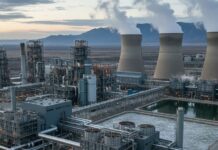

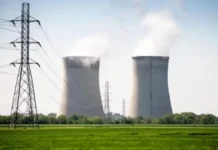
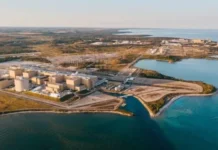
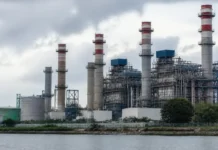


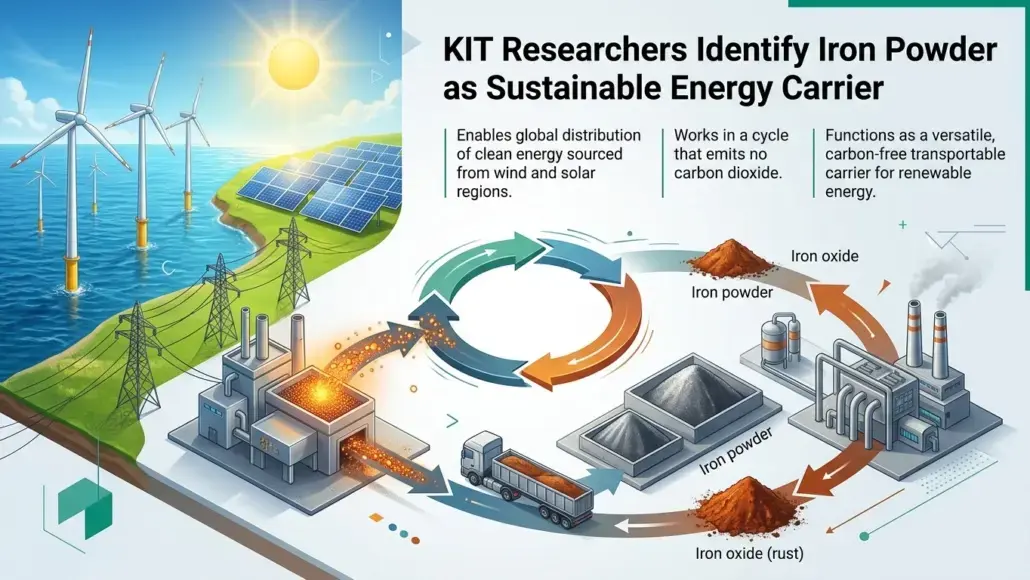

Scientists at the Karlsruhe Institute of Technology (KIT) have released findings suggesting that iron powder could serve as a versatile, carbon-free transportable carrier for renewable energy. This technology enables the global distribution of clean energy sourced from wind-rich coastal areas or solar-intensive desert regions. Julia Schuler from KIT’s Institute for Industrial Production (IIP) explained that the system “works in a cycle that emits no carbon dioxide or environmentally harmful substances.” During power generation, the iron powder undergoes combustion to create iron oxide, commonly known as rust. This byproduct is then reduced back into iron powder using hydrogen derived from renewable energy sources, effectively removing the oxygen and allowing the material to be reused indefinitely. Schuler noted that “when burned, iron powder behaves very much like coal,” prompting the team to investigate the feasibility of retrofitting existing coal power plants for iron-firing capabilities.
Integrating the Iron Cycle into the Hydrogen Economy
The research, conducted under the Clean Circles project, utilized the PERSEUS energy-system model to project the development of European energy infrastructure through 2050. The results indicate that the iron fuel potential lies in its role as a strategic complement to the hydrogen economy. While hydrogen requires extensive and expensive pipeline networks and underground storage, iron powder is a stable material that is significantly easier to store and transport. This characteristic allows for the global movement of renewable energy with reduced infrastructure investment. In regions with limited capacity for hydropower or underground hydrogen storage, iron-fired power generation can bridge supply gaps during periods of low wind or solar availability. By utilizing the iron fuel potential, the energy system can alleviate pressure on hydrogen transport pipelines when they reach their operational limits.
Economic Viability and Infrastructure Repurposing
The study highlights that Germany, with its extensive network of coal power plants, stands to benefit significantly from this transition. Much of the existing infrastructure, including turbines, grid connections, and heat networks, could be retained, with modifications primarily required for the heat generators. Across all simulated scenarios, iron-fired plants emerged as an essential component of a cost-minimizing energy system. Schuler emphasized that “iron might play a very special, but economically meaningful role for reaching carbon neutrality and in reliably making renewables available.” The eventual adoption of this “iron age” will depend on the technical complexity of retrofitting existing facilities and the future efficiency of the reduction processes used to convert iron oxide back into fuel.