








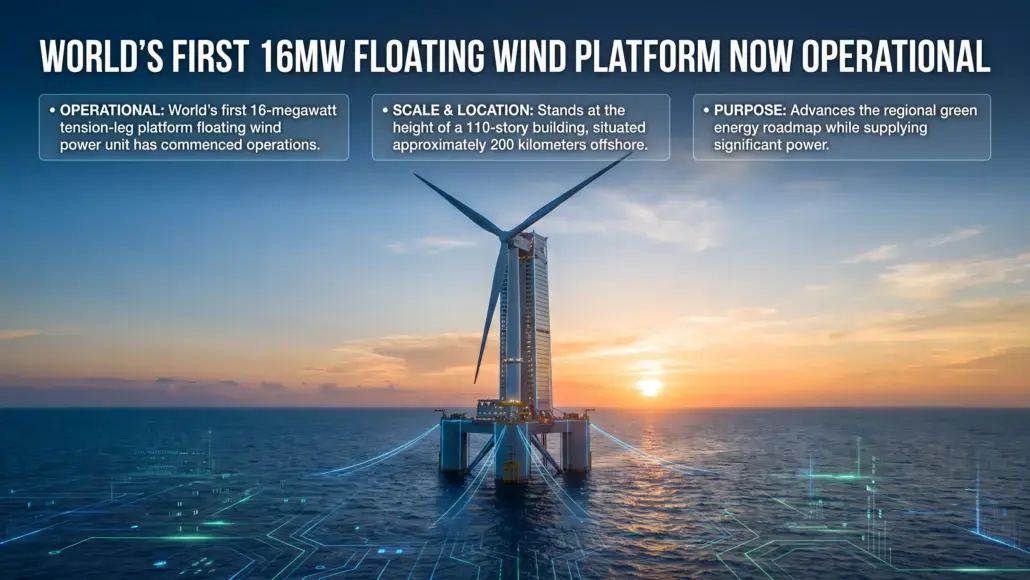

China National Offshore Oil Corp has officially commenced operations of the world’s first 16-megawatt tension-leg platform floating wind power unit in the Pearl River Mouth Basin of the South China Sea. Situated approximately 200 kilometers southeast of Shenzhen, the structure stands at a height comparable to a 110-story building. As China’s largest producer of offshore oil and gas, China National Offshore Oil Corp launched this facility to advance the regional green energy roadmap while supplying clean electricity directly to offshore operations.
Technical Engineering and Power Generation Specifications
Operating in a water depth of 136 meters and located 136 kilometers offshore, the deepwater offshore platform facility features a 16-MW anti-typhoon wind turbine. Engineered with an operational lifespan of 25 years, the structure is built to withstand extreme 17-level typhoons. Once fully operational, the project will supply 54 million kilowatt-hours of clean electricity annually to the Lufeng Oilfield grid through a 4.3-kilometer subsea cable. This annual generation replaces crude oil power generation, equating to fuel savings of 15,000 cubic meters of fuel oil and a reduction in carbon dioxide emissions of 35,000 metric tons per year.
Structural Advantages and Multi-Energy Integration
As an advanced offshore platform, a tension-leg platform (TLP) system comprises an upper floating body, subsea anchor foundations, and a mooring system. Compared to semi-submersible platforms, the TLP structure offers exceptional stability, lower steel consumption per megawatt, and a smaller sea-use footprint, minimizing conflicts between offshore wind development and traditional marine activities. Although TLP platforms are internationally recognized as highly complex floating wind assets with dense patent barriers that previously prevented domestic applications in China, this project marks a historic breakthrough in local deployment.
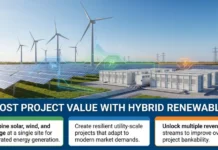
To address the intermittency and volatility inherent to wind resources, China National Offshore Oil Corp pioneered a multi-energy coordinated power supply model. By integrating offshore wind, conventional fuel generation, and energy storage, the facility achieves high penetration into the oilfield grid. Successfully deploying this floating wind power architecture serves as a pivotal step for the national energy transition by reducing fossil fuel dependence and lowering overall emission intensity.
Marine Economic Growth and Industrial Chain Expansion
Energy analysts observe that China’s energy increments are accelerating toward marine domains in 2026, with offshore wind and deepwater oil and gas development acting as core engines to safeguard national energy security while expanding power supplies. Figures from the Ministry of Natural Resources indicate that China’s preliminary gross ocean product reached 5.5 trillion yuan ($815.1 billion) in the first half of the year, representing a 5.1 percent year-on-year growth. This growth rate exceeded broader gross domestic product by 0.4 percentage points, expanding the marine economy to a 7.9 percent share of total GDP.
Clustered Manufacturing and Global Market Leadership
China continues to solidify its leading edge in the sector through deep-sea infrastructure expansion. Coastal industrial hubs in provinces such as Guangdong, Jiangsu, Shandong, and Fujian have established clustered manufacturing supply chains encompassing turbine production, subsea cabling, installation, and maintenance. Supported by dozens of specialized national-level enterprises, the industry has overcome technical challenges in critical components, including turbine bearings and monitoring sensors, creating a self-reliant supply chain for deep-sea floating wind projects.
According to the Global Wind Turbine Market Shares 2025 report published by BloombergNEF, global wind capacity additions reached a record 169 gigawatts last year, representing a 38 percent year-on-year surge primarily underpinned by China’s booming onshore sector. Supported by consistent long-term policy measures, wind energy expansion has become increasingly concentrated in China over the past decade, further accelerating the broader green energy transition.