






















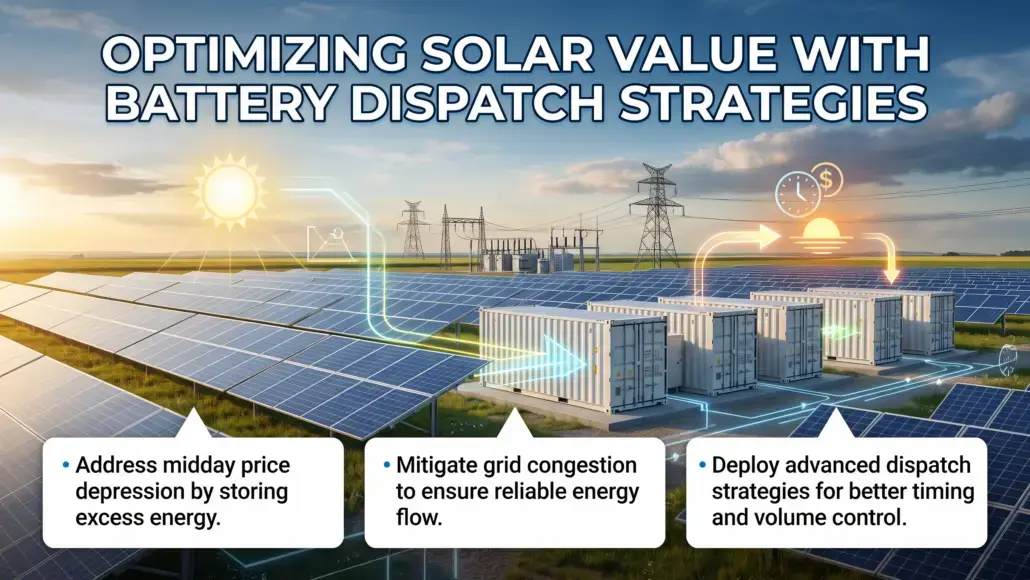

The integration of battery energy storage systems with utility-scale solar installations is no longer a peripheral consideration but a central element of modern energy infrastructure. As solar penetration grows, the traditional model of exporting power as it is generated is becoming increasingly inefficient due to midday price depression and grid congestion. To counter these challenges, developers are turning to advanced battery dispatch strategies to optimize the timing and volume of energy exports. These strategies are essential for improving solar market value by ensuring that renewable energy is delivered when it is most needed and most highly valued by the grid. The ability to control the flow of energy transforms a passive solar plant into a dynamic and highly competitive power generation asset. Effective dispatch management requires a deep understanding of market price signals, grid conditions, and technical asset capabilities. Instead of a simple charge-discharge cycle, modern operators use complex algorithms to balance multiple objectives, including energy arbitrage, ancillary service provision, and peak shaving. By shifting solar generation from the midday peak to the evening hours when demand and prices are typically higher, these systems can significantly increase the total revenue earned per megawatt-hour of solar capacity. The successful implementation of these strategies is a primary driver for the growing adoption of hybrid solar-plus-storage projects across the globe. By applying PV co-location strategies improving utility-scale solar asset value, developers can maximize the physical and financial performance of their sites.
Optimizing Energy Arbitrage Through Intelligent Storage Management
Energy arbitrage is the core function of most battery storage systems, involving the purchase or storage of energy during low-price periods and its sale during high-price periods. For solar operators, this means capturing the excess energy produced during the middle of the day and releasing it during the morning or evening peaks. The success of this strategy depends on the ability to accurately predict price fluctuations and manage the battery’s state of charge to ensure it is ready to respond when prices rise. This intelligent management is a fundamental component of increasing solar market value in volatile electricity markets. The profitability of arbitrage is influenced by the “spread” between high and low prices, as well as the round-trip efficiency of the storage system. As more solar enters the grid, the midday price dip becomes deeper, creating larger spreads and greater opportunities for arbitrage. However, the increased competition from other storage assets can also narrow these spreads over time. To remain competitive, operators must continually refine their dispatch algorithms to identify the most profitable windows for energy injection. This requires real-time data integration and a sophisticated understanding of the factors that drive price volatility in the local market. Managing the physical health of the battery is also a critical part of the dispatch strategy. Frequent cycling can lead to degradation, reducing the battery’s capacity and efficiency over its lifetime. Intelligent dispatch systems must therefore balance the potential for immediate revenue against the long-term cost of asset wear and tear. By optimizing the depth of discharge and the rate of charging, operators can extend the life of their storage systems and maximize the total lifetime solar market value. This holistic approach to asset management ensures that the project remains profitable for decades.
Mitigation of Solar Price Cannibalization and Negative Pricing Events
Price cannibalization is a significant risk for merchant solar projects, as the high output of many plants at the same time can drive prices down to zero or even into negative territory. Battery dispatch strategies provide a vital hedge against this risk by allowing the operator to withhold energy from the grid during these low-price periods. Instead of exporting energy for little or no return, the power is stored and released later when prices have recovered. This ability to time the market is a key factor in protecting the financial viability of large-scale solar developments. Negative pricing events are becoming more frequent in markets with high renewable penetration, such as parts of Europe and the United States. During these events, generators are actually penalized for exporting power to the grid. A well-managed battery system can absorb this energy, effectively getting paid to charge, and then sell it back to the grid when prices are positive. This “double-dip” revenue opportunity is a powerful example of how storage can improve solar market value in a way that is impossible for a standalone plant. The complexity of managing these events requires a high degree of automation and rapid response capabilities. The impact of cannibalization is not just limited to hourly price patterns but can also affect seasonal revenue profiles. By using long-duration storage technologies, operators could potentially shift energy across days or even weeks to capture higher seasonal prices. While most current battery systems are optimized for shorter durations, the continued development of new storage chemistries and technologies will expand the possibilities for long-term energy management. As the market continues to evolve, the ability to mitigate these macro-level price risks will become even more important for maintaining the competitive position of solar power.
The Role of Predictive Analytics in Real-Time Dispatch Decision Making
Predictive analytics is the engine that drives modern battery dispatch strategies. By analyzing historical price data, weather forecasts, and grid status indicators, these systems can generate highly accurate predictions of future market conditions. This allows the operator to plan their dispatch strategy in advance, ensuring that the battery is always positioned to capture the highest-value opportunities. The integration of artificial intelligence and machine learning allows these systems to continuously learn and improve their performance over time. Real-time decision-making is essential for participating in fast-moving market segments like frequency regulation or imbalance markets. These markets require assets to respond to signals within seconds or minutes, leaving no time for manual intervention. Automated dispatch platforms can monitor thousands of data points simultaneously and execute trades or dispatch commands with millisecond precision. This level of technical sophistication is what allows hybrid solar assets to provide the same level of reliability and flexibility as traditional thermal power plants. The data gathered from these systems also provides valuable insights for the design of future projects. By analyzing which dispatch strategies are most effective in different market conditions, developers can optimize the sizing and configuration of their solar and storage components. This data-driven approach to development leads to more efficient and profitable assets, further improving the overall solar market value of the industry’s portfolio. The continued investment in digital infrastructure is therefore a key requirement for the long-term success of the renewable energy sector.
Enhancing Grid Stability and Capturing Ancillary Service Revenue
Beyond energy arbitrage, battery storage systems provide essential services that help maintain the stability and reliability of the electricity grid. These ancillary services, such as frequency response, voltage control, and black-start capability, are highly valued by grid operators and represent an important secondary source of revenue for solar projects. By dedicating a portion of their storage capacity to these services, operators can diversify their income and improve their project’s financial resilience. The participation in ancillary service markets requires a high degree of technical compliance and reliability. Batteries are ideally suited for these tasks because of their ability to provide near-instantaneous response and precise control over both active and reactive power. By offering these services, solar-plus-storage projects can help to offset the loss of inertia and stability that occurs when traditional fossil fuel plants are retired. This role as a “grid citizen” is an important part of the value proposition for large-scale solar and a key driver of its continued integration into the global power mix. Strategic dispatch involves balancing the requirements of these different market segments to maximize total returns. For example, a battery might provide frequency response during the morning hours, store solar energy during the midday peak, and then perform energy arbitrage in the evening. This multi-use approach ensures that the storage asset is generating value throughout the day, significantly increasing the total solar market value of the facility. The ability to switch between different modes of operation based on real-time price and grid signals is a powerful tool for asset optimization.
Integrating Battery Dispatch Into Long-Term Asset Management Frameworks
The long-term success of a solar-plus-storage project depends on the effective integration of battery dispatch into a comprehensive asset management framework. This involves not only the daily operation of the system but also long-term planning for maintenance, upgrades, and end-of-life disposal. A well-designed framework ensures that all components of the project are working together to maximize the total solar market value over its entire lifecycle. Ongoing performance monitoring and reporting are essential for identifying opportunities for improvement and ensuring compliance with market and grid requirements. By tracking key performance indicators such as round-trip efficiency, cycle count, and response accuracy, operators can identify potential issues before they lead to significant downtime or revenue loss. This proactive approach to maintenance is particularly important for storage systems, where early detection of cell degradation or thermal issues can prevent catastrophic failure. The financial performance of the asset should also be reviewed regularly to ensure that the dispatch strategy is still aligned with market conditions. As energy markets evolve and new regulations are introduced, the most profitable way to operate the system may change. A flexible and adaptive approach to asset management allows the owner to stay ahead of these changes and continue to deliver superior returns. By embracing innovation and constantly striving for operational excellence, the solar industry can ensure that its assets remain a dominant and valuable part of the global energy system for decades to come. Provision of these advanced dispatch techniques is the foundation upon which the future of renewable energy will be built. Success in this field requires a dedicated effort to master both the technical and financial aspects of the industry. As we move toward a fully decarbonized grid, the role of intelligent storage management will only become more critical. Through careful planning and execution, the full potential of every solar and storage site can be realized, delivering maximum benefit to investors, consumers, and the environment alike. This commitment to value creation is what will drive the next wave of energy infrastructure development across the world.