




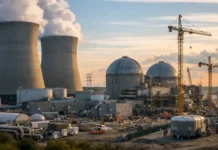



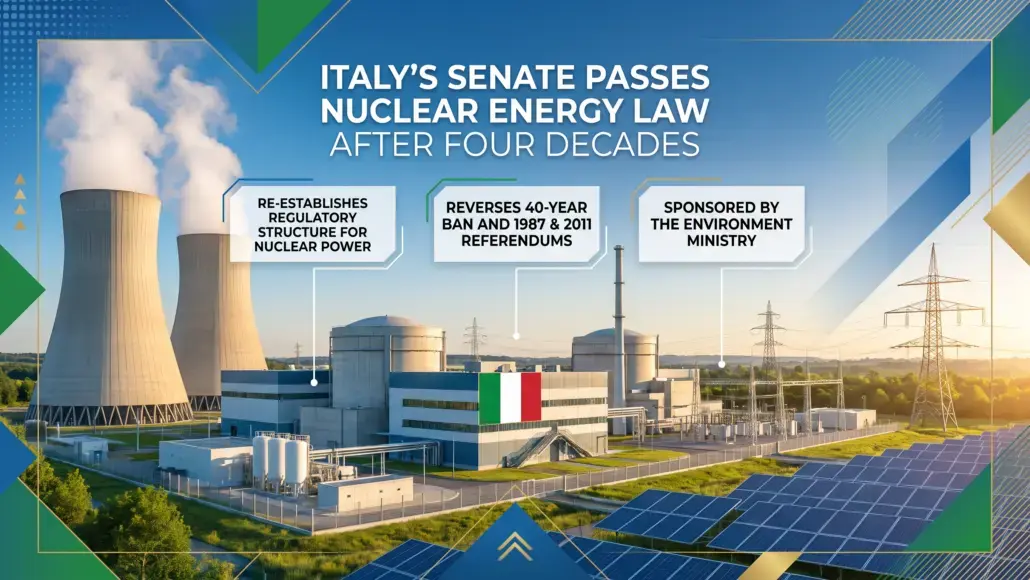

Italy has formally reopened the door to nuclear power after its Senate granted final approval to a government framework legislation — already passed by the Chamber of Deputies — that re-establishes a regulatory structure for nuclear energy in the country. The move comes more than forty years after Italy dismantled its nuclear programme following the 1987 referendum, and over a decade after a second referendum in 2011 reaffirmed that decision.
Italy’s nuclear energy law, sponsored by Environment and Energy Security Minister Gilberto Pichetto Fratin, delegates authority to the government to issue legislative decrees that will govern the nuclear sector comprehensively — covering the construction and operation of nuclear facilities, hydrogen production using nuclear energy, spent fuel and radioactive waste management, safety regulations, and the establishment of relevant regulatory bodies.
A Changing European Context
Italy’s decision unfolds against a notably different European backdrop compared to the time of its two referendums. Nuclear power currently accounts for approximately 23% of electricity generation across the European Union. The European Commission has progressively reinforced its support for nuclear energy’s contribution to decarbonisation, industrial competitiveness, and energy security — while leaving the final choice of energy mix to individual member states.
European Commission President Ursula von der Leyen underscored this stance in her State of the Union address on 16 September. “We have invested in our homegrown clean energies – renewables and nuclear,” she stated, stressing the need to accelerate the deployment of domestic low-carbon energy sources “be it renewables and nuclear, or biomethane and others,” under a “technologically neutral” approach, with the overarching goal of increasing Europe’s energy independence.
Following the bill’s passage, Prime Minister Giorgia Meloni described the outcome as “a courageous and common-sense choice” on social platform X, writing: “Today Parliament gave final approval to the nuclear law. After almost forty years, Italy once again has a regulatory framework for producing nuclear energy.”
Meloni linked the return to nuclear power to energy security and the growing electricity demand being driven by the expansion of data centres and artificial intelligence. She asserted that new nuclear technologies should provide “greater energy security, meaning less dependence on foreign countries and less exposure to international crises,” while complementing renewables with stable, low-emission power. “We are talking about next-generation technologies, not the old nuclear power plants,” she said.
Minister Pichetto Fratin, for his part, stated that the approval meant “Italy is taking a step towards the future.” He rejected the notion that the legislation signalled a simple return to past nuclear models, arguing that next-generation technologies, integrated with renewable energy, could contribute to energy security and the goal of achieving climate neutrality by 2050. He also highlighted the expertise retained by Italian companies, which have continued to operate internationally in the nuclear sector despite Italy’s domestic withdrawal from nuclear power generation. “Sustainable nuclear power is a concrete opportunity, not a closed chapter,” the minister said. He described the delegation bill as both “a milestone and a new starting point.”
What Italy’s Nuclear Energy Law Actually Covers
At the heart of the legislation is the establishment of a National Programme for the development of sustainable nuclear energy production and use, including nuclear fusion. The implementing decrees will regulate every phase in the life cycle of nuclear facilities — from experimentation, siting, construction, installation, and operation through to decommissioning and dismantling.
The law’s scope also encompasses nuclear fuel management and reprocessing, the temporary storage and final disposal of radioactive waste and spent fuel, scientific research, skills development, and the reorganisation of governance and regulatory oversight.
Particular emphasis is placed on next-generation technologies. The implementing decrees will determine which types of reactors may be authorised, in line with the principle of technological neutrality and EU legislation. This includes modular technologies such as Small Modular Reactors (SMRs) and more advanced systems such as Advanced Modular Reactors (AMRs).
Beyond electricity, the legislation also envisages the use of nuclear energy for hydrogen and heat production and in the naval and maritime sectors, alongside continued investment in nuclear fusion research. Crucially, the law does not, in itself, authorise the immediate construction of any new nuclear power plants. The government has 12 months from the law’s entry into force to adopt one or more implementing decrees.
Financing Framework and Private Investment
The law does not directly allocate funding for the construction of future nuclear plants. Instead, it aims to create the regulatory and financial conditions necessary to attract private capital, including through public-private partnerships.
Potential instruments include Power Purchase Agreements (PPAs), long-term electricity supply contracts, and two-way Contracts for Difference (CfDs), under which a reference price is guaranteed. If the market price falls below a set level, the support mechanism covers the gap; if it rises above that level, the producer repays the surplus. Ring-fenced resources, financed through revenues from electricity sales, are also expected to cover future decommissioning and radioactive waste management costs. Any public support mechanisms will need to comply with EU rules and, where required, receive European Commission approval.
Safety, Siting, and the Radioactive Waste Question
The law provides for a reorganisation of existing nuclear regulatory bodies, with the possibility of establishing an independent administrative authority for nuclear safety. Many of the relevant responsibilities are currently held by Italy’s National Inspectorate for Nuclear Safety and Radiation Protection (ISIN).
The politically sensitive matter of where new plants could be built remains unresolved. The legislation provides for the involvement of affected communities and measures to benefit host territories, alongside the possibility for areas to volunteer as sites, subject to the relevant environmental assessment procedures.
Underlying these discussions is the still-unresolved issue of Italy’s National Repository for radioactive waste. The country’s former nuclear power plants remain under decommissioning, while a site for the permanent disposal of low- and intermediate-level radioactive waste — and temporary storage of high-level waste — has yet to be built.
Industry Backs the Move
Italy’s main employers’ federation, Confindustria, welcomed Parliament’s approval. Vice-President Aurelio Regina, responsible for energy matters, described the vote as “a historic turning point for the country’s future and for strengthening the national energy mix.” Confindustria noted that nuclear power accounts for around 10% of global electricity generation and 23% of EU electricity production.
The federation also noted that more than 70 Italian companies already operate within the nuclear supply chain, spanning reactor design, component manufacturing, and plant maintenance. According to Regina, a national nuclear programme could generate around 117,000 new jobs and produce an annual economic impact exceeding €50 billion.
Opposition and Environmental Groups Push Back
Opposition parties and non-governmental organisations have taken sharply critical positions, focusing above all on the absence of clearly defined costs, timelines, and funding mechanisms.
Democratic Party senator and party secretary Nicola Irto stated: “What the government presents as the beginning of a new energy era is, in practice, an extremely broad delegation that postpones the essential decisions until tomorrow.” He argued that “there are no costs, no timelines, no funding,” effectively asking Parliament to cast “a vote in the dark.” Irto further stressed that the law “does not build a single power plant, does not produce even one kilowatt-hour and does not reduce a family’s electricity bill by a single euro,” while questioning who will ultimately finance the required investment. He also pointed to the unfinished decommissioning of Italy’s old nuclear facilities and the failure to establish the National Repository.
Five Star Movement member and Chamber of Deputies Vice-President Sergio Costa argued that the legislation sets out “no plant, no certain cost and no credible date.” He challenged the government’s focus on SMRs, noting that Small Modular Reactors are not yet being produced on a commercial scale, and raised again the unresolved radioactive waste question. “Before thinking about producing new waste, Minister Pichetto Fratin should come to Parliament and explain where he intends to put the waste we already have at home,” Costa said.
Angelo Bonelli, co-spokesperson for Green Europe, described the return to nuclear energy as “economic madness” and called on the government to disclose the programme’s costs and financing arrangements. Bonelli argued that SMRs cannot provide a short-term answer to high energy prices and that investment should instead be directed towards renewables, electricity grids, and storage.
A joint statement by Greenpeace Italy, Legambiente, WWF Italy, and Kyoto Club contended that the nuclear technology available today is “almost the same as that available 15 years ago,” when Italians rejected nuclear power for the second time in a referendum. The environmental organisations also criticised the bill’s reference to technological neutrality within the nuclear sector, arguing it grants the executive excessively broad discretion. They further contested the bill’s references to modular reactors — not yet commercially available at scale — as a “rhetorical device,” and disputed the argument that smaller reactors are necessarily cleaner, pointing to studies raising concerns about waste generation, costs, and safety.
The political and regulatory focus will now shift to the implementing decrees. These will determine which technologies may be authorised, the procedures for selecting sites, the safety and oversight regime, radioactive waste management, and the economic model through which sustainable nuclear power in Italy could ultimately be financed and delivered.