









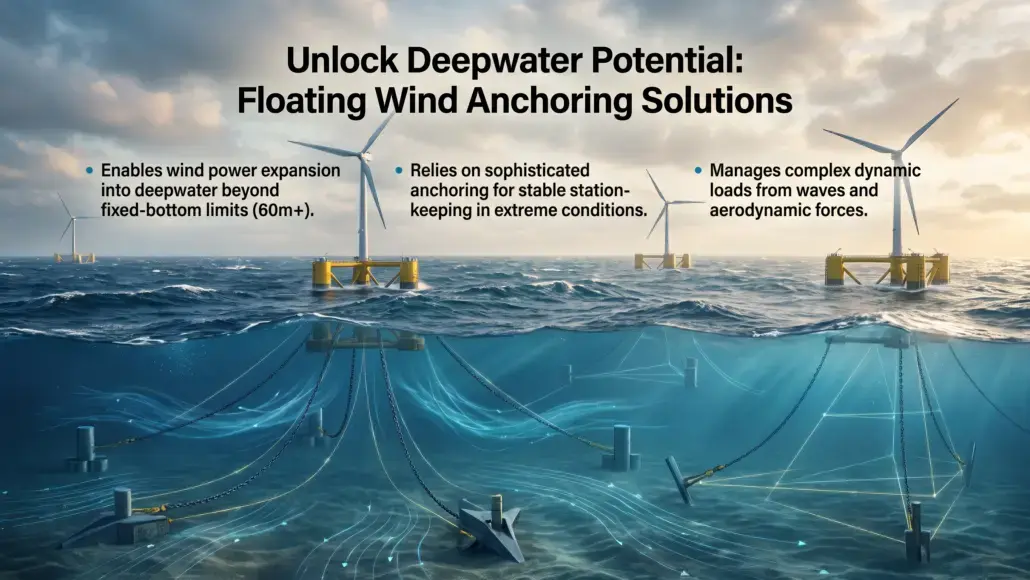

The expansion of offshore wind power into deepwater environments represents a critical shift in global energy strategies, as conventional fixed-bottom foundations reach their technical and economic limits at depths exceeding sixty meters. The viability of these structures depends on sophisticated floating wind anchoring technologies capable of maintaining station-keeping in extreme conditions. These systems manage complex dynamic loads from waves and aerodynamic forces while ensuring the integrity of subsea cables. As the industry moves to large-scale arrays, the focus has shifted toward engineering solutions that provide longevity. Deepwater sites present challenges for subsea engineering, requiring an understanding of seabed geology. The selection of an anchoring system is not merely a matter of structural support but a fundamental component of the project’s financial feasibility. By integrating advanced materials, the sector is establishing a framework for deploying multi-megawatt turbines in regions previously considered inaccessible for renewable energy production.
Evolution of Mooring Configurations for Floating Power Assets
Mooring systems serve as the primary link between the floating hull and the seabed, acting as the stabilizer for the entire power generation unit. Traditionally, catenary mooring has been the standard approach, utilizing heavy steel chains that rely on their own weight to provide restoring force. In this configuration, a significant portion of the chain rests on the seabed, providing a horizontal pull on the anchor. While effective in moderate depths, the sheer weight of these chains becomes a limiting factor as deployments move into deeper waters, as the vertical load on the floating platform reduces the available buoyancy for the turbine and nacelle.
To address these limitations, engineers are increasingly adopting taut-leg and semi-taut configurations. These systems utilize synthetic fiber ropes, such as polyester or nylon, which offer high strength-to-weight ratios and specified elastic properties. Unlike steel chains, synthetic lines are tensioned directly between the platform and the anchor, significantly reducing the footprint on the seabed and the overall mass of the system. This shift in floating wind anchoring technologies allows for smaller floating hulls and more efficient installation processes. Additionally, the elasticity of synthetic materials helps to dampen the peak loads experienced during storm events, protecting both the mooring components and the turbine’s internal machinery from excessive fatigue.
Advanced mooring designs explore shared anchoring systems, where multiple platforms connect to a single anchor point. This approach reduces subsea penetrations and leads to savings in material costs. However, shared mooring requires computational modeling to ensure that the failure of one line does not lead to instability. The integration of load monitoring sensors provides real-time data on tension levels, allowing operators to perform maintenance and adjust parameters to optimize energy production.
Geotechnical Considerations in Subsea Anchor Selection
The effectiveness of any mooring system is fundamentally tied to the capacity of the anchor to resist vertical and horizontal forces without significant displacement. Seabed conditions vary drastically across offshore wind lease areas, ranging from soft silts and clays to dense sands and rocky outcrops. Selecting the appropriate anchor type requires extensive geotechnical surveys, including cone penetration tests and sub-bottom profiling, to characterize the soil’s shear strength and load-bearing capacity. Each soil profile necessitates a specific anchoring technology to ensure long-term stability over the twenty-five to thirty-year lifespan of the wind farm.
Drag embedment anchors represent one of the most common floating wind anchoring technologies due to their simplicity and reliability in sandy or relatively soft soil conditions. These anchors are designed to penetrate the seabed as they are pulled horizontally, reaching a depth where the soil resistance matches the required holding capacity. While highly effective for horizontal loads, traditional drag anchors have limited resistance to vertical forces, often requiring long catenary mooring lines to ensure the pull remains parallel to the seabed. For deeper waters where taut-leg systems are preferred, specialized vertical load anchors have been developed. These components are installed like standard drag anchors but feature a triggering mechanism that changes the orientation of the fluke once the desired depth is reached, allowing them to resist forces from any direction.
In harder or more cohesive soils, suction piles have become the preferred solution for large-scale floating wind projects. These large-diameter steel cylinders are lowered to the seabed and then embedded by pumping out the water from within the pile, creating a pressure differential that drives the structure into the soil. Suction piles provide exceptional resistance to both horizontal and vertical loads, making them ideal for the high-tension requirements of taut-leg mooring systems. Additionally, the installation process for suction piles is relatively quiet compared to traditional pile driving, reducing the acoustic impact on marine life and simplifying the environmental permitting process. For sites with rocky seabeds where penetration is impossible, gravity-based anchors utilizing heavy concrete blocks or rock-filled containers provide the necessary stability through mass alone, though their sheer size can complicate logistics and installation.
Structural Stability and Dynamic Load Management
The primary engineering objective of floating wind anchoring technologies is to maintain the turbine’s verticality and rotational stability within strict operational tolerances. Unlike fixed-bottom turbines, floating units are subject to six degrees of freedom: surge, sway, heave, roll, pitch, and yaw. Excessive movement in any of these axes can significantly degrade the aerodynamic efficiency of the rotor blades and increase the mechanical stress on the drivetrain and yaw systems. Maintaining a stable platform is essential for maximizing energy yield and ensuring that the turbine can operate safely in high wind speeds without exceeding its structural design limits.
Dynamic load management involves a sophisticated interplay between the mooring system and the turbine’s control software. Modern floating units often employ active pitch control to mitigate the thrust forces generated by the wind, reducing the pitching motion of the platform. However, these adjustments must be synchronized with the natural frequency of the mooring system to avoid resonance, which could lead to catastrophic structural failure. High-fidelity numerical simulations are used during the design phase to model the behavior of the system under thousands of different environmental scenarios, ensuring that the anchoring technologies can withstand the combined effects of extreme waves and wind gusts.
The integrity of the dynamic export cable is another critical factor in the stability equation. As the platform moves, the subsea cable must flex and bend without sustaining damage to its insulation or conductors. Engineers use buoyancy modules to create “lazy wave” or “steep wave” configurations, which provide the necessary slack for the cable to move freely. The anchoring system must be designed to limit the platform’s excursion range to prevent the cable from being pulled taut or rubbing against the seabed. This coordination between the mooring engineers and the electrical system designers is vital for the long-term reliability of the power generation asset, as cable failures are among the most frequent and costly issues in the offshore wind industry.
Economic Scalability and Installation Logistics
For floating wind to compete with established power generation technologies, the industry must move beyond bespoke engineering and toward standardized, mass-produced components. The current cost of floating wind anchoring technologies is significantly higher than that of fixed-bottom foundations, primarily due to the complexity of the mooring systems and the specialized vessels required for installation. Achieving commercial scale requires a dramatic reduction in the time and resources needed to deploy each unit, as well as a more durable supply chain for high-strength mooring components and subsea anchors.
Standardization of anchor designs is a key driver for cost reduction. By utilizing proven designs, manufacturers can invest in automated facilities, reducing lead times. The development of modular mooring systems allows for pre-installation of anchors before the floating platform arrives. This approach enables developers to use smaller vessels for the initial subsea work, reserving heavy-lift vessels for the final hook-up. This logistical strategy reduces the overall project cost and provides flexibility in scheduling.
Regional port infrastructure also plays a vital role in the scalability of floating offshore wind. The deepwater requirements and large footprints of floating hulls mean that many existing ports are unsuitable for assembly and deployment. Investment in dedicated offshore wind hubs with sufficient quay strength, water depth, and storage space for anchors and mooring chains is essential. As the market matures, the integration of local content in the manufacturing of anchoring components can help to mitigate geopolitical risks. The transition to commercial-scale floating wind farms will ultimately depend on the industry’s ability to demonstrate that these complex anchoring systems can be deployed reliably and cost-effectively across a wide range of global maritime environments.
Long-Term Maintenance and Environmental Stewardship
The operational phase of a floating wind farm requires a rigorous inspection and maintenance regime to ensure the continued integrity of the anchoring system. Subsea environments are inherently corrosive, and mooring lines are subject to biofouling, abrasion, and fatigue over decades of service. Regular underwater inspections using Remotely Operated Vehicles are necessary to monitor the condition of the anchors, connectors, and synthetic lines. Early detection of wear or damage is critical for extending the useful life of power generation assets.
Advancements in sensor technology are transforming subsea maintenance. Fiber-optic sensors embedded within synthetic mooring lines provide continuous data on strain, while acoustic sensors on the seabed detect anchor displacement. This shift toward condition-based maintenance allows for targeted interventions. When a component reaches the end of its service life, the anchoring system must be designed for safe decommissioning. Floating wind anchoring technologies that allow for the recovery of subsea components are becoming important as regulatory bodies emphasize the circular economy.
Environmental stewardship involves minimizing the impact of the anchoring system on biodiversity. Shared mooring and low-footprint anchors help preserve the seabed and reduce disruption to benthic habitats. The selection of materials for mooring lines must consider chemical leaching or the entanglement of marine mammals. By prioritizing sustainable engineering, the floating wind industry ensures that its contribution to the energy transition does not come at the expense of oceanic health. The refinement of anchoring technologies remains a pillar of the offshore wind sector.