









































The maintenance and operation of a modern electrical grid are among the most cognitively and physically demanding tasks in any industrial sector. While the industry has historically focused its safety efforts on the massive physical assets the towers, the conductors, and the complex protective relays there is a growing and vital recognition that the most critical and complex element of the entire system is the human mind that designs, builds, and maintains it. This realization has placed human factors power transmission safety at the very center of the safety strategies for the world’s leading utility organizations. Human factors is a scientific discipline that explores the interactions among humans and other elements of a system, and in the context of the power sector, it is about designing the work, the equipment, and the entire environment to perfectly fit the capabilities and the inherent limitations of the human operator.
The importance of human factors power transmission safety cannot be overstated in an industry where the margin for error is often non-existent. Research across various high-risk industries consistently shows that the vast majority of accidents are not the result of simple mechanical or equipment failure, but are instead driven by human error. However, a sophisticated human factors perspective teaches us that error is not a character flaw or a lack of professionalism; it is a predictable and often preventable outcome of a system that is poorly matched to human psychology and physiology. By studying human factors power transmission safety, we can identify the subtle “error traps” and systemic weaknesses that lead even the most experienced and dedicated professionals to make mistakes. This shift from blaming the individual to improving the design of the system is the hallmark of a truly mature and professional approach to safety psychology in the modern power sector.
Cognitive Load and the Dynamics of Decision-Making in the Field
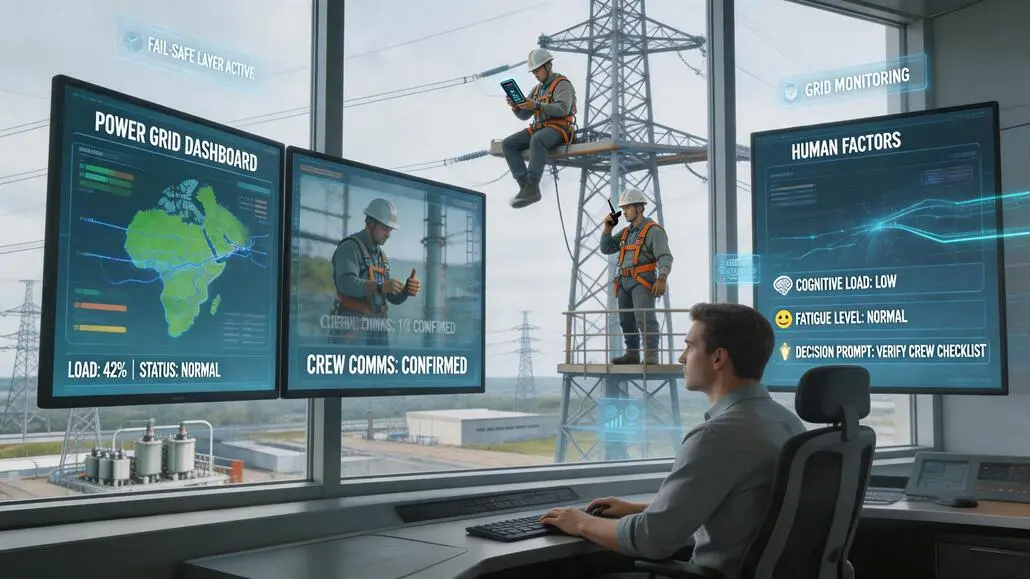
At the heart of human factors power transmission safety is the critical management of cognitive load. A lineman working at height or a system dispatcher managing a complex switching operation during a grid disturbance is often inundated with a staggering amount of information. They must simultaneously monitor voltage levels, track the physical position of their peers, listen to multi-channel radio communications, and navigate the extreme physical challenges of their immediate environment. When this cognitive load exceeds the brain’s natural processing capacity, performance inevitably declines, situational awareness is lost, and the likelihood of a catastrophic error increases exponentially. Human factors power transmission safety focuses on simplifying and prioritizing the flow of information, using intuitive displays and standardized procedures to ensure that the worker can maintain their focus on the most critical tasks at hand.
Decision-making under extreme pressure is another vital area of human factors power transmission safety. During an emergency storm response or a sudden, large-scale grid failure, technicians and engineers are frequently required to make high-stakes decisions with incomplete or conflicting information. Safety psychology reveals that under these conditions, the human brain often relies on “heuristics”—mental shortcuts—that can lead to dangerous biases and errors in judgment, such as confirmation bias or overconfidence. Human factors power transmission safety protocols, such as the mandatory use of structured “Stop-Work Authority” and “Peer-Verification” steps for all critical operations, are designed to deliberately interrupt these psychological biases. By introducing brief, purposeful pauses in the workflow, we can move from impulsive “fast-brain” thinking to more analytical “slow-brain” thinking, significantly improving the quality and safety of the final outcome.
Error Reduction Strategies and the Biological Management of Fatigue
Fatigue is perhaps the most pervasive and insidious threat to human factors power transmission safety in the modern utility environment. Whether it is the result of long, grueling shifts during a disaster recovery effort, the challenges of rotating shift work, or the cumulative effect of chronic sleep deprivation, fatigue impairs every single aspect of human performance from fine motor coordination and reaction times to complex emotional regulation and logical reasoning. Human factors power transmission safety strategies for fatigue management include the use of sophisticated, data-driven scheduling models, mandatory rest periods that prioritize circadian rhythms, and the implementation of “fitness-for-duty” assessments at the start of every shift. By acknowledging the hard biological reality of fatigue rather than trying to power through it, organizations can build a much more resilient system that protects the worker when they are at their most physiologically vulnerable.
In addition to managing the biological drivers of error, human factors power transmission safety utilizes a specific set of “error-reduction tools” that are integrated into the daily operations of every crew. One of the most effective and widely adopted is the STAR principle: Stop, Think, Act, Review. This simple but powerful cognitive tool encourages the worker to pause before any critical action, mentally verify their intentions against the required procedure, and then evaluate the actual result of the action before moving to the next step. Another cornerstone of human factors power transmission safety is the “Three-Way Communication” protocol, which ensures that every command or piece of critical information is heard, understood, and verbally confirmed by the receiver before it is acted upon. These tools are not mere bureaucratic hurdles; they are sophisticated psychological interventions that create a vital layer of defense against the inevitable and natural lapses in human attention that occur in even the best-trained professionals.
The Physical Interface and the Principles of User-Centric Design
While much of the focus in human factors power transmission safety is cognitive and psychological, it also encompasses the critical physical design of the workspace and the tools. A control room with poorly labeled or inconsistently arranged switches, or a piece of heavy equipment with unintuitive controls that go against a worker’s natural instincts, is quite literally an accident waiting to happen. User-centric design is a core principle of human factors power transmission safety, ensuring that every piece of equipment from the smallest hand tool to the largest substation control panel is designed with the user’s natural physical and mental instincts in mind. For example, the consistent use of color-coded controls and tactile feedback allows a worker to operate equipment correctly even when their visual attention is focused elsewhere or when visibility is severely compromised. This reduction in the “physical-cognitive gap” is essential for achieving error-free performance in high-pressure, high-stakes environments.
The ergonomic design of personal protective equipment (PPE) is also a vital and often overlooked part of human factors power transmission safety. A fall protection harness that is difficult to put on correctly, or a pair of high-voltage gloves that severely limits the manual dexterity needed for an intricate task, will eventually be used incorrectly or, in the worst cases, not at all. By making safety equipment “easy to use right and hard to use wrong,” manufacturers and utility companies are directly supporting the human factor of compliance. When the physical interface of the job is intuitive, comfortable, and supportive, the worker’s mental energy is freed up for technical problem-solving and maintaining high-level situational awareness. This synergy between the physical and the psychological is the ultimate goal of human factors power transmission safety.
Building a Resilient System through the Science of Human Performance
The final piece of the human factors power transmission safety puzzle is the move toward a “systems-thinking” approach to human performance. This means recognizing that a worker’s behavior is influenced by the culture, the training, the equipment, and the management decisions that surround them. A resilient system is one that is designed to absorb the inevitable human error without it leading to a disaster. By implementing “fail-safe” engineering and redundant safety layers, human factors power transmission safety ensures that no single mistake can result in a fatality or a major grid failure. This approach fosters a culture of reporting and transparency, as workers feel safe to share their mistakes and “near-misses” knowing that the focus will be on strengthening the system rather than punishing the individual.
In conclusion, the full integration of human factors power transmission safety is a fundamental and transformative advancement in how we protect the men and women who power our world. By moving beyond a narrow focus on physical hazards to a deep, scientific understanding of human psychology, cognitive performance, and biological limits, we are building a more resilient, effective, and compassionate energy industry. The future of power transmission operations depends on our continued ability to design systems that acknowledge human limitations while simultaneously leveraging and supporting human strengths. Through the continued and rigorous application of human factors power transmission safety, we can ensure that every decision made on the grid is supported by the best possible science, leading to a much safer and more reliable energy future for everyone.