





































Legislation that came into force on Thursday, 21 May 2026, introduces significant changes to how offshore wind developers in the United Kingdom can fulfil their environmental obligations, broadening the range of compensatory measures available when projects affect protected marine sites.
The reforms, backed by the Department for Energy Security and Net Zero and the Department for Environment, Food and Rural Affairs, are framed as a core part of the government’s commitment to delivering clean power by 2030, while simultaneously upholding protections for the UK’s marine ecosystems.
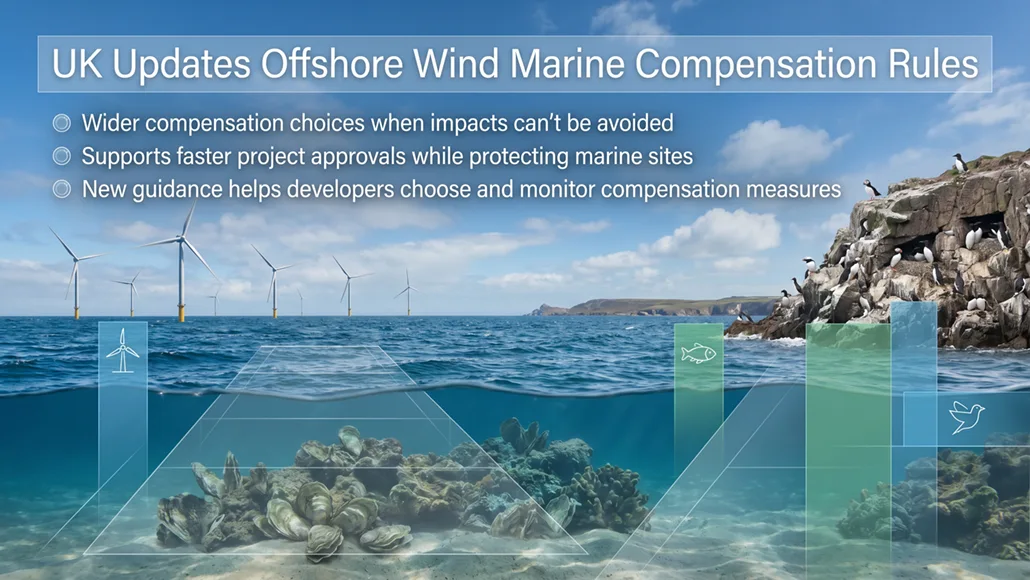
Previously, offshore wind developers faced strict and narrow restrictions on the types of environmental compensation they could offer when their projects created unavoidable impacts on protected sites. The new legislation removes those constraints, enabling a wider variety of compensatory options that can be tailored to the nature and scale of individual projects.
Under the updated rules, acceptable compensatory measures may now include protecting seabird nesting sites, reducing predator numbers near protected colonies, and funding the restoration of native oyster populations. The intent is to allow offshore wind environmental compensation to be more strategically designed, more effective in practice, and better aligned with the broader ambitions of the UK’s offshore wind programme.
The statutory instrument amends both the Conservation of Habitats and Species Regulations 2017 and the Conservation of Offshore Marine Habitats and Species Regulations 2017, and applies specifically in cases where a developer cannot avoid or mitigate an adverse effect on a protected site but there is an overriding public interest for the development to proceed.
Marine Minister Emma Hardy stated that offshore wind power is a key driver of the government’s mission to make Britain energy secure and address the climate crisis, adding that the reforms are designed to ensure that building necessary clean energy infrastructure can also deliver real, lasting benefits for nature, from restoring native oyster beds to protecting seabird colonies for future generations.
Energy Minister Michael Shanks noted that following two fossil fuel crises in five years, the government is accelerating its push for clean, homegrown power. He described the changes as a measure that will accelerate offshore wind development while maintaining strong protections for the marine environment, thereby strengthening Britain’s energy independence.
RenewableUK’s Head of Environment and Consents, Kat Route-Stephens, confirmed that the industry had worked closely with the government and nature conservation organisations to shape the reforms. She described them as major milestones that will cut delays and enable offshore wind developers to build new clean energy infrastructure significantly faster, while retaining the ability to compensate for environmental impacts across a much wider range of options. She added that the changes provide greater certainty and clarity for wind farm developers as they plan, build, and operate projects, and described the outcome as a win for both nature conservation and the renewable energy sector.
Benj Sykes, Offshore Wind Industry Council Workstream Sponsor for Environment and Consents and Ørsted UK Country Manager, emphasised that the reforms are not about lowering environmental standards. He described the shift as moving towards a more outcomes-focused approach to marine compensation, stating that the goal is to implement a more effective, strategic approach that delivers better outcomes for nature while advancing the UK’s Clean Power 2030 ambitions.
Accompanying the legislative changes, the government has also published guidance to help offshore wind developers understand and implement the new system. The guidance covers how to select the most appropriate type of offshore wind environmental compensation for a given project, and how the effectiveness of that compensation will be monitored over time. It is available via the official government publications portal.
The changes collectively position the UK’s approach to offshore wind and marine protection as complementary rather than competing priorities, with the legislative framework and supporting guidance designed to give the industry the clarity it needs to move forward at pace.