



















For over a century, the debate between Alternating Current (AC) and Direct Current (DC) was largely considered a closed chapter in the history of engineering, settled firmly in favor of AC. The famous “War of Currents” in the late 19th century, featuring titans like Thomas Edison and Nikola Tesla, concluded that AC’s unique ability to be easily stepped up and down in voltage via simple transformers made it the only viable choice for long-distance power transmission and grid distribution. However, the energy landscape of the 21st century is fundamentally and irreversibly different from the one that birthed our traditional power grid. Today, we are witnessing a quiet but incredibly powerful resurgence of DC technology. As we look toward a future dominated by renewable energy, ubiquitous electric vehicles, and hyper-scale data centers, it is becoming clear that DC power architectures future energy needs are not just a nostalgic alternative, but a technical and economic necessity for a sustainable world.
The Massive Inefficiency of Redundant Conversion Steps
One of the primary and most urgent drivers behind the move toward DC is the relentless quest for energy efficiency. In our current AC-dominated world, we live in a constant, hidden cycle of power conversion that wastes a significant portion of the electricity we generate. Modern solar panels produce DC; this must be converted to AC by an inverter to feed into the utility grid. The grid then transmits this AC to our homes and offices, where it is almost immediately converted back into DC by the power bricks for our laptops, LED lighting systems, and electric vehicle batteries.
Each of these conversion steps from DC to AC and back again results in a measurable energy loss, usually dissipated as waste heat. By implementing native DC power architectures future energy needs can be met more sustainably by eliminating these redundant and wasteful steps. In a “native DC” building, for example, solar power from the roof can be used to charge on-site batteries and power modern LED lighting directly. This approach can reduce the total energy consumption of a facility by 10% to 15% without changing a single appliance, simply by removing the efficiency tax of conversion.
Empowering the Global Renewable Energy Transition
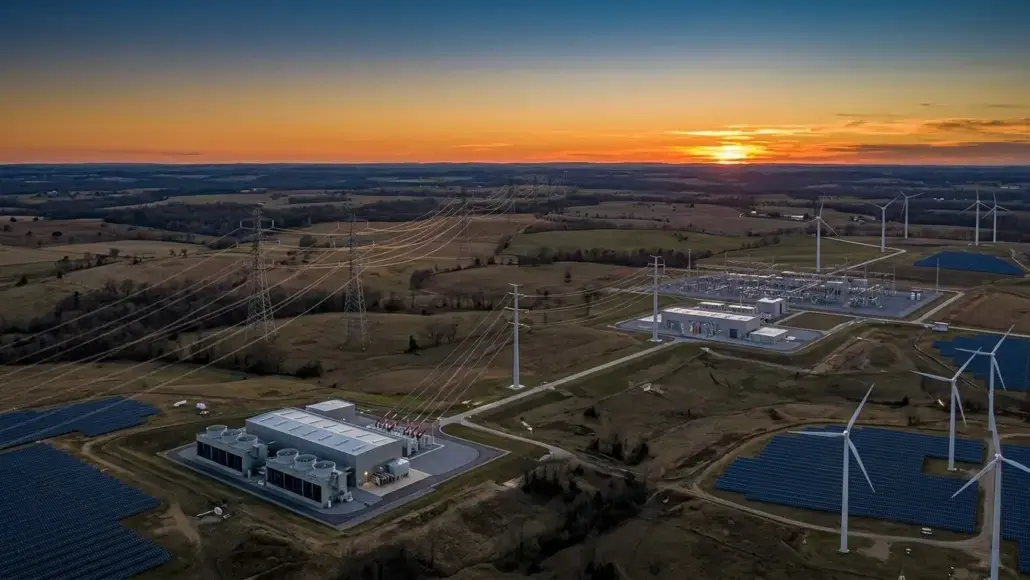
The global shift toward renewable energy is, by its very physical nature, a shift toward DC power. Photovoltaic (PV) cells, wind turbine internal electronics, and all modern battery storage systems are inherently DC technologies. In traditional grid integration, the requirement to synchronize these variable sources with a rigid 50Hz or 60Hz AC grid adds significant layers of complexity, cost, and potential failure points. Furthermore, as the grid becomes more decentralized, with millions of “prosumers” generating their own power, the challenge of maintaining AC frequency stability across a vast network becomes immense.
DC power architectures future energy needs are greatly simplified in this regard; they do not require frequency synchronization, making it much easier to connect disparate energy sources like solar, wind, and batteries into a single, cohesive microgrid. This inherent flexibility is essential for creating resilient energy communities that can operate independently of the main utility grid during emergencies or natural disasters, providing a level of energy security that is difficult to achieve with traditional AC architectures.
High-Density Applications: Data Centers and EV Fast Charging
Nowhere is the benefit of a DC-first approach more apparent than in the world’s most energy-intensive digital sectors. Data centers, which now consume a staggering and growing percentage of global electricity, are increasingly adopting DC distribution at the server rack level. By using 380V DC instead of traditional AC distribution, data center operators can reduce their power conversion losses by as much as 15%, while also significantly reducing the physical footprint and cooling requirements of their power equipment.
Similarly, the rapidly growing electric vehicle (EV) charging infrastructure is a major proponent of DC technology. While “Level 2” residential chargers use AC, the “DC Fast Chargers” that enable long-distance travel bypass the vehicle’s internal, weight-limited converter to pump high-power electricity directly into the battery. As we move toward ultra-fast charging standards (350kW and above), the role of DC power architectures future energy needs will be central to providing these massive power levels without placing an unsustainable and destabilizing load on the local AC distribution network.
Overcoming the Historic Technical Hurdles of DC
Despite its many clear advantages, the wide-scale adoption of DC is not without significant technical challenges that have held it back for a century. The primary reason AC won the original war of currents was the ease of circuit interruption. When you break an AC circuit, the current naturally crosses zero 100 or 120 times per second, making it relatively easy for a circuit breaker to extinguish the resulting electrical arc. In a DC system, there is no such zero-crossing, meaning that breaking a high-voltage DC circuit can create a continuous, extremely destructive arc that can melt equipment or start fires.
However, recent and major advancements in solid-state circuit breakers and hybrid interruption technologies have largely solved this historic problem, allowing for the safe management of high-voltage DC. Furthermore, the lack of standardized DC voltages for residential and commercial use remains a hurdle for manufacturers. For DC power architectures future energy needs to be fully realized, the global industry must align on common standards for connectors, protection devices, and voltage levels (such as the emerging 48V and 380V standards) to ensure interoperability and consumer safety.
The Critical Role of HVDC in Long-Distance Energy Transmission
While much of the recent innovation is focused on local distribution, High-Voltage Direct Current (HVDC) is also completely transforming the world of long-distance transmission. HVDC is significantly more efficient than AC for distances exceeding 600 kilometers because it avoids the “skin effect” and reactive power losses that plague AC lines. HVDC is also the only technically viable way to connect power grids across long stretches of sea via undersea cables, where AC losses would be prohibitive after just a few dozen kilometers.
Major HVDC “super-grids” are currently being planned and constructed to connect massive offshore wind farms in the North Sea to the European mainland and to bring abundant solar power from the Sahara Desert to the population centers of Northern Europe. In this grand context, DC power architectures future energy needs are served by allowing for the global trade of clean energy, effectively smoothing out the natural variability of wind and sun across vast geographical areas and time zones.
Smart Buildings and the Integration of Data and Power
Inside our homes and modern commercial buildings, the trend toward “low-voltage DC” is gaining significant momentum. The rise of USB-C Power Delivery, which can now supply up to 240W over a single thin cable, and Power over Ethernet (PoE) means that many of our daily devices from monitors and laptops to security cameras and sensors can be powered directly by DC data cables. Imagine a future where your office lighting, climate sensors, and computing equipment are all part of a single, unified DC network that is powered by rooftop solar and managed by an intelligent central energy controller.
This vision of DC power architectures future energy needs emphasizes not just raw efficiency, but also the deep integration of data and power. A DC-ready building is inherently smarter, more controllable, and more easily integrated into a modern building management system. It allows for granular control of energy use, where the building can automatically prioritize power for critical systems while dimming non-essential lights during a cloud passing or a period of high utility prices.
The Hybrid Future: A Coexistence of AC and DC
It is highly unlikely that the entire world will switch to DC overnight, given the trillions of dollars invested in existing AC infrastructure. Instead, we are entering an era of “hybrid” power systems. The legacy AC grid will continue to serve as the high-capacity backbone for much of our national infrastructure, but it will be increasingly interspersed with DC microgrids, HVDC links, and DC-native buildings.
Sophisticated power electronic converters, known as Solid-State Transformers (SSTs), will act as the intelligent, bidirectional bridges between these two worlds. This hybrid approach allows us to leverage the unique strengths of both systems the proven reliability and existing infrastructure of AC, combined with the superior efficiency and renewable-friendliness of DC. As we navigate the complex path toward a zero-carbon future, the intelligent use of DC power architectures future energy needs will be one of the most important tools in our engineering arsenal, helping us build a world that is not only cleaner but also more resilient and efficient than ever before.
In conclusion, the return of direct current is not a step backward in time, but a necessary leap forward into a more sophisticated and sustainable energy paradigm. By aligning our power distribution architectures with the DC-native nature of our modern generation sources and our digital loads, we can unlock unprecedented levels of efficiency and resilience. DC power architectures future energy needs are defined by their ability to simplify the complex, eliminate waste, and empower the individual energy consumer. As the remaining technical challenges of protection and standardization are overcome, the second “War of Currents” may well end not with a winner and a loser, but with a peaceful and highly productive coexistence that fuels the next century of human progress.