






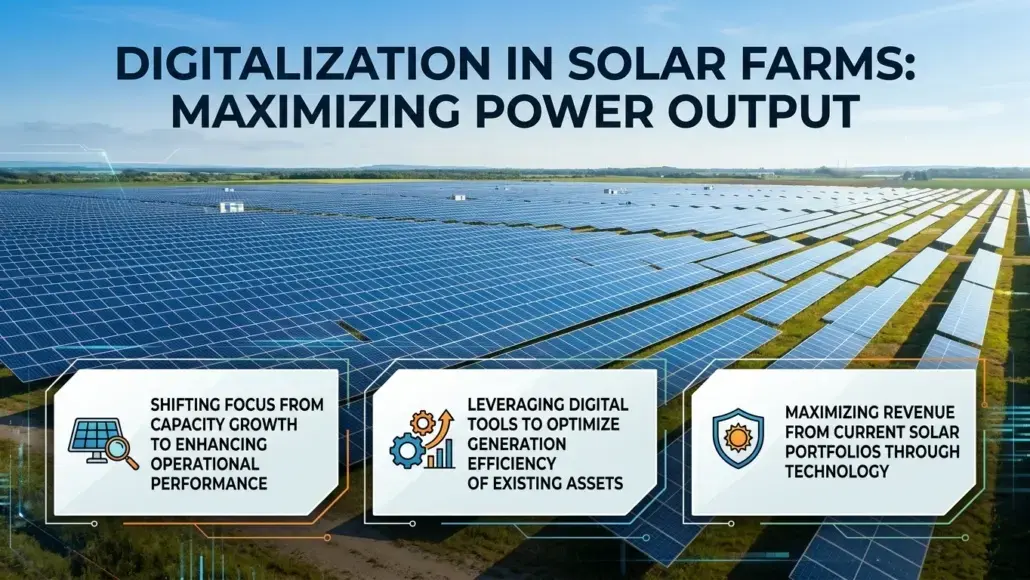

For much of the past decade, solar energy growth was largely defined by installation capacity. Developers focused on deploying more megawatts, reducing module costs, and accelerating project development. While these priorities remain important, the industry’s focus is increasingly shifting toward a different objective: maximizing performance from existing assets.
As utility-scale solar portfolios expand, operators are recognizing that generation efficiency can be just as valuable as additional capacity. This evolution is driving greater interest in digitalization in solar farms, where data-driven technologies are helping operators improve performance, reduce downtime, and optimize long-term asset value.
The conversation is no longer solely about building larger solar farms. It is increasingly about operating them more intelligently.
Data Is Becoming a Core Solar Asset
Modern solar farms generate far more than electricity. They also generate vast amounts of operational data.
Sensors, monitoring systems, weather stations, inverters, trackers, and grid connections continuously produce information that can provide insights into system performance. Historically, much of this data was underutilized, serving primarily as a tool for basic monitoring and fault detection.
Today, advances in analytics platforms and digital infrastructure are transforming data into a strategic asset. Operators are using information gathered across solar facilities to identify inefficiencies, predict equipment issues, and improve generation outcomes.
This shift is making digitalization in solar farms an increasingly important component of renewable energy operations.
Real-Time Visibility Is Changing Operations
One of the most significant benefits of digitalization is the ability to gain real-time visibility into solar farm performance.
Traditional monitoring approaches often relied on periodic inspections and reactive maintenance practices. While effective to a degree, these methods frequently identified problems only after performance had already been affected.
Modern digital platforms allow operators to continuously track system conditions and generation metrics. This provides immediate insight into equipment performance, environmental influences, and operational anomalies.
By identifying issues as they emerge, operators can respond more quickly and reduce generation losses that might otherwise go unnoticed.
Predictive Maintenance Is Reducing Downtime
Maintenance has always played a critical role in solar asset performance. However, conventional maintenance strategies often rely on fixed schedules or reactive interventions.
Digitalization is changing this model through predictive maintenance.
Using historical and real-time operational data, advanced analytics systems can identify patterns associated with potential equipment failures before they occur. This enables operators to schedule maintenance proactively rather than waiting for a component to fail.
For solar farms, reducing unplanned downtime can significantly improve generation performance and revenue stability. Predictive maintenance is therefore becoming one of the most valuable outcomes of digitalization in solar farms.
Performance Optimization Beyond Equipment Monitoring
The value of digitalization extends beyond identifying faults and maintenance requirements.
Advanced analytics platforms can evaluate how environmental conditions, operational settings, and equipment behavior interact to influence generation outcomes. This allows operators to continuously optimize system performance.
Factors such as:
- Solar irradiance
- Temperature variations
- Inverter efficiency
- Tracker positioning
- Module performance
can be analyzed collectively to improve overall generation efficiency.
This capability transforms solar farm management from a reactive process into a proactive and continuously optimized operation.
Improving Asset Economics Through Better Decisions
As the solar industry matures, financial performance is becoming increasingly dependent on operational excellence.
Even modest improvements in generation efficiency can have substantial economic implications across large utility-scale projects. A small increase in annual output can translate into meaningful revenue gains over the lifespan of an asset.
By improving visibility, reducing downtime, and optimizing performance, digitalization in solar farms helps operators extract greater value from existing infrastructure.
This aligns closely with broader industry trends emphasizing lifecycle performance and asset optimization rather than simply expanding installed capacity.
The Growing Role of Artificial Intelligence and Analytics
Artificial intelligence is becoming an increasingly important component of solar farm digitalization.
Machine learning algorithms can analyze large volumes of operational data far more efficiently than traditional methods. These systems are capable of identifying performance trends, detecting anomalies, and supporting more informed decision-making.
In addition to operational improvements, AI-driven analytics can support forecasting activities, helping operators anticipate generation patterns and better manage interactions with the grid.
As solar portfolios continue to grow, the ability to process and act upon large datasets will become an increasingly important competitive advantage.
Grid Integration Is Driving Digital Innovation
Solar generation is becoming a larger component of modern power systems, creating new challenges related to grid integration and stability.
Digital tools are helping operators manage these challenges more effectively. Real-time data allows for improved forecasting, more accurate generation planning, and better coordination with grid operators.
As renewable penetration increases, the ability to predict and manage generation variability will become increasingly important.
This positions digitalization in solar farms not only as an operational tool but also as a strategic enabler of broader energy system integration.
Challenges to Digital Transformation
Despite its advantages, digitalization is not without challenges.
Many solar operators face hurdles related to:
- Data integration across multiple platforms
- Cybersecurity considerations
- Workforce training requirements
- Legacy system compatibility
- Data management complexity
In addition, the effectiveness of digital systems depends heavily on data quality and organizational readiness.
Successful digital transformation therefore requires more than technology investment alone. It also demands changes in operational processes, workforce capabilities, and management strategies.
The Future Solar Farm Will Be Data-Driven
The future of solar energy will increasingly be shaped by operational intelligence rather than hardware improvements alone.
Module efficiency gains remain important, but the ability to optimize generation through data is emerging as an equally significant opportunity. As projects become larger and more sophisticated, digital technologies will play a central role in ensuring that solar assets operate at their highest potential.
For developers, operators, and investors, the focus is shifting toward extracting maximum value from every installed asset. In this environment, digitalization in solar farms is becoming a critical component of long-term competitiveness.
Conclusion
Solar energy has entered a phase where operational performance is becoming as important as deployment scale. As asset portfolios expand and competition intensifies, operators are seeking new ways to improve generation efficiency and strengthen project economics.
Digitalization in solar farms provides a pathway to achieve these goals through data analytics, predictive maintenance, real-time monitoring, and performance optimization. By transforming operational data into actionable intelligence, digital technologies are helping redefine how solar assets are managed and valued.
The solar farms of the future will not simply generate electricity. They will increasingly generate insights, enabling smarter decisions and better performance across the entire lifecycle of the asset.