
















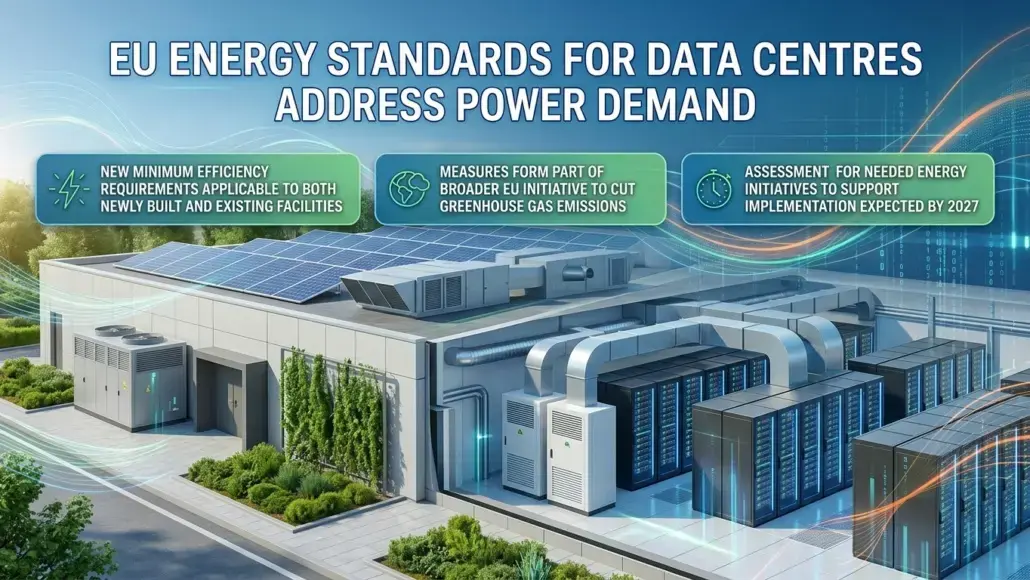

The European Union is moving ahead with new measures aimed at improving the energy performance of data centres as electricity demand from the sector continues to rise sharply. Under the bloc’s revised Energy Efficiency Directive, the European Commission is preparing minimum energy efficiency requirements for both newly built and existing facilities. A needs assessment to support the initiative is expected by 2027. The measures form part of the EU’s broader objective of cutting greenhouse gas emissions by at least 55% by 2030 compared with 1990 levels. The initiative, described as EU Energy Standards, comes as policymakers seek to address the growing energy footprint of digital infrastructure.
Alongside performance requirements, the Commission is developing a sustainability label for data centres that would require major facilities to disclose information related to areas such as water consumption and clean energy sourcing. According to officials cited by Reuters, discussions are continuing on several aspects of the framework, including the methodology for assessing facilities powered by nuclear energy. The Commission said the proposed rules are intended to strengthen incentives for improved energy efficiency and sustainability while enhancing transparency and comparability across member states through a common reporting and rating structure established under the Energy Efficiency Directive.
The Commission warned that delaying action could make future challenges more difficult to manage as the sector’s energy use continues to increase. It stated, “If not tackled at EU level now, these challenges could grow considerably and become harder to solve in the coming years, as the energy consumption of the sector is expected to increase further.” Projections indicate that data centre capacity across the EU will expand from 12 GW in 2025 to 28 gigawatts by 2030. As a result, their share of regional electricity consumption is expected to rise beyond the current level of 2.5%.
Highlighting the strategic importance of efficiency measures, the Commission said, “Energy efficiency is a central pillar of the EU’s energy and climate framework, as well as being a key policy for delivering energy savings, improving affordability, and strengthening the competitiveness and resilience of the European economy on its path to climate neutrality.” The International Energy Agency expects data centres to account for 20% of growth in electricity demand across advanced economies by 2030. The Commission is also preparing a post-2030 energy efficiency framework scheduled for publication later this year. Reuters reported that the plans form part of a wider technology package designed to expand domestic cloud and AI capabilities, reduce dependence on major technology companies, and support energy infrastructure through AI-enabled tools and permitting processes. The broader package further reinforces the role of EU Energy Standards in the bloc’s long-term digital and energy strategy.