

















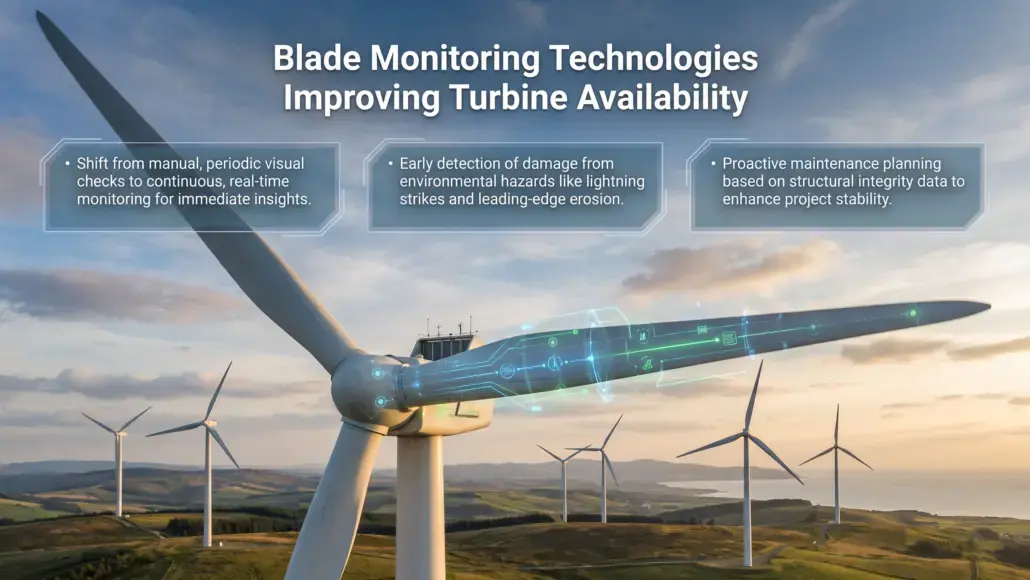

The operational stability of utility-scale wind projects is fundamentally dependent on the structural integrity and the aerodynamic performance of the turbine blades. As the industry moves toward larger rotors to capture more energy from the wind, the blades are subject to immense mechanical stresses and environmental hazards, such as lightning strikes, leading-edge erosion, and structural fatigue. In a traditional maintenance model, the health of the blades is assessed through periodic visual inspections, often requiring technicians to use drones or to climb the tower to capture images. This reactive approach can lead to significant downtime and for providing only a partial view of the blade’s condition. The implementation of blade monitoring technologies improving turbine availability is a critical evolution in the field, providing a continuous and data-driven way to safeguard the health of these vital energy assets.
Strategic asset management now involves the use of high-fidelity sensors and predictive analytics to identify the subtle signs of damage before they can lead to a catastrophic failure. Unlike visual inspections, which only detect surface issues, advanced monitoring systems can sense the internal changes in the blade’s structure, including cracks, delamination, and moisture ingress. A comprehensive suite of blade monitoring technologies improving turbine availability ensures that the utility operator can maintain a continuous power supply while reducing the overall cost of operations and maintenance (O&M). The move toward a more proactive and engineered approach to structural health is a hallmark of the modern power generation sector, where the focus is on achieving the highest possible standards of reliability.
Advanced Sensors and the Detection of Structural Anomalies
The technical foundation of modern blade monitoring lies in the integration of specialized sensors directly into the blade structure or onto its surface. These might include acoustic emission sensors, fiber-optic strain gauges, and accelerometers that track the vibration and the deformation of the blade in real-time. Blade monitoring technologies improving turbine availability utilize these data points to create a “digital twin” of the blade that reflects its current mechanical health. This capability ensures that the maintenance team can identify the subtle changes in the blade’s performance that indicate the presence of a developing flaw, even when it is not visible from the outside.
Furthermore, the use of AI-driven analytics allows for the identification of damage patterns that are invisible to the human eye. By analyzing the frequency and the amplitude of the sensor signals, the system can distinguish between normal operating noise and the distinct signature of a structural failure. This level of technical precision ensures that the turbine can be stopped for repair exactly when needed, preventing the secondary damage that occurs when a faulty blade is allowed to continue spinning under load. The focus remains on achieving the best possible balance between operational throughput and the absolute security of the wind energy components.
Improving Turbine Availability and Reducing Maintenance Costs
The primary benefit of utilizing a continuous monitoring model is the significant improvement in the overall equipment effectiveness of the wind farm. In a traditional O&M environment, a turbine might be taken out of service for several days every year for inspection, regardless of its actual condition. Blade monitoring technologies improving turbine availability address this by allowing for “condition-based” maintenance, where the work is only performed when the data indicates a clear need. This shift from a calendar-based to a data-driven approach significantly increases the annual energy production of the facility and provides a clearer return on investment for the project developer.
Furthermore, the early detection of issues such as leading-edge erosion can lead to substantial savings on repair costs for the power generation facility. If a minor surface defect is identified and treated early, it can prevent the more extensive structural damage that requires the replacement of the entire blade. The move toward more professional and standardized maintenance practices is what earns the trust of the utility companies and institutional investors, providing a secure foundation for the next generation of large-scale wind projects. The ability to manage complex maintenance requirements with professional precision is a defining characteristic of the modern energy industry, and the role of monitoring technology in supporting this transition is indisputable.
Data Integration and the Future of Wind Farm Operations
The success of any monitoring program depends on the ability to integrate the blade data with the broader wind farm management system. This requires the use of high-speed digital networks and cloud-based platforms to aggregate and analyze the information from across the entire site. Blade monitoring technologies improving turbine availability ensure that the insights from individual blades are shared with the central control room, providing the operators with the information needed for effective dispatch and planning. By identifying the turbines that are operating at suboptimal efficiency due to blade issues, the team can optimize the performance of the entire fleet.
Furthermore, the coordination of global performance benchmarks allows for the identification of emerging trends and vulnerabilities across different blade designs and environmental conditions. By sharing information on the failure modes and the success of different repair techniques, the power sector can develop more resilient blades and more effective maintenance strategies. The commitment to transparency and professional collaboration is a key factor in the long-term success of the effort to improve the productivity of the renewable energy sector. The ultimate goal is the creation of a global energy ecosystem that can deliver on the promise of sustainable and high-quality power for every community.
Future Strategic Direction of Blade Health Management
As the power generation sector continues to evolve toward a more autonomous and AI-driven model, the role of intelligent monitoring systems will only grow in importance. We are already seeing the emergence of self-diagnosing blades that can adjust their own operation to minimize the stress on a damaged area until a repair can be performed. Blade monitoring technologies improving turbine availability are at the forefront of this evolution, providing the physical and the digital platform for a more resilient and efficient energy future. The focus is no longer just on the physical structure of the turbine, but on the ability to manage the entire lifecycle of the asset with professional precision.
Looking ahead, the integration of new materials and the use of automated repair systems, such as blade-climbing robots, will further enhance the performance and the flexibility of the wind sector. These advancements will allow for the maintenance of even larger and more remote turbines, further reducing the reliance on traditional fossil fuels. The ability to manage complex maintenance requirements with the same speed and precision as a simple assembly task is a major goal for both researchers and utility operators. The ongoing commitment to technical innovation and operational excellence is what will define the success of these programs in the decades to come, providing a secure foundation for the transition to a carbon-neutral power system.
The transition toward a more connected and data-driven approach to asset protection is a defining characteristic of the modern industrial sector. By prioritizing the use of blade monitoring technologies improving turbine availability, utility operators can achieve levels of reliability and efficiency that were once considered unattainable in a purely mechanical system. The benefits of this approach extend beyond the wind farm itself, contributing to a more responsive and resilient energy infrastructure that is better equipped to handle the challenges of a global market.