







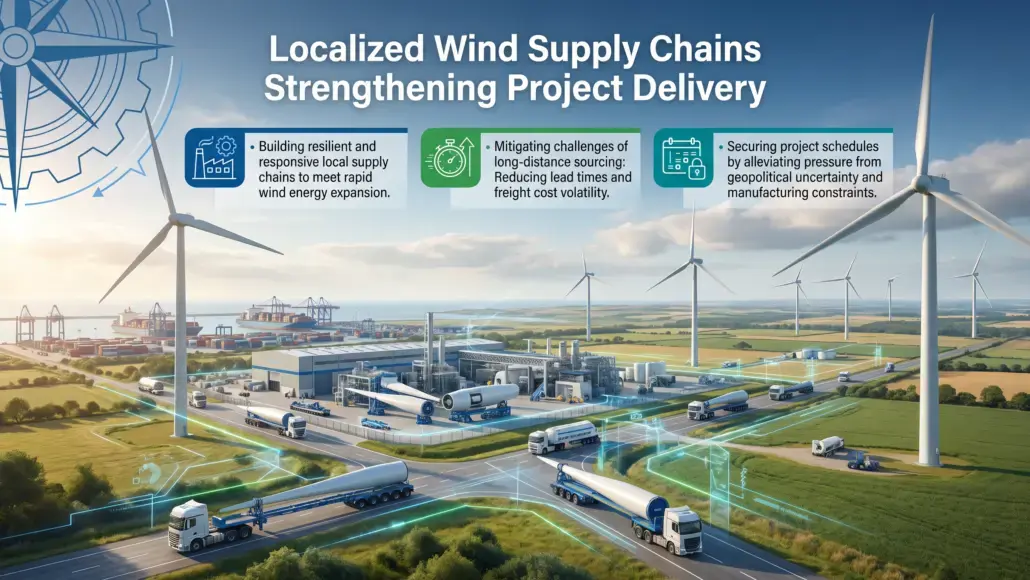

The rapid expansion of wind energy has intensified the need for supply chains that are both resilient and responsive. As turbine capacities increase and utility-scale projects become more geographically diverse, conventional procurement models built around long-distance sourcing are facing mounting challenges. Extended lead times, volatile freight costs, geopolitical uncertainty, and limited manufacturing capacity are placing greater pressure on project schedules, making supply chain resilience a strategic priority rather than an operational consideration.
Localized manufacturing and procurement are emerging as effective solutions for improving project execution while strengthening regional industrial capabilities. By producing critical wind turbine components closer to installation sites, developers can reduce transportation complexity, improve delivery reliability, and create stronger collaboration between manufacturers, suppliers, logistics providers, and project developers. This regional approach supports more predictable project timelines while enhancing operational flexibility across increasingly complex renewable energy portfolios.
The transition toward localized supply chains also reflects broader changes in the renewable energy landscape. Governments are encouraging domestic manufacturing through industrial policies, developers are seeking greater supply security, and original equipment manufacturers are expanding regional production facilities to meet growing demand. Together, these developments are reshaping how wind projects are planned, manufactured, and delivered, establishing localized supply networks as a competitive advantage for the next generation of renewable energy infrastructure.
Strengthening Supply Chain Resilience Through Regional Manufacturing
Traditional global supply chains have served the wind industry for decades by leveraging specialized manufacturing facilities concentrated in a limited number of regions. While this model enabled economies of scale during the industry’s early expansion, it has become increasingly vulnerable as project volumes and turbine dimensions continue to grow. Large rotor blades, towers, nacelles, and drivetrain components require specialized transportation, making long-distance logistics both expensive and operationally complex.
Regional manufacturing hubs are helping address these challenges by bringing production closer to deployment locations. Manufacturing blades, towers, foundations, and electrical components within regional markets significantly reduces transportation distances while improving supply chain responsiveness. Shorter logistics routes reduce dependency on congested ports, minimize customs-related delays, and simplify coordination across multiple suppliers.
Localized manufacturing also enables greater production flexibility. Manufacturers can respond more quickly to engineering modifications, customer specifications, and evolving project requirements without lengthy international shipping cycles. This responsiveness becomes particularly valuable for offshore wind projects, where installation windows are highly dependent on seasonal weather conditions and vessel availability.
Regional supplier ecosystems further strengthen resilience by diversifying procurement options. Rather than relying on a single overseas source, developers can establish relationships with multiple qualified suppliers across domestic and neighboring markets, reducing exposure to unexpected disruptions while improving continuity throughout project execution.
Accelerating Project Delivery and Schedule Certainty
Project schedules remain one of the most important performance indicators for utility-scale wind developments. Delays in component availability often create cascading impacts that extend beyond construction, affecting financing, regulatory compliance, commissioning, and commercial operation dates.
Localized supply chains improve schedule certainty by reducing transit times and enabling closer coordination between manufacturers, logistics providers, engineering teams, and installation contractors. Shorter transportation routes allow greater flexibility when managing production schedules and responding to unforeseen changes during project execution.
Improved visibility across regional supply networks also enhances planning accuracy. Digital tracking platforms provide real-time information on manufacturing progress, inventory levels, transportation status, and delivery milestones, enabling project teams to identify potential bottlenecks before they impact construction schedules. Closer collaboration between regional suppliers also facilitates faster issue resolution. Engineering adjustments, replacement components, or quality-related concerns can often be addressed within days rather than weeks, significantly reducing operational disruptions and supporting continuous project progress.
As wind projects continue increasing in scale and complexity, reducing uncertainty throughout the supply chain becomes essential for maintaining competitive project economics while meeting increasingly ambitious renewable energy deployment targets.
Economic Value Beyond Manufacturing
Localized supply chains generate benefits that extend well beyond project delivery. Establishing regional manufacturing capacity stimulates industrial investment, supports workforce development, and strengthens domestic capabilities across multiple segments of the renewable energy value chain.
Production facilities for turbine blades, towers, foundations, cables, transformers, and electrical equipment create demand for highly skilled engineering, manufacturing, logistics, and maintenance professionals. As regional supplier networks mature, supporting industries—including precision machining, advanced composites, steel fabrication, digital technologies, and specialized transportation services—also experience sustained growth.
The expansion of domestic manufacturing capabilities helps reduce dependence on imported components while improving long-term industrial competitiveness. Governments increasingly recognize localized renewable energy manufacturing as an opportunity to strengthen national energy security while supporting economic diversification and clean energy objectives.
For developers, stronger regional supply ecosystems also contribute to improved stakeholder engagement. Demonstrating local investment, employment creation, and industrial development often strengthens relationships with policymakers, regulators, communities, and investors, supporting smoother project approvals and broader public acceptance. Localized procurement strategies therefore create value across economic, operational, and strategic dimensions, making them increasingly attractive for long-term renewable energy investment.
Optimizing Logistics for Large Wind Components
Transporting modern wind turbine components presents unique logistical challenges. Rotor blades frequently exceed 100 meters in length, while towers, nacelles, and foundation structures require specialized heavy-lift equipment, purpose-built vessels, and carefully coordinated transportation routes.
Reducing transportation distances through localized manufacturing significantly simplifies these operations. Regional production facilities minimize the number of handling stages, reducing the likelihood of component damage while improving delivery reliability. Closer proximity between manufacturing plants, ports, marshalling yards, and installation sites enables better coordination across logistics providers. This integrated approach improves scheduling efficiency, reduces idle time for installation vessels and heavy-lift equipment, and minimizes costly delays during project execution.
Localized logistics also contribute to environmental sustainability by lowering transportation-related emissions. Shorter freight routes reduce fuel consumption across road, rail, and maritime transport while supporting broader decarbonization objectives throughout the renewable energy supply chain.As environmental performance becomes an increasingly important procurement criterion, optimizing logistics through regional manufacturing provides both operational and sustainability advantages for utility-scale wind developments.
Building Collaborative Regional Ecosystems
The long-term success of localized wind supply chains depends on strong collaboration across the entire value chain. Developers, turbine manufacturers, component suppliers, logistics providers, port operators, utilities, and policymakers all play an important role in creating resilient regional manufacturing ecosystems. Early engagement between stakeholders helps align production schedules, infrastructure investments, workforce development, and procurement strategies, reducing project risks and improving execution efficiency.
Digital technologies are further strengthening these regional ecosystems by improving supply chain visibility. Cloud-based planning platforms, digital twins, predictive analytics, and real-time inventory management allow stakeholders to monitor component production, logistics, and installation progress throughout the project lifecycle. Greater transparency enables proactive decision-making, allowing potential disruptions to be identified and resolved before they affect construction schedules.
Investment in workforce development remains equally important. Expanding domestic manufacturing capacity requires engineers, technicians, quality specialists, logistics professionals, and advanced manufacturing experts with industry-specific skills. Training partnerships between manufacturers, educational institutions, and government agencies will play a central role in building the skilled workforce needed to support continued growth across the wind energy sector.
The Future of Localized Wind Supply Chains
As global wind installations continue to accelerate, localized supply chains will become an increasingly important driver of project performance and long-term industry resilience. Growing turbine sizes, expanding offshore developments, and evolving regulatory frameworks are encouraging developers to build stronger regional manufacturing networks capable of supporting large-scale renewable energy deployment.
Advances in automation, digital manufacturing, artificial intelligence, and advanced materials are expected to further improve production efficiency while enhancing flexibility across regional supply networks. These innovations will enable manufacturers to respond more rapidly to changing project requirements, reduce production bottlenecks, and improve quality assurance across critical wind turbine components.
Localized supply chains also position the industry to better manage future market uncertainties by reducing reliance on distant manufacturing hubs and creating diversified procurement strategies. As governments continue promoting domestic clean energy manufacturing, regional industrial ecosystems will become increasingly important in supporting energy security, economic development, and decarbonization objectives.
Conclusion
Localized supply chains are reshaping how wind energy projects are planned, manufactured, and delivered. By bringing component production closer to installation sites, developers can improve schedule certainty, reduce logistics complexity, strengthen supply chain resilience, and support more efficient project execution. At the same time, regional manufacturing creates broader economic benefits through workforce development, industrial investment, and stronger domestic supply capabilities.
As wind energy continues expanding to meet global decarbonization goals, resilient regional supply networks will become a defining characteristic of successful project delivery. Organizations that invest in localized manufacturing, digital supply chain visibility, and strategic industry partnerships will be better positioned to navigate market uncertainties while delivering reliable, cost-effective, and scalable renewable energy infrastructure. Localized wind supply chains strengthening project delivery is no longer simply a procurement strategy—it has become a fundamental enabler of sustainable growth and long-term competitiveness across the global wind energy industry.