
























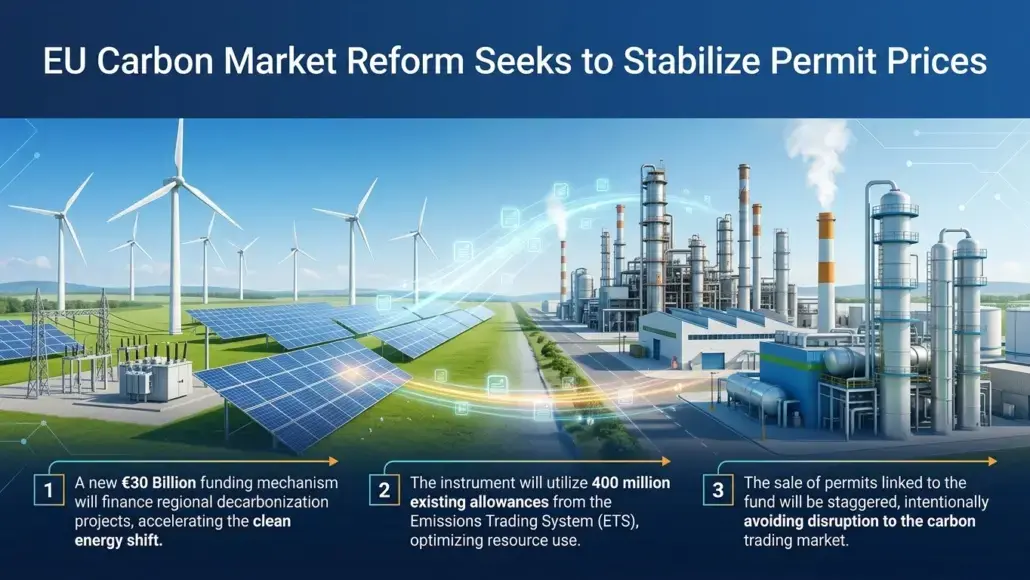

The European Union is working on the design of a new funding mechanism valued at about €30 billion to support its clean-energy transition while avoiding disruption to the bloc’s carbon trading system. The proposed instrument, based on 400 million existing allowances from the Emissions Trading System (ETS), is intended to finance decarbonization projects across the region. According to people familiar with the plans, the European Commission intends to stagger the sale of permits linked to the initiative in order to prevent a large influx of allowances from affecting market stability. The proposal follows a commitment made by European Commission President Ursula von der Leyen in March to create a new financing tool using existing ETS resources.
The initiative comes as climate and energy policy remain central priorities for the EU. Policymakers are seeking to maintain ambitious emissions-reduction targets while addressing concerns from governments and energy-intensive industries over the financial burden associated with carbon costs. The issue has gained additional attention amid worries that Europe is losing competitiveness relative to China and the United States. Brussels estimates that carbon costs contribute around 11% of electricity prices on average, although the impact varies across member states. Countries such as Poland, where carbon-related costs account for a significantly larger share of power bills, have advocated measures that could ease the economic challenges of the energy transition. The proposed EU Carbon Market initiative is being structured with these concerns in mind.
Further details are expected on July 15 when the European Commission presents its review of the ETS, the bloc’s flagship cap-and-trade emissions framework. People familiar with the matter said allowances for the new mechanism will be drawn from the ETS reserve for new entrants as well as an existing pool of free permits that can be allocated to companies undertaking low-carbon investments. The commission was not immediately available for comment.
The new tool is expected to form part of the EU Industrial Decarbonization Bank, a broader financing framework that could mobilize €100 billion for energy-transition investments. Once published, the ETS review will move to discussions involving the European Parliament and EU member states in the Council. Both institutions will have the opportunity to propose amendments during the legislative process, which can extend for up to two years. Among the options being considered is an accelerated approach to permit sales under the booster mechanism, a move that could help advance industrial decarbonization efforts. The outcome of the review is likely to play an important role in shaping the future direction of the EU Carbon Market.