

































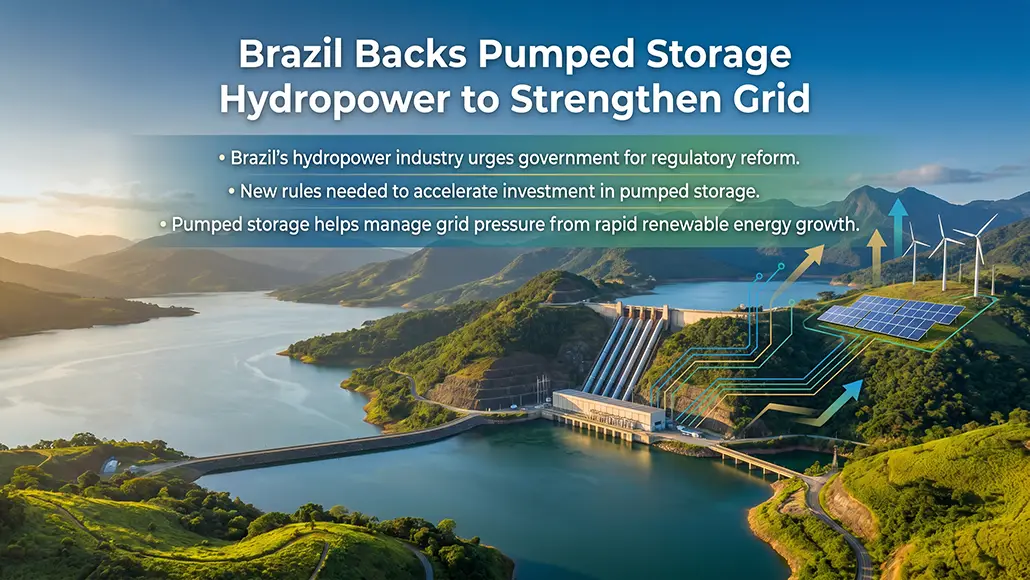

Brazil’s hydropower industry is urging the government to introduce regulatory changes that would accelerate investment in Pumped Storage Hydropower, as the country’s electricity network faces increasing pressure from the rapid expansion of renewable energy generation. The call was made during a high-level roundtable organised by the International Hydropower Association (IHA) in Brasília, where government representatives, regulators and energy companies gathered to examine the role of large-scale electricity storage in the nation’s energy transition.
The discussion comes as Brazil continues to rely heavily on renewable power, with around 90% of its electricity generated from renewable sources following decades of investment in hydropower infrastructure. While the growth of wind and solar capacity has strengthened the country’s clean energy profile, it has also introduced new operational challenges for the power system. These include rising levels of renewable energy curtailment, greater risks to grid stability and an increasing requirement for long-duration storage solutions capable of balancing supply and demand over extended periods. Recent estimates indicate that losses associated with renewable curtailment reached $1.1bn in 2025.
Industry representatives highlighted Pumped Storage Hydropower as an established technology capable of addressing these challenges. They noted that, unlike battery storage systems, pumped storage facilities do not depend on critical minerals and can deliver large-scale storage capacity while also providing important grid balancing services. The sector further pointed to the long operational lifespan of such facilities, which can function for more than 100 years while requiring relatively limited maintenance.
At the Brasília roundtable, industry participants presented five recommendations aimed at creating a more favourable investment environment. The proposals include establishing a clear regulatory framework for pumped storage developments, creating long-term auction pipelines, introducing 30-year capacity contracts, streamlining environmental licensing procedures and improving coordination among government agencies. Sector leaders argue that implementing these measures would help unlock large-scale storage investment and strengthen the resilience of Brazil’s electricity system as renewable generation continues to expand.