























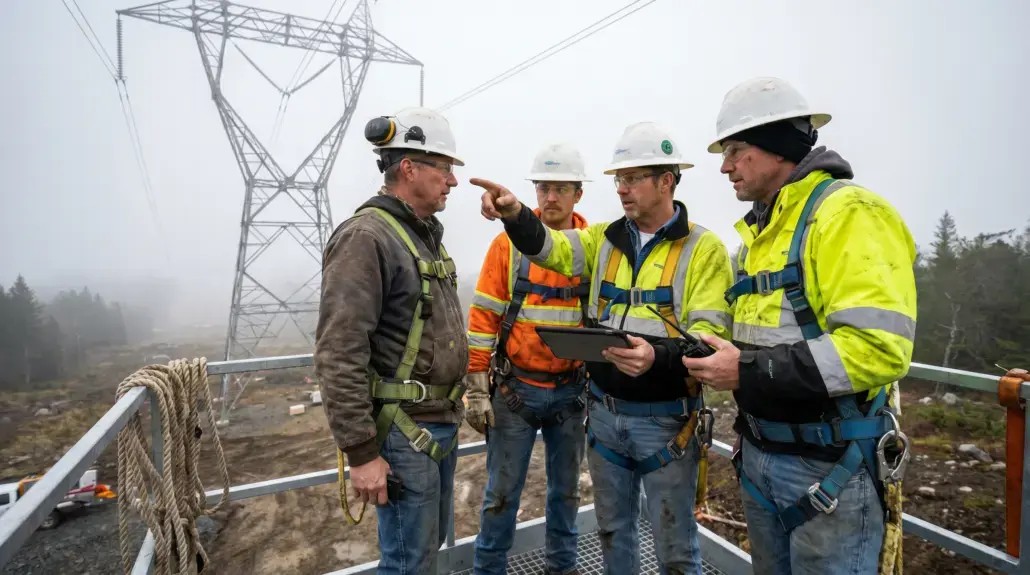

In the high-stakes world of electrical transmission, where workers operate at the intersection of extreme heights and lethal voltages, the most powerful safety tool is not a piece of equipment, but the synergy of the team itself. While individual skill and technical proficiency are essential, it is workforce collaboration transmission safety that truly defines the safety profile of a project. Transmission work is inherently a “team sport” that requires a high degree of coordination between diverse groups from engineers and system operators to lineworkers and vegetation management crews. When these groups work in silos, the risk of miscommunication and error rises; when they collaborate effectively, they create a formidable and redundant safety net that protects every person on the job.
Enhancing safety through collaboration is about more than just “getting along.” it involves the intentional design of communication channels and the fostering of a culture where information flows freely across all levels of the organization. In the context of the power sector, this means breaking down the traditional hierarchies that can sometimes stifle the voice of the worker. By prioritizing workforce engagement safety, utilities can tap into the collective intelligence of their teams, identifying hazards and developing solutions that no single individual could have conceived alone. This collaborative spirit is the ultimate driver of grid operations teamwork and a cornerstone of a mature safety culture.
Communication as the Lifeblood of Collaborative Safety
At the heart of workforce collaboration transmission safety is effective communication. In a high-voltage environment, a misunderstanding about a “Switching Order” or a “Clearance” can have immediate and catastrophic consequences. Therefore, safety communication power sector strategies must be built on a foundation of clarity, brevity, and verification. This is why the industry relies so heavily on “Three-Way Communication,” where a command is given, repeated back by the receiver, and then confirmed by the sender. This simple but powerful collaborative tool ensures that there is a “shared mental model” of the task at hand.
However, collaboration goes beyond formal protocols. It also involves the informal “Safety Conversations” that happen every day on the jobsite. This includes the ability of a junior worker to question a senior foreman if they see something that doesn’t look right. Fostering this level of psychological safety where workers feel safe to speak up without fear of ridicule or reprisal is a hallmark of effective workforce collaboration transmission safety. When every member of the team knows that they are expected to be a “safety observer” for their colleagues, the organization gains a massive increase in its hazard-detection capability.
Inter-Disciplinary Coordination and the Integrated Team
Transmission projects are increasingly complex, often involving multiple disciplines working in close proximity. A single jobsite might include civil contractors, electrical crews, environmental monitors, and traffic control personnel. Effective transmission workforce coordination requires that these diverse groups operate as a single, integrated team. This begins with joint planning sessions and “Multi-Disciplinary Tailboards” where each group shares their scope of work and identifies any potential “clashes” or shared hazards. For example, a civil crew needs to know exactly where the electrical crew is grounding their equipment to avoid a step-potential hazard during excavation.
This level of team collaboration safety is particularly vital during the “Handover” phases of a project. When one crew finishes their shift and another takes over, the transfer of information is a high-risk moment. Collaborative frameworks ensure that these handovers are structured and thorough, covering not just what has been completed, but the current status of the equipment and any lingering hazards. By treating the project as a continuous flow of shared responsibility, rather than a series of disconnected tasks, utilities can maintain a high level of safety performance even across long durations and complex organizational boundaries.
The Role of Technology in Fostering Collaboration
Digital tools are playing an increasingly important role in workforce collaboration transmission safety. We are seeing the adoption of shared “Safety Dashboards” and mobile apps that allow workers to share photos of hazards and “Good Catches” in real-time with their entire team. This digital transparency ensures that a hazard identified by one crew in the morning is known to all crews by the afternoon. Furthermore, the use of collaborative design tools such as Building Information Modeling (BIM) allows teams to “walk through” a project in a virtual environment before construction begins.
This virtual collaboration allows for the identification of safety issues such as inadequate clearance for a bucket truck or a lack of safe anchor points for fall protection during the design phase, where they are much easier and cheaper to fix. By bringing together engineers, safety professionals, and field workers in a virtual space, utilities can leverage the “Practical Wisdom” of the field to improve the “Theoretical Safety” of the design. This synergy is a powerful example of how workforce collaboration transmission safety can be integrated into the very DNA of a project, leading to safer and more efficient outcomes.
Fostering Engagement through Safety Committees and Councils
One of the most effective ways to drive workforce collaboration transmission safety is through the establishment of joint management-worker safety committees. These groups provide a formal forum for workers to contribute to the development of safety policies, the selection of new PPE, and the review of incident investigations. By giving workers a seat at the table, utilities demonstrate that they value the input of those who are most exposed to the hazards. This level of workforce engagement safety leads to more practical and “buy-able” safety initiatives that are more likely to be followed in the field.
Furthermore, these committees serve as a “Force Multiplier” for the safety message. When a safety initiative is championed by a respected peer rather than a manager, it carries much more weight. Collaborative safety councils also provide an opportunity for “Cross-Pollination” of ideas between different regions or departments. A safety innovation developed by a crew in one state can be shared and adopted across the entire enterprise. This culture of “Continuous Learning and Sharing” is what allows for the constant refinement of grid operations teamwork and the overall safety strategy.
Conclusion: The Enduring Power of the Human Connection
As we move toward a future of increased automation and remote monitoring, the importance of workforce collaboration transmission safety remains undiminished. While robots and AI can handle many high-risk tasks, they cannot replace the intuition, judgment, and mutual care that human workers provide for each other. The strongest safety system in the world is a team of workers who are connected by a shared mission and a genuine concern for each other’s well-being. By investing in the “Social Infrastructure” of safety the relationships, communication, and collaboration we are building a grid that is not only powerful but also profoundly humane.
In conclusion, enhancing safety through collaboration is a journey of transformation from “My Safety” to “Our Safety.” It requires a commitment to transparency, an embrace of diversity, and a relentless focus on the power of the team. By perfecting our transmission workforce coordination and fostering a culture of deep engagement, we can ensure that every worker returns home safely, every time. The future of energy is built on collaboration, and by working together, we can overcome any challenge and navigate any hazard. The human connection is the ultimate insulator against risk, proving that we are truly stronger, and safer, together.