


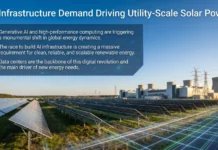





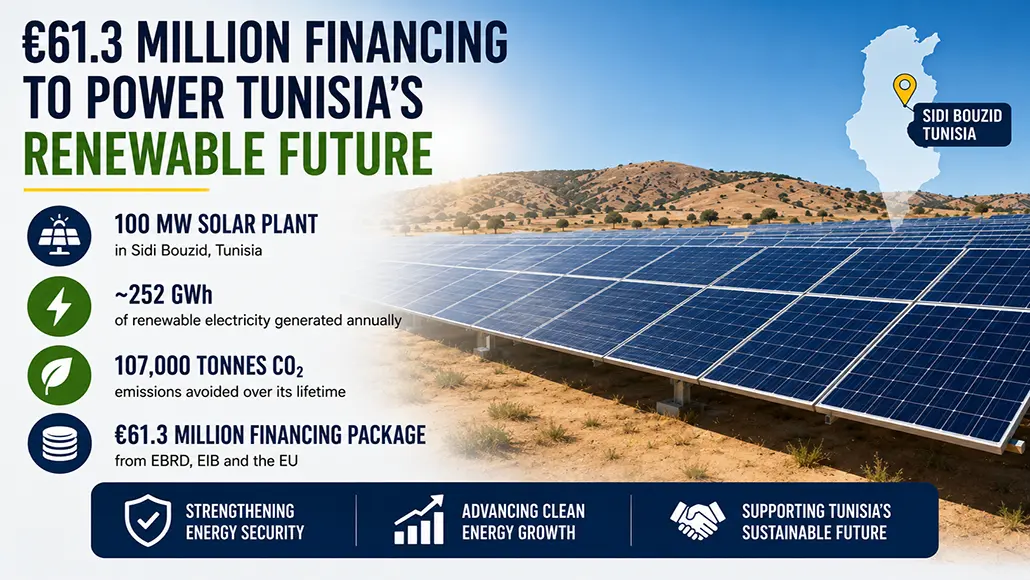

A €61.3 million financing package from the European Bank for Reconstruction and Development (EBRD), the European Investment Bank (EIB) and the European Union will support the development of a new 100 MW solar photovoltaic plant in Tunisia’s Sidi Bouzid region. The project, being delivered through the Scatec-Aeolus joint venture and developed by Scatec Khobna PV Power, is intended to strengthen Tunisia’s energy security, broaden its energy mix and reduce reliance on natural gas imports. The Tunisia Solar Project Expansion is expected to generate around 252 GWh of renewable electricity each year once operational, while cutting annual carbon dioxide emissions by an estimated 107,000 tonnes over its lifetime. The project also advances private-sector involvement in Tunisia’s energy sector through a large-scale privately financed renewable energy development.
The financing structure includes support from the European Fund for Sustainable Development Plus (EFSD+), with the EBRD benefiting from a first-loss guarantee and the EIB receiving backing through the Connectivity Component of the EFSD+ Open Architecture Guarantee Agreement. In addition, €5.5 million in grant funding from the EU’s Neighbourhood Investment Platform (NIP) will help finance associated transmission infrastructure. This contribution forms part of a wider €35.8 million EU Global Gateway package aimed at accelerating renewable energy investment in Tunisia. The development is linked to Tunisia’s 1.7 GW renewable energy concession programme launched in 2022, which supports the country’s goal of sourcing 35 per cent of its energy from renewables by 2030.
Harry Boyd-Carpenter, Managing Director of the EBRD’s Sustainable Infrastructure Group, said: “We are delighted to be partnering once again with Scatec and Aeolus, two of the most dynamic and rigorous investors in this sector, to finance this important project. This is also a great Team Europe effort, where we are partnering with our co-lender, the EIB, and benefiting from generous donor support from the European Union to support the development of clean and very low-cost energy in Tunisia. These benefits are even more important in the current circumstances, where we are seeing challenges to energy security. The success of this project is also a tribute to the Tunisian government’s determined efforts to push forward with an ambitious energy reform and transition agenda.” EIB Vice-President Ioannis Tsakiris stated: “This project marks an important step in supporting Tunisia’s efforts to deliver affordable, reliable and sustainable energy to its citizens, in line with the country’s national objectives. Through EIB Global and the Team Europe approach, we are working with our partners to scale up renewable energy investment and strengthen the infrastructure needed for a more secure and resilient energy system.” Giuseppe Perrone, EU Ambassador to Tunisia, added: “In the spirit of the EU-Tunisia memorandum of understanding on energy of June 2024, the European Union is taking concrete action in the renewable energy sector to ensure Tunisia’s energy security and decarbonisation, in line with the T MED programme launched by Commissioner Suica on 9 June 2026 during European Sustainable Energy Week.”
Alongside financing, the project will receive technical cooperation support from the EBRD’s Shareholder Special Fund. Programmes will focus on workforce capacity building in the Sidi Bouzid and Gabès regions to address emerging skills needs in Tunisia’s energy sector. Community initiatives in Khobna and Mezzouna will also promote awareness of gender-based violence and harassment (GBVH) and care-related benefits, with the aim of encouraging greater female participation in the workforce. Established in June 2021, EFSD+ provides grants and guarantees to mobilise investment across partner countries and has a global guarantee capacity of €39.8 billion for the 2021–2027 period, including €22.5 billion dedicated to enlargement and neighbourhood regions. Since 2012, the EBRD has invested more than €3 billion in Tunisia through 90 projects while supporting nearly 2,000 local small and medium-sized enterprises through EU-funded technical assistance programmes. The Tunisia Solar Project Expansion further strengthens cooperation between European institutions and Tunisia in advancing renewable energy and decarbonisation objectives.