



























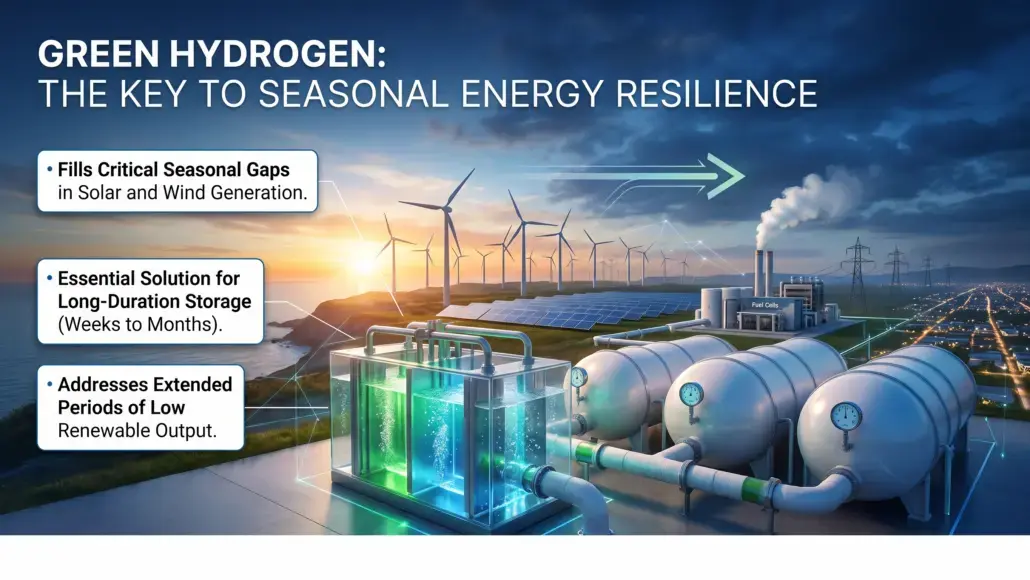

National energy departments are prioritizing the development of green hydrogen supporting long-duration renewable energy storage to address the critical seasonal gaps in solar and wind generation. While lithium-ion batteries have proven effective for short-duration frequency regulation and daily peak shifting, they remain economically and physically impractical for storing energy across weeks or months. During periods of extended low renewable generation, often referred to as dunkelflaute in Europe, the power grid requires a high-density energy carrier that can be stored at scale without significant self-discharge losses. Green hydrogen, produced via water electrolysis using surplus renewable electricity, offers a versatile solution by decoupling energy production from consumption in both time and space. This chemical storage medium can be compressed and injected into massive geological formations or converted into liquid carriers, providing the strategic reserves necessary to ensure energy security in a weather-dependent power system. The ability to store terawatt-hours of energy in the form of hydrogen molecules is increasingly viewed as the lynchpin of a resilient net-zero electricity network.
Geological Storage Solutions for Gigawatt Scale Reserves
The primary mechanism for achieving green hydrogen supporting long-duration renewable energy storage at the required scale involves the utilization of underground geological formations, specifically salt caverns and depleted gas fields. Salt caverns are particularly advantageous due to their inherent gas tightness and high operational flexibility, allowing for rapid injection and withdrawal cycles. These massive structures, which can be larger than the Eiffel Tower, are created through a process called solution mining, where water is used to dissolve salt deposits deep underground. Once developed, a single cavern can store thousands of tons of hydrogen, representing hundreds of gigawatt-hours of potential electricity generation. Unlike battery systems that suffer from degradation over thousands of cycles, geological hydrogen storage is stable over decades, with minimal loss of the stored energy. This makes it the ideal candidate for seasonal balancing, where energy harvested during a windy spring can be deployed during a calm winter. The development of these storage hubs is already underway in regions with favorable geology, such as the Gulf Coast of the United States and Northern Europe, where they are being integrated into regional power generation clusters to provide a reliable backstop for the grid.
Comparative Analysis of Chemical Carriers and LOHC
Beyond gaseous storage in caverns, the industry is exploring various chemical carriers to facilitate green hydrogen supporting long-duration renewable energy storage in regions lacking suitable geology. Liquid Organic Hydrogen Carriers (LOHC) and ammonia are two prominent technologies that allow for the high-density storage and transport of hydrogen using existing industrial infrastructure. LOHC systems involve the chemical bonding of hydrogen to a stable organic liquid, which can then be stored in standard atmospheric tanks for indefinite periods. This approach is particularly attractive because the carrier remains in a liquid state across a wide range of temperatures, eliminating the need for energy-intensive cryogenic cooling. Ammonia, on the other hand, is already a globally traded commodity with a well-established supply chain and high volumetric energy density. By synthesizing ammonia from green hydrogen and atmospheric nitrogen, power generators can create a fuel that is easy to store and transport over long distances. While both technologies incur energy losses during the conversion and reconversion processes, their ability to provide stable, long-term storage makes them essential components of the broader energy storage portfolio, especially for islanded grids or densely populated regions where large scale geological storage is not an option.
Strategic Energy Security and Grid Resilience
The deployment of green hydrogen supporting long-duration renewable energy storage is as much a matter of national energy security as it is a technical requirement for decarbonization. As nations move away from coal and natural gas, they lose the inherent energy storage provided by stockpiles of fossil fuels. Green hydrogen allows countries to rebuild these strategic reserves using domestic renewable resources, reducing their dependence on imported energy and protecting against global supply chain disruptions. In a future power generation environment dominated by renewables, the ability to maintain a several-week supply of energy is critical for managing extreme weather events that can simultaneous suppress solar and wind output across entire continents. Additionally, hydrogen storage systems provide a form of systemic resilience by offering a non-electric pathway for energy distribution. If the transmission network is damaged or overloaded, stored hydrogen can be converted back to electricity locally or used directly in industrial processes, providing a multi-layered defense against widespread power failures. The integration of these storage assets into national emergency planning reflects their growing importance as the foundation of a stable and sovereign energy system.
Economic Drivers and Policy Support Mechanisms
The economic case for green hydrogen supporting long-duration renewable energy storage is evolving as carbon pricing and renewable penetration rates continue to rise. Currently, the high capital expenditure associated with electrolyzers and storage infrastructure remains a barrier, but this is being addressed through innovative policy support mechanisms. Governments are introducing contracts for difference, tax credits, and direct subsidies to bridge the cost gap and encourage the early adoption of long-duration storage technologies. Additionally, as the share of curtailed renewable energy increases, the opportunity cost of not producing hydrogen also grows. By capturing energy that would otherwise be wasted, hydrogen storage systems can improve the overall economic efficiency of the power sector. The development of dedicated hydrogen pipelines and the repurposing of existing gas networks will further reduce the cost of moving stored energy from production sites to consumption centers. As these markets mature, the value of long-term storage will be increasingly recognized through specialized capacity payments and strategic reserve contracts, providing the long-term revenue certainty needed to attract institutional investors to the sector.
Technical Challenges in Reconversion and Efficiency
While the storage of hydrogen is technically mature, the overall round-trip efficiency of green hydrogen supporting long-duration renewable energy storage remains a focus of ongoing research and development. The process of electrolysis, compression, storage, and subsequent reconversion to electricity via fuel cells or hydrogen turbines currently results in energy losses that can exceed 60 percent. Improving this efficiency is critical for reducing the levelized cost of storage and maximizing the utilization of renewable resources. Advances in high-temperature electrolysis and integrated thermal management systems are showing promise in capturing waste heat from the conversion processes and repurposing it for industrial or district heating applications. Additionally, the development of high-efficiency hydrogen-to-power technologies, such as advanced combined cycle turbines, is essential for reclaiming the maximum amount of energy from the stored hydrogen. The industry is also investigating hybrid storage systems that combine short-duration batteries with long-duration hydrogen, allowing for the optimization of the discharge cycle based on real-time market needs and grid conditions. By addressing these efficiency challenges through systemic integration and technological innovation, the power generation sector can ensure that green hydrogen becomes a cost-effective and indispensable pillar of the global energy transition.
Integration with Multi-Vector Energy Systems
The ultimate value of green hydrogen supporting long-duration renewable energy storage lies in its ability to facilitate the integration of multi-vector energy systems. Hydrogen is unique in its capacity to serve as a bridge between the electricity, heating, and industrial sectors, allowing for the cross-sectoral optimization of energy resources. For power generators, this means that excess renewable electricity can be stored as hydrogen and then deployed wherever the value is highest at any given moment. During a cold winter week, the stored hydrogen might be used for district heating, while during a peak electricity demand period, it could be fed into a turbine to support the grid. This flexibility enhances the overall resilience of the energy system and provides multiple pathways for the decarbonization of hard-to-abate sectors. The creation of regional hydrogen hubs, where production, storage, and consumption are co-located, is the most efficient way to realize these benefits. These hubs act as energy clearinghouses, balancing the variability of renewables with the constant demands of industry and the fluctuating needs of the power grid. By treating hydrogen as a central energy vector, the power generation sector can move beyond the limitations of purely electric storage and build a truly integrated and sustainable energy future.
Digital Management and Optimization of Strategic Reserves
The effective deployment of green hydrogen supporting long-duration renewable energy storage requires a sophisticated digital layer to manage the complexities of seasonal forecasting and market optimization. Advanced predictive analytics are now being employed to model weather patterns months in advance, allowing grid operators to determine the optimal timing for hydrogen injection and withdrawal. These AI-driven platforms integrate data from wind speeds, solar irradiance, and historical demand profiles to create a dynamic storage strategy that maximizes both grid stability and economic return. By simulating thousands of potential scenarios, these tools help to ensure that hydrogen reserves are sufficient to handle even the most extreme low-probability weather events. Additionally, blockchain technology is being explored to provide a transparent and immutable record of the green credentials of the stored hydrogen, ensuring that the environmental value of the energy is preserved throughout the storage cycle. This digital oversight is essential for maintaining the integrity of the energy system and providing the data-driven insights needed to manage a complex, decentralized network of storage assets. As the volume of stored hydrogen grows, the ability to coordinate these reserves across national borders will become increasingly important, requiring a high degree of digital interoperability between different grid operators and storage providers. By combining physical storage with digital intelligence, the power generation sector can create a highly responsive and reliable system that is capable of meeting the demands of a modern, decarbonized society.