
































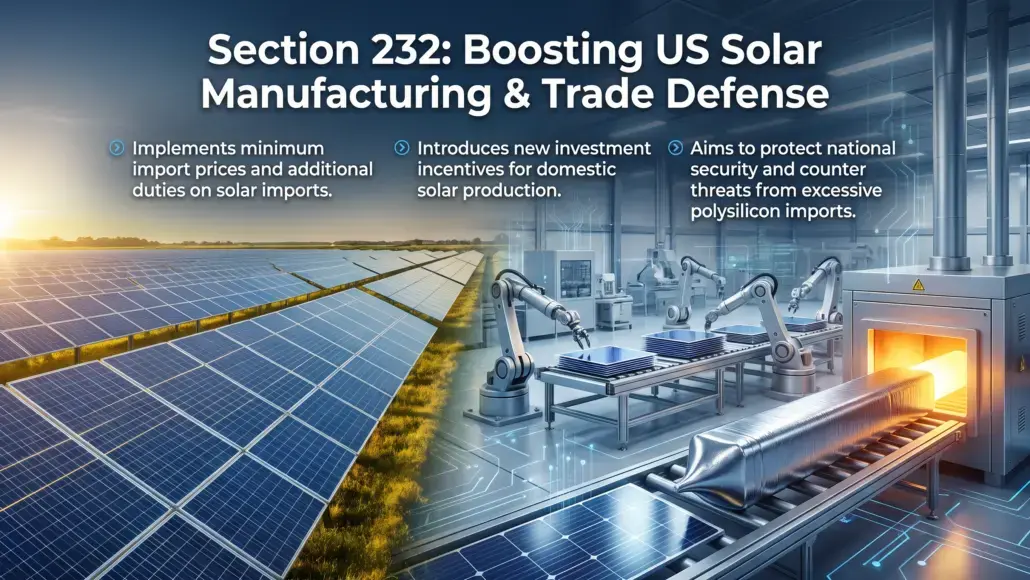

The United States has adopted a comprehensive suite of trade measures for the solar sector, including minimum import prices (MIP), additional ad valorem duties, and new investment incentives for domestic production. President Trump signed the proclamation on August 6, 2026, following a U.S. Department of Commerce investigation conducted under Section 232 of the Trade Expansion Act of 1962. The investigation concluded that current levels of polysilicon imports and their derivatives threaten to impair U.S. national security, necessitated the implementation of more stringent polysilicon import regulations. These measures are designed to safeguard the domestic supply chain and encourage the onshoring of critical solar infrastructure.
Effective December 4, 2026, the MIP program establishes mandatory pricing floors for goods entered for consumption or withdrawn from a warehouse. The proclamation sets the MIP for raw polysilicon at $21 per kilogram, while polysilicon ingots and wafers are set at $100 per kilogram. Downstream solar components are also covered, with solar cells required to meet a minimum price of $0.22 per watt and solar modules set at $0.38 per watt. Under these polysilicon import regulations, importers must provide documentation certifying that the first arm’s-length U.S. sale occurs at or above the relevant MIP. Failure to provide such documentation will result in a specific tariff equal to the applicable MIP, while entered values below the threshold will trigger a tariff equal to the price difference.
Ad Valorem Duties and International Alignment
In conjunction with the pricing floors, the proclamation imposes an additional 15% ad valorem duty on imports of polysilicon ingots and specified derivatives starting December 4, 2026. This duty generally applies in addition to existing taxes, fees, and charges. However, the proclamation includes specific provisions for key trading partners to ensure total duty rates remain aligned with strategic objectives. For imports originating from Japan, Korea, Taiwan, Switzerland, Liechtenstein, or European Union member countries, the combined Section 232 tariff and the applicable Column 1 duty rate will equal 15%. Imports from the United Kingdom will be subject to a 10% additional duty. The Secretary of Commerce maintains the authority to adjust MIPs periodically to reflect nondistorted market conditions and fair market values.
Onshoring Incentives and Investment Programs
To support the growth of a domestic manufacturing base, the proclamation authorizes the Secretary of Commerce to establish an investment incentive program. This program is open to companies producing raw polysilicon, ingots, wafers, and solar cells within the United States. Participating firms must submit an onshoring plan that includes a commitment to build, refurbish, or expand domestic facilities, with construction mandated to begin by January 20, 2029. If a plan is approved, the company may be permitted to import necessary production equipment and covered products without paying the newly established Section 232 duties.
The volume of duty-free imports permitted under this program will be commensurate with the scale of the company’s committed investment. These benefits are strictly tied to the facility’s construction period and remain contingent on meeting progress milestones under the approved plan. The Department of Commerce will provide continuous monitoring and enforcement to ensure that the incentives directly contribute to the expansion of U.S. polysilicon production capacity. This dual approach of protective trade barriers and aggressive investment incentives aims to decouple the U.S. solar industry from volatile global markets while reinforcing the national security of the energy transition.