




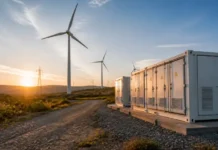











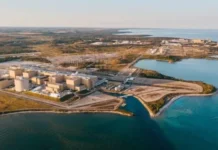










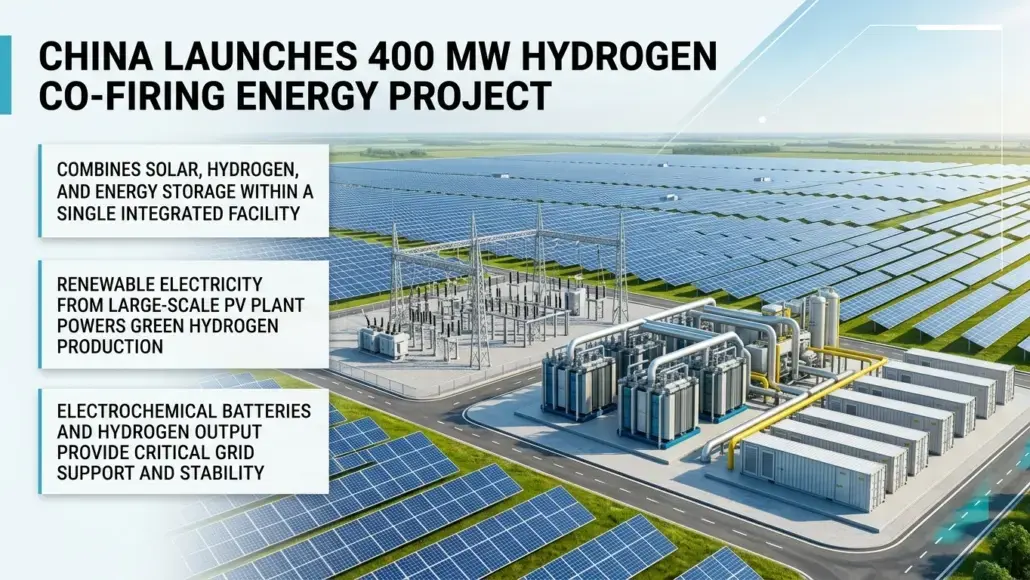

China has completed construction of its largest integrated Hydrogen Co-Firing project in Jiangsu Province, combining photovoltaic generation, hydrogen production and energy storage within a single facility. The development includes 400 MW of photovoltaic capacity, a newly built 220 kV onshore booster station, a hydrogen production unit capable of generating 1,500 standard cubic metres per hour, and an electrochemical energy storage station. The project marks a significant step in the country’s efforts to integrate renewable energy with existing power generation infrastructure.
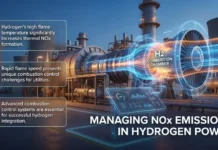
A key achievement of the facility is the successful implementation of two technologies for the first time: 50% green hydrogen co-firing and 100% pure hydrogen combustion. The system enables hydrogen and pulverised coal to be fully blended and burned inside the boiler, allowing a 50% heat input ratio from hydrogen in a 40 MW coal-fired boiler. According to project information, this represents a world-first application at this scale. The technology has the potential to cut coal consumption and carbon emissions by as much as 50% while also reducing nitrogen oxide (NOx) emissions. The presence of onsite solar generation and energy storage further supports the production and use of green hydrogen when required.
The completion follows a large-capacity pilot-scale hydrogen-coal co-firing test carried out on June 7 by Yantai Longyuan Power Technology, a subsidiary of CHN Energy Technology & Environment Limited. The test took place at the company’s 40 MW Boiler Clean Combustion Engineering Laboratory and demonstrated the operation of a fully self-developed low-NOx burner designed specifically for hydrogen-coal co-firing applications. The project also incorporates a comprehensive safety protection system covering the entire process, from hydrogen delivery through to combustion inside the furnace.
Green hydrogen used in the project is produced using electricity generated from renewable sources such as solar and wind power. Because its combustion releases only water, developers describe it as a zero-carbon fuel. They believe the Hydrogen Co-Firing technology provides a practical pathway for reducing emissions from existing coal-fired power plants while supporting the broader transition toward greener and lower-carbon power generation. The project is also expected to encourage closer integration between coal power assets and renewable energy resources.