




















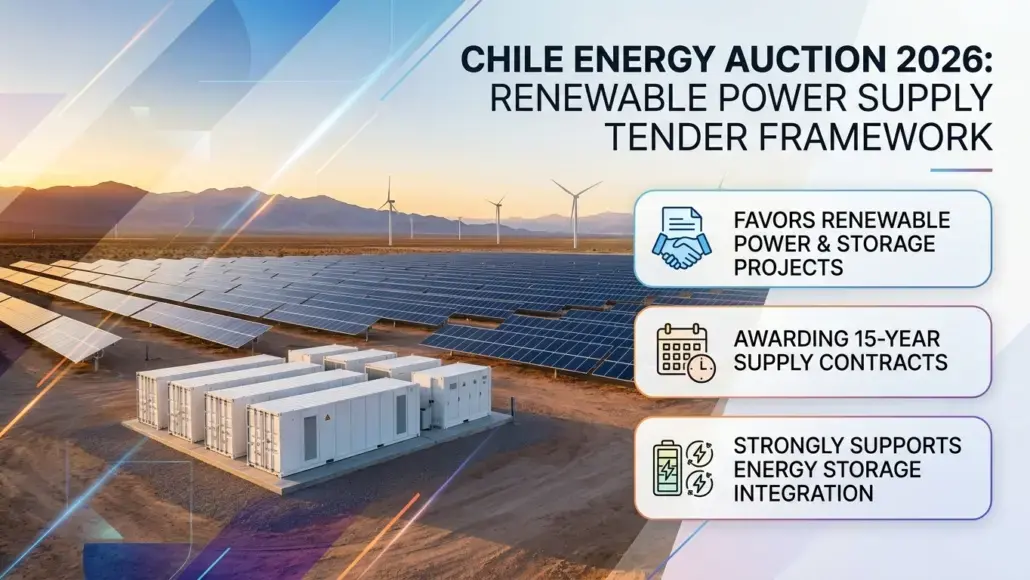

Chile’s National Energy Commission has moved forward with establishing the framework for the 2026/01 power supply tender, formally approving the preliminary bidding terms for what represents a significant procurement process in the country’s energy sector. The tender mechanism, while maintaining a technology-neutral structure, incorporates design features that create favorable conditions for renewable energy participation, particularly for photovoltaic installations paired with battery storage solutions.
The Chile Energy Auction 2026 process restricts eligible fuel sources to those meeting environmental standards, explicitly prohibiting coal, petroleum coke, diesel, and No. 6 fuel oil as primary generation sources. This framework means that generation assets or storage systems must connect to the National Electric System to qualify for bidding. The inclusion of battery storage as a valid backup mechanism represents a structural advantage for renewable developers seeking to meet supply obligations across different time periods throughout the day.
The tender encompasses two distinct supply blocks across a 15-year contracting period. Block 1 allocates 1,575 GWh annually from January 2029 through December 2043, while Block 2 provides 1,260 GWh annually from January 2030 through December 2044. Combined, these blocks represent a total tendered volume of 2,835 GWh annually, establishing substantial demand for long-term energy supply agreements.
The procurement strategy incorporates geographical zoning that concentrates most supply requirements in Zone 2, which encompasses demand from major distributors. Zone 2 accounts for 1,000 GWh in Block 1 and 799 GWh in Block 2. The remaining zones Zone 3, Zone 1, and Zone 4 collectively account for smaller but significant portions of the total demand.
A defining characteristic of the Chile Energy Auction 2026 structure involves time-of-day demand segmentation. Each supply block divides into three distinct bands: Band A covering off-peak hours (00:00–07:59 and 23:00–23:59), Band B capturing daytime periods (08:00–17:59), and Band C encompassing evening peaks (18:00–22:59). This segmentation creates differentiated demand patterns that align with natural solar generation cycles and storage discharge requirements.
Band B, corresponding to peak solar generation hours, represents the largest allocation within the tender. Block 1 assigns 700 GWh to this band, while Block 2 allocates 558 GWh. Band C, crucial for evening demand coverage through storage-enabled delivery, totals 389 GWh in Block 1 and 312 GWh in Block 2. This time-based structure enables renewable developers to leverage daytime solar generation while deploying stored energy during peak evening demand periods.
Renewable projects participating in the procurement must satisfy multiple operational criteria. The tender includes a variable component representing 5 percent of annual base energy demand, requiring bidders to demonstrate capacity for handling unexpected demand fluctuations. Developers must establish sufficient backup capacity, secure financial closure, and demonstrate measurable progress toward project execution timelines.
Bidders proposing new generation facilities must obtain backup contracts either through alternative generators or approved storage systems should project delays occur. For solar-plus-storage configurations, energy sourced from generation assets must remain clearly differentiated from energy discharged through storage systems, enabling transparent tracking of supply sources and ensuring compliance with contracted obligations.
The National Energy Commission’s demand forecasts anticipate continued growth throughout the study period. Regulated customer demand is projected to increase from 32,863 GWh in 2029 to 41,789 GWh by 2037. Alternative demand datasets suggest participating distributors’ consumption could rise from 32,279 GWh in 2029 to 46,018 GWh in 2040, indicating substantial long-term energy needs driving the scale of the procurement process.
The tender timeline establishes key milestones beginning with the official launch scheduled for July 1, 2026. An inquiry period extends through August 28, with responses and potential amendments due October 2. Bid submission takes place December 4, 2026, followed by economic offer opening January 5, 2027, and the award ceremony January 13, 2027. All bids must be denominated in USD per megawatt-hour, with reserve pricing determined through confidential administrative processes and disclosed only during economic offer evaluation.