








































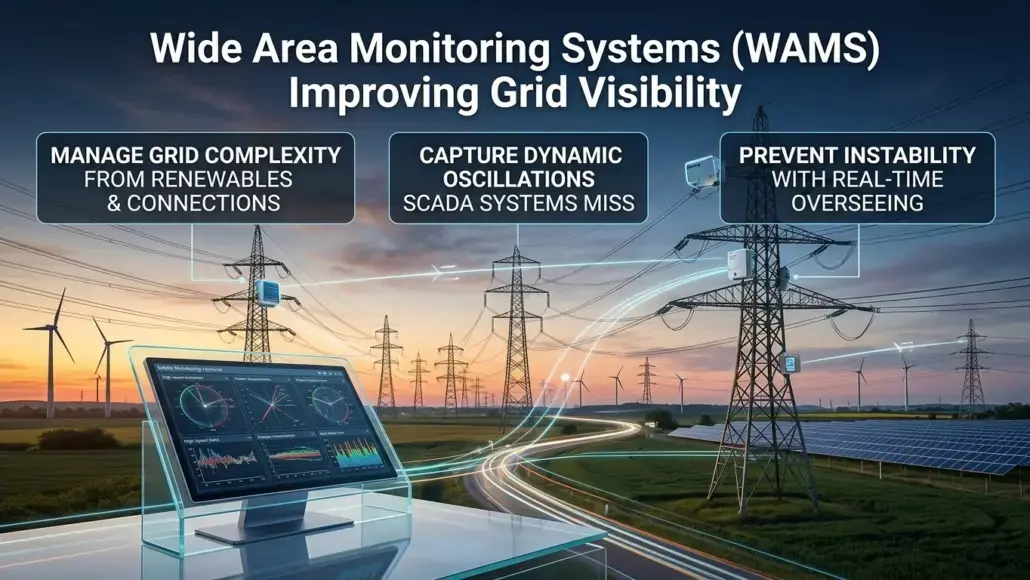

The increasing complexity of the modern power grid, driven by the integration of renewable energy and the growth of cross-border interconnections, requires a level of oversight that traditional monitoring systems can no longer provide. Conventional Supervisory Control and Data Acquisition systems typically update every few seconds, which is sufficient for steady-state operations but too slow to capture the dynamic oscillations and transient events that can lead to grid instability. To address this, the industry is increasingly utilizing advanced sensing and communication networks that provide high-speed data across entire continents. The implementation of Wide Area Monitoring Systems represents a fundamental shift in how power systems are observed, providing the real-time visibility needed to manage a more volatile and interconnected grid.
Wide Area Monitoring Systems rely on a network of Phasor Measurement Units that are synchronized using satellite timing signals. These units can capture the voltage and current phasors of the grid at a rate of 30 to 60 times per second, providing a high-fidelity view of the system’s dynamics. By aggregating this data from multiple locations, operators can see the actual state of the grid across vast geographical distances. This transparency allows for the detection of issues such as inter-area oscillations or voltage instability that would be invisible to traditional monitoring tools. The adoption of Wide Area Monitoring Systems is a strategic response to the need for greater awareness in a grid that is moving faster and becoming more complex every day.
Real-Time Dynamics and Synchrophasor Standards
The use of synchrophasor data provides a level of temporal precision that is essential for understanding the dynamic behavior of the power system. In a purely localized monitoring environment, the phase angle of the voltage is difficult to compare across different locations. Wide Area Monitoring Systems solve this by using GPS-synchronized timestamps, ensuring that the measurements from every unit are perfectly aligned. This allows for the calculation of the phase angle difference between different points on the grid, which is a reliable indicator of the stress on the transmission network. By tracking these angles in real-time, operators can identify when the system is approaching its stability limits and take corrective action before a failure occurs.
Furthermore, the high speed of the data allows for the identification of low-frequency oscillations that can occur between different regions of the grid. These oscillations, if left unchecked, can grow in magnitude and lead to a total collapse of the system. Wide Area Monitoring Systems utilize advanced analytical software to identify these patterns as they emerge, providing the early warning needed to implement damping strategies. The ability to see these dynamics across the entire network is a hallmark of the modern move toward more professionalized and data-driven grid management. This focus on real-time awareness is a fundamental requirement for maintaining the reliability of the 21st-century power network.
Grid Stability and Voltage Management
Voltage stability is a major concern for grid operators, particularly in areas with high levels of remote generation and long transmission corridors. Traditional monitoring tools often provide a delayed view of voltage trends, which can be catastrophic during a rapid decline. Wide Area Monitoring Systems provide a continuous and high-speed view of the voltage profile across the entire region, allowing for the detection of localized issues that could indicate an impending voltage collapse. This visibility ensures that reactive power resources can be dispatched more effectively, maintaining a stable voltage profile even during periods of high demand or equipment outages.
The integration of synchrophasor data also supports the development of more accurate models for grid behavior. By comparing the real-time data from Wide Area Monitoring Systems with the results of offline simulations, engineers can identify discrepancies and refine their understanding of the system’s response to different events. This continuous improvement of the grid model leads to more reliable planning and a better understanding of the risks associated with new interconnections or renewable projects. The role of high-speed data in driving this technical precision is an essential aspect of the modern power industry, ensuring that the grid is built on a foundation of empirical evidence rather than theoretical assumptions.
Digital Integration and Control Room Visibility
The successful implementation of these systems requires a thoughtful approach to data management and control room integration. The massive volume of high-speed data generated by Phasor Measurement Units can easily overwhelm a human operator if it is not presented effectively. Modern Wide Area Monitoring Systems utilize advanced visualization tools that distill the complex phasor data into intuitive maps and alerts. This allows the control room staff to identify potential issues at a glance and make informed decisions with greater speed. The shift toward digital integration ensures that the technical depth of the monitoring system is translated into actionable insights for the operational team.
Furthermore, the integration of these systems with automated control schemes—often referred to as Wide Area Control Systems—is the next logical step in this evolution. These systems can use the synchrophasor data to automatically adjust the output of generators or the settings of flexible AC transmission systems (FACTS) to dampen oscillations or stabilize voltage. This move toward autonomous grid management reduces the reliance on human intervention during fast-moving events and ensures a more consistent response to grid stress. The coordination between monitoring and control is a key factor in the long-term resilience of the interconnected power network.
Regional Coordination and Strategic Planning
The global nature of the power sector means that grid events often transcend national or state boundaries. Wide Area Monitoring Systems facilitate the coordination between different balancing authorities, allowing them to share data and understand the state of the neighbor’s network. This regional perspective is essential for managing the flow of power across large interconnections and for ensuring that the actions of one operator do not have a negative impact on the rest of the system. The transparency provided by these systems is a vital component of the modern effort to create a more cooperative and efficient energy market.
The data generated by these systems also provide a valuable record of major grid events, such as blackouts or equipment failures. By analyzing the high-speed data from every point on the grid during an event, investigators can identify the exact sequence of failures and the root causes of the problem. This “black box” capability is essential for learning from past mistakes and for developing the strategies needed to prevent similar issues in the future. The investment in Wide Area Monitoring Systems is therefore a strategic priority that enhances the safety, the reliability, and the accountability of the entire power industry. The ongoing evolution of this technology will remain a critical factor in the success of the global energy transition for decades to come.