

















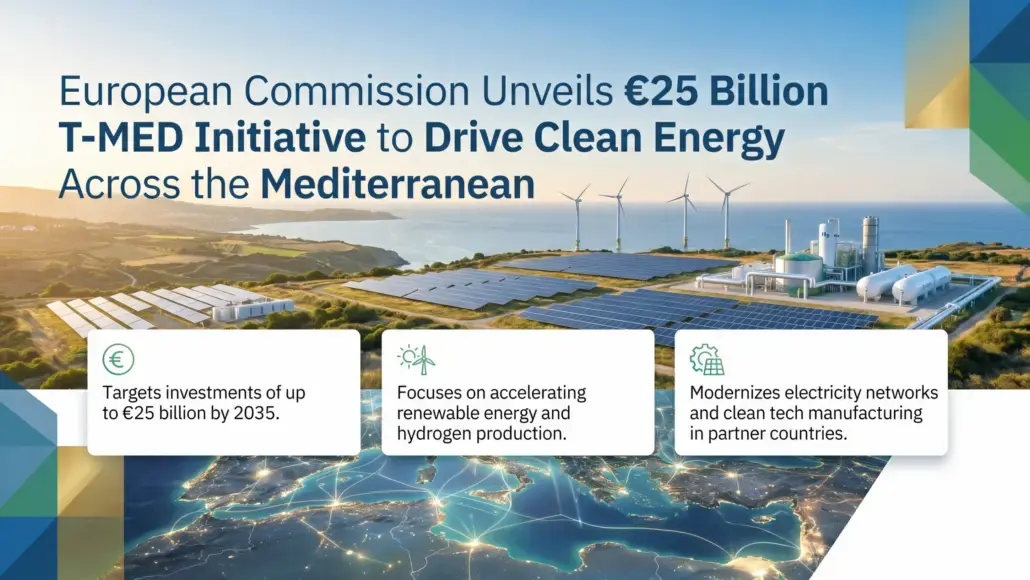

The European Commission has unveiled a sweeping new programme called T-MED, designed to channel up to €25 billion in expected investments toward clean energy development across the Mediterranean region by 2035. The initiative targets the acceleration of renewable energy, hydrogen production, clean technology manufacturing and the modernisation of electricity networks throughout partner countries bordering the Mediterranean.
Announced during European Sustainable Energy Week by Commissioner for the Mediterranean Dubravka Šuica and Commissioner for Energy and Housing Dan Jørgensen, the T-MED clean energy programme is backed by more than €5 billion in guarantee capacity made available by the European Commission under the European Fund for Sustainable Development Plus. This guarantee capacity is intended to help unlock both public and private investment in the sectors covered by the initiative. By 2035, the programme is expected to contribute to the development of 15 gigawatts of new renewable energy capacity, drive regulatory reforms in partner countries, and help generate more than 100,000 jobs across clean energy sectors.
The T-MED clean energy initiative will be delivered through five coordinated actions. The first centres on investment mobilisation, bringing together the Commission, European and international financial institutions, and the private sector to reduce investment risks, attract funding and support renewable energy and clean technology projects across the region.
The second action focuses on regulatory cooperation, helping partner countries improve the investment climate by simplifying permitting procedures, aligning regulations and reducing barriers to investment. Third, a dedicated T-MED Skills Agenda will align vocational training with the needs of the clean energy sector, ensuring local workforces can benefit from new job opportunities arising from the energy transition. This Skills Agenda will include support for modernised technical and vocational education and training systems, strengthen university partnerships, and promote excellence in engineering, digital technologies and green finance.
Fourth, T-MED will support infrastructure upgrades and renewable energy trading by mobilising investments to modernise electricity grids, promote cross-border energy trade and encourage the deployment of smart technologies to better integrate Mediterranean renewables into power systems. The fifth action involves clean tech industrial cooperation, supporting local manufacturing and more resilient supply chains while fostering innovation and industrial partnerships across the region.
Dan Jørgensen, Commissioner for Energy and Housing, commented: “The current energy crisis underscores how energy security cannot only rely on diversifying fossil fuel imports. We must move towards electrified energy systems based on clean energy, strong interconnections and efficient networks. This initiative will be key to unlock the untapped clean energy potential of the Southern Mediterranean region and foster investments in clean tech. It will serve both Europe’s and the region’s interest in lowering exposure to fossil fuel price shocks.”
Commissioner for the Mediterranean Dubravka Šuica added: “At a time of geopolitical uncertainty, growing energy demand and increasing climate pressures, unlocking this potential is in the shared interest of both the EU and its southern Mediterranean partners.”
The Commission has launched dedicated platforms for investors to participate. Private investors including commercial banks, asset managers and impact funds were invited to express their interest by 15 June, while project promoters can register interest until 15 August. By October 2026, the European Commission will chair the first operational meeting of the T-MED Investment Platform. The first EU-Mediterranean clean tech industrial collaborations are expected to take shape by 2027, bringing together companies from both sides of the Mediterranean.
The programme represents a significant effort to harness the region’s hydrogen and renewable energy potential, bolster energy security for both Europe and its southern neighbours, and build a clean technology manufacturing base capable of generating substantial employment across the Mediterranean.