


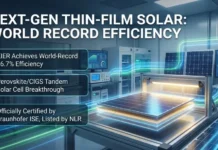





























Longi has reported a new benchmark in photovoltaic performance, announcing it has achieved a Solar Cell Efficiency of 28.13% for a silicon solar cell, marking what it describes as the highest level recorded globally. The milestone was independently verified by Germany’s Institute for Solar Energy Research Hamelin (ISFH), reinforcing the credibility of the result. The announcement came shortly after Trina Solar disclosed a 28.0% efficiency for its TOPCon-compatible hybrid back-contact solar cell, placing Longi marginally ahead in the ongoing efficiency race among leading manufacturers.
The company stated that its hybrid interdigitated-back-contact (HIBC) solar cell architecture enabled the breakthrough, combining multiple advanced design elements. These include passivated tunneling contacts, dielectric passivation layers, and both n-type and p-type contacts integrated within the same structure. Longi further noted that HIBC-based modules have already demonstrated an efficiency of 26.4%, a figure certified by the U.S. National Renewable Energy Laboratory (NREL). According to the company, “These breakthroughs in technological capability have already translated into a leading edge in mass production.”
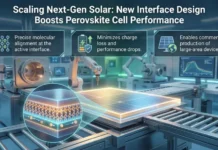
Longi’s previously published research outlines the technical configuration underpinning the achievement. The cell is constructed on a high-resistivity half-cut M10 wafer that incorporates edge passivation and optimized n-type contacts formed through a dual-temperature process. An indium tin oxide (ITO) layer is used to enhance lateral conductivity, while multilayer coatings of aluminum oxide (AlOx) and silicon nitride (SiNx) are applied to suppress surface recombination. Additional refinements include reduced phosphorus doping in the n-type polycrystalline silicon layer to limit diffusion, as well as in situ edge passivation during fabrication.
Further design enhancements involve deep-trenched metal fingers and selective ITO etching to minimize leakage between contact types. A thicker amorphous silicon layer has been introduced to improve junction coverage and sidewall encapsulation. To address contact resistivity while maintaining passivation quality, the amorphous silicon layer is crystallized using a pulsed green nanosecond laser. Longi indicated that while the technology shows potential for scaling into heterojunction solar cell manufacturing, further work is required to reduce resistive losses in the p-type contact. The company’s latest result reinforces the competitive trajectory of Solar Cell Efficiency improvements in next-generation photovoltaic technologies.