





































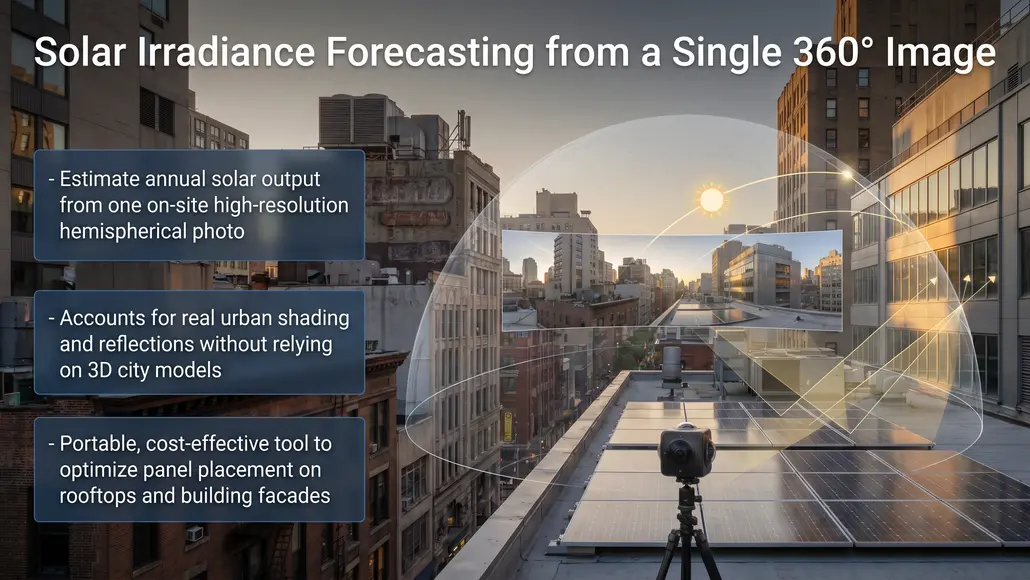

Researchers at Columbia University have introduced a new technique that enables Solar Irradiance Forecasting using a single high-resolution hemispherical image captured on-site. The approach allows accurate estimation of solar energy generation at any location without depending on complex 3D city models, marking a shift in how urban solar potential is assessed.
The method works by analysing a 360° equirectangular image taken at the installation point of a solar panel. From this single visual input, the system extracts information about sky visibility, surrounding structures, and illumination conditions. According to corresponding author Shree K. Nayar, the technique can be applied both before installation to estimate annual energy output and after installation to optimise panel orientation, particularly in dense urban environments such as rooftops or narrow urban canyons.
Conventional forecasting methods rely heavily on 3D city models and simulation tools, but these often fail to capture smaller environmental details that significantly influence energy generation. “Unfortunately, these 3D models are simply not accurate enough to provide precise energy estimates,” Nayar explained, noting that elements such as vents, signage, and window structures can affect light reflection and shadowing as much as larger buildings. The new system instead leverages visual cues such as textures, edges, and lighting patterns captured in the image, bypassing the limitations of inertial sensors, which are often unreliable in urban settings.
At the core of the technique is a neural network trained to determine sun direction and gravitational orientation directly from the image. These outputs are aligned with real-world coordinates using time, date, and GPS data. The model then calculates irradiance by combining three components: direct sunlight, sky illumination, and reflected light from surrounding structures. Notably, the “scene irradiance” contribution derived from nearby buildings accounts for approximately 12% of total energy received, highlighting the importance of environmental context in Solar Irradiance Forecasting.
The system has been validated across multiple urban environments using real-world pyranometer measurements. Results show that it accurately tracks daily irradiance patterns under varying weather conditions, including clear and overcast skies, while effectively capturing rapid fluctuations when the sun moves in and out of visible sky regions. Researchers emphasise that the solution is both portable and cost-effective, offering a practical tool for homeowners and commercial developers to improve solar project planning. The approach also opens opportunities for vertical solar installations, as building facades often receive substantial sunlight exposure.