









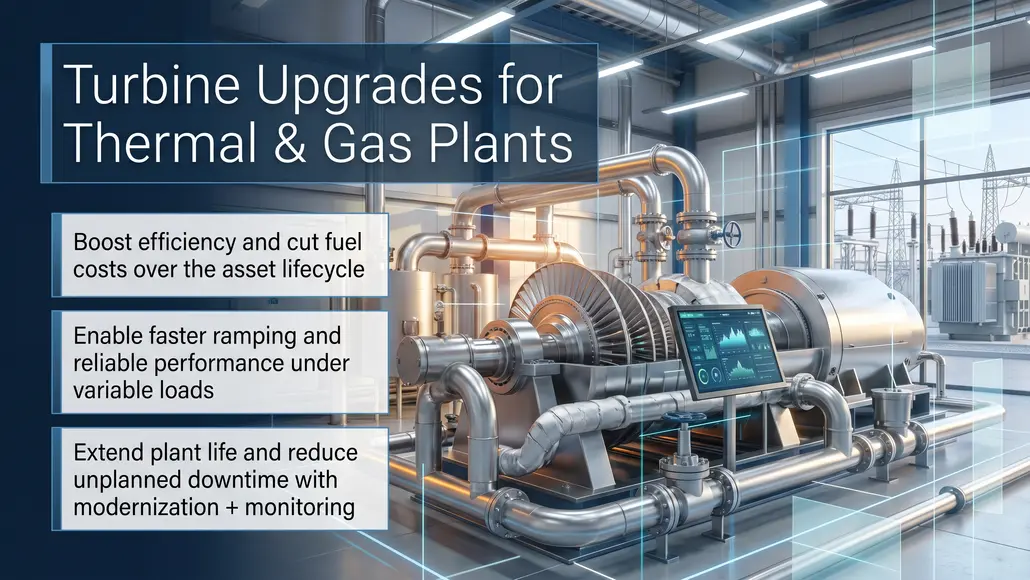

The power generation sector is undergoing a structural shift where conventional assets are expected to deliver more with less. While renewable capacity continues to expand, thermal and gas-based plants remain essential for grid stability. However, their role has evolved from steady baseload generation to flexible, responsive operation. In this context, turbine upgrades in thermal, gas plants are no longer optional improvements but strategic decisions tied to long-term viability, efficiency, and competitiveness.
Why Aging Turbines Are Becoming a Constraint
A large portion of the global thermal and gas fleet was designed for operating conditions that no longer exist. These turbines were built for continuous, stable output, not for the frequent cycling and load variability seen today. As renewable energy penetration increases, conventional plants are required to ramp up and down more often, operate at partial loads, and respond quickly to grid imbalances. This shift exposes inefficiencies in older turbine designs, leading to higher fuel consumption, increased wear, and rising maintenance costs.
Over time, performance degradation becomes inevitable. Even well-maintained turbines begin to operate below optimal efficiency, directly affecting plant economics. This is why turbine upgrades in thermal, gas plants are increasingly viewed as necessary interventions rather than discretionary investments.
What Modern Turbine Upgrades Actually Achieve
Turbine modernization involves more than simple component replacement. It is a combination of aerodynamic redesign, advanced materials, and engineering refinements aimed at improving overall system performance. These upgrades enhance efficiency, increase output capacity, and improve operational reliability without requiring major structural changes to the plant.
In gas turbines, upgrades often focus on improved blade design, better combustion systems, and advanced cooling technologies. In thermal plants, steam turbine retrofits target blade efficiency, sealing improvements, and pressure optimization. The result is a more efficient conversion of fuel into electricity, along with improved durability and reduced mechanical stress.
The Cost Perspective: Looking Beyond Initial Investment
The financial case for turbine upgrades in thermal, gas plants cannot be evaluated solely on upfront capital expenditure. While the initial investment can be significant, a lifecycle perspective reveals a more balanced picture. Efficiency improvements reduce fuel consumption, which is one of the largest operating expenses in power generation. Even small gains in efficiency can lead to substantial cost savings over time.
Additionally, improved reliability reduces unplanned downtime, while higher output capacity can increase revenue potential. Upgrades also extend the operational life of existing assets, delaying the need for costly new infrastructure. When these factors are combined, the overall return on investment often becomes more favorable than a simple CapEx comparison would suggest.
Efficiency Gains and Their Long-Term Impact
Efficiency improvements from turbine upgrades are often incremental in percentage terms, but their financial impact is far from minor. A slight improvement in heat rate can translate into significant annual savings, particularly in large-scale plants where fuel consumption is high. In gas-fired plants, where margins are closely tied to efficiency, these gains can directly improve profitability.
In thermal plants, improved efficiency helps offset rising fuel costs and regulatory pressures. Over time, these incremental gains accumulate, reinforcing the value of modernization. This underscores an important point efficiency improvements may appear small, but they scale significantly across large operations and extended timeframes.
Flexibility as a New Performance Requirement
The increasing share of renewable energy in the grid has introduced a new performance metric: flexibility. Power plants must now respond quickly to fluctuations in supply and demand, rather than operating at a constant output. This requires turbines that can start faster, ramp more efficiently, and maintain performance under variable load conditions.
Modern turbine upgrades enable this level of flexibility. They allow plants to operate more dynamically, supporting grid stability while maintaining efficiency. In this sense, turbine upgrades in thermal, gas plants are not just about improving output—they are about enabling a different mode of operation aligned with modern energy systems.
Retrofitting vs New Capacity: A Strategic Balance
Operators are often faced with the decision of whether to upgrade existing turbines or invest in new generation capacity. Retrofitting offers a practical and cost-effective alternative. It requires lower capital investment, involves shorter implementation timelines, and avoids many of the regulatory challenges associated with new projects.
However, the decision depends on factors such as the age and condition of the plant, market demand, and long-term energy policies. In many cases, upgrades serve as a transitional strategy, extending asset life while providing time to adapt to future market conditions.
Digital Integration Enhancing Upgrade Value
The impact of turbine upgrades is increasingly amplified through digital technologies. Real-time monitoring systems, predictive maintenance tools, and performance analytics ensure that upgraded turbines operate at optimal efficiency. These technologies allow operators to detect issues early, optimize performance continuously, and reduce operational risks.
The integration of digital systems with mechanical upgrades is redefining plant operations. As often highlighted in discussions across Power Info Today, this convergence is transforming traditional power assets into intelligent, data-driven systems that deliver sustained performance improvements.
Market Pressures Are Accelerating Modernization
External factors are also driving the adoption of turbine upgrades. Rising fuel costs increase the financial benefits of efficiency improvements, while stricter emissions regulations push plants toward higher performance standards. At the same time, competition from renewable energy sources is intensifying, making cost efficiency and operational flexibility more critical than ever.
In this environment, delaying upgrades can lead to higher long-term costs and reduced competitiveness. Early adoption, on the other hand, positions plants to operate more efficiently and adapt to changing market dynamics.
Conclusion: Efficiency vs Cost Is a False Trade-Off
The discussion around turbine upgrades in thermal, gas plants is often framed as a trade-off between efficiency and cost. In reality, the two are closely linked. While upgrades require upfront investment, the long-term benefits in terms of fuel savings, operational flexibility, and asset longevity create substantial value.
For power producers, the real question is not whether upgrades are expensive, but whether operating inefficient, aging turbines is more costly in the long run. As the energy landscape continues to evolve, the ability to modernize existing assets will play a critical role in maintaining competitiveness and ensuring sustainable operations.