














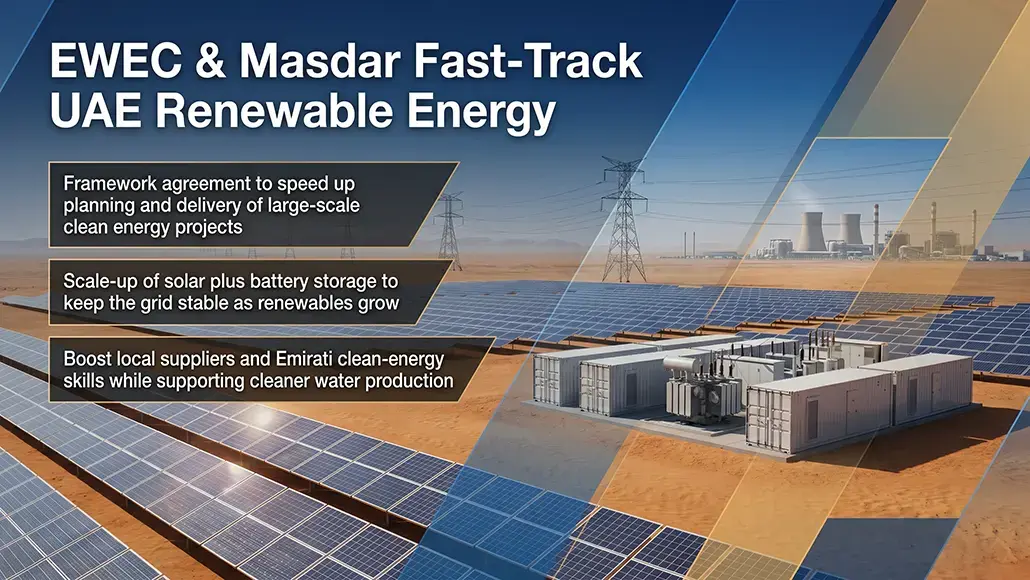

The Emirates Water and Electricity Company (EWEC) and Abu Dhabi Future Energy Company, widely known as Masdar, have signed a landmark Collaboration Framework Agreement (CFA) aimed at accelerating renewable energy development across the United Arab Emirates. The agreement is designed to simplify and speed up the planning and execution of large-scale clean energy projects, helping the nation advance more rapidly toward its sustainability targets.
The CFA was signed by Ahmed Ali Alshamsi and Mohamed Jameel Al Ramahi, both of whom underscored the importance of strengthened cooperation to improve project efficiency particularly in the development of solar power plants and battery energy storage systems.
A Partnership Built on Proven Collaboration
The UAE renewable energy agreement between EWEC and Masdar is not built from scratch. Both organisations share a strong history of working together on some of the region’s most significant solar power initiatives, including the Al Dhafra, Al Ajban, and Khazna solar projects. These past efforts have laid a solid foundation for what is now expected to be a broader and more structured collaboration under the new framework.
By combining EWEC’s deep expertise in energy procurement with Masdar’s globally recognised capabilities in renewable energy development, the partnership is positioned to deliver faster and more efficient project outcomes.
Targeting 60 Percent Clean Energy by 2035
One of the central objectives of the Collaboration Framework Agreement is to support Abu Dhabi in achieving 60 percent of its total energy demand from renewable and clean sources by 2035. To reach this goal, EWEC has outlined plans to expand its solar power capacity to more than 30 gigawatts.
In parallel, a minimum of 8 gigawatts of battery energy storage will be integrated into the grid. This large-scale storage deployment is intended to ensure the stability and reliability of power supply as the share of intermittent clean energy sources continues to rise.
These efforts are firmly aligned with the UAE’s long-term national commitment to achieving net-zero emissions by 2050.
Supporting the Local Economy and Emirati Workforce
Beyond energy production targets, the CFA also places considerable emphasis on economic and social outcomes. The agreement includes specific measures to increase In-Country Value by promoting the use of local suppliers and service providers within project supply chains.
Additionally, the partnership seeks to create meaningful employment and skills development opportunities for Emirati professionals in the clean energy sector, contributing to a more locally empowered energy workforce.
Toward Emission-Free Water Production
The collaboration extends beyond electricity generation. The agreement is also expected to contribute to cleaner water production by reducing dependence on fossil fuels in desalination processes. This is in alignment with the UAE’s broader goal of achieving nearly emission-free water production by 2030 a target that ties energy and water sustainability together within a unified national vision.
Strengthening Energy Security Through Innovation
Officials from both EWEC and Masdar stated that the agreement will enhance the country’s energy security while encouraging innovation across the sector. The structured framework is expected to reduce timelines and improve the execution quality of future UAE renewable energy projects, as both parties leverage their combined strengths.
The Collaboration Framework Agreement represents a concrete step in building a more sustainable, reliable, and resilient energy system capable of supporting the UAE’s long-term growth and development ambitions.