


















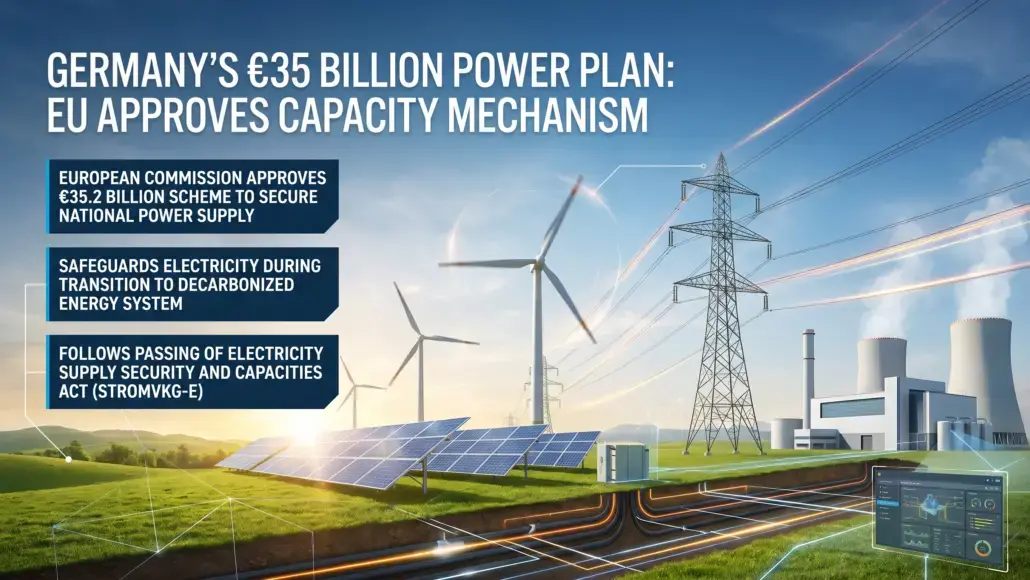

The European Commission has officially approved a German electricity capacity mechanism valued at up to €35.2 billion, a scheme designed to safeguard the national power supply during the country’s transition to a decarbonized energy system. This approval follows the legislative adoption of the Electricity Supply Security and Capacities Act, known as Strom-Versorgungssicherheits-und Kapazitätengesetz (StromVKG-E), which was passed by the German Bundestag and Bundesrat in July. The market-wide initiative, scheduled to become available from 2031, aims to ensure sufficient energy storage, generation, and demand-side flexibility is maintained as the power system increases its reliance on variable renewable generation.
Under the approved framework, Germany’s transmission system operators (TSOs) will procure necessary capacity through competitive auctions to meet national reliability standards. The mechanism is technology-neutral, opening participation to existing and new capacity across power generation, storage, and demand response sectors. Contracts within the scheme can extend up to 15 years, with the first delivery set for 2031. For resources located in other EU member states, eligibility is extended to those with direct electricity network connections to Germany, except for initial tenders reserved for domestic capacity.
Climate Neutrality and Hydrogen Readiness Requirements
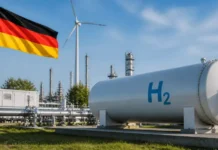
The electricity capacity mechanism integrates strict environmental criteria to align with broader climate objectives. Any capacity receiving a 15-year contract must operate on a climate-neutral basis by 2045 at the latest. Furthermore, new gas-fired power plants applying for long-term contracts are required to be hydrogen-ready, enabling a future fuel switch to reduce long-term fossil fuel dependence. Germany also intends to launch separate decarbonization tenders to support the conversion of parts of its existing gas-fired fleet to hydrogen, utilizing financial support to facilitate the transition.
Tender Volumes and Projected Economic Impact
The initial round of auctions is scheduled for 2026, focusing on securing additional long-term domestic capacity. A total of 9GW of new capacity will be released across two 4.5GW tender rounds in 2026, targeting systems capable of operating at full nominal output for at least 10 consecutive hours. Subsequent technology-neutral auctions are planned for 2027 and 2029. According to European Commission estimates, the scheme will cost between €1 billion and €3 billion in 2031, with annual costs projected to range from €0.9 billion to €2.3 billion through 2045. By providing these tools for managing security of supply, policymakers aim to create a reliable market for dispatchable power and flexible technologies as conventional generation is phased out.