










































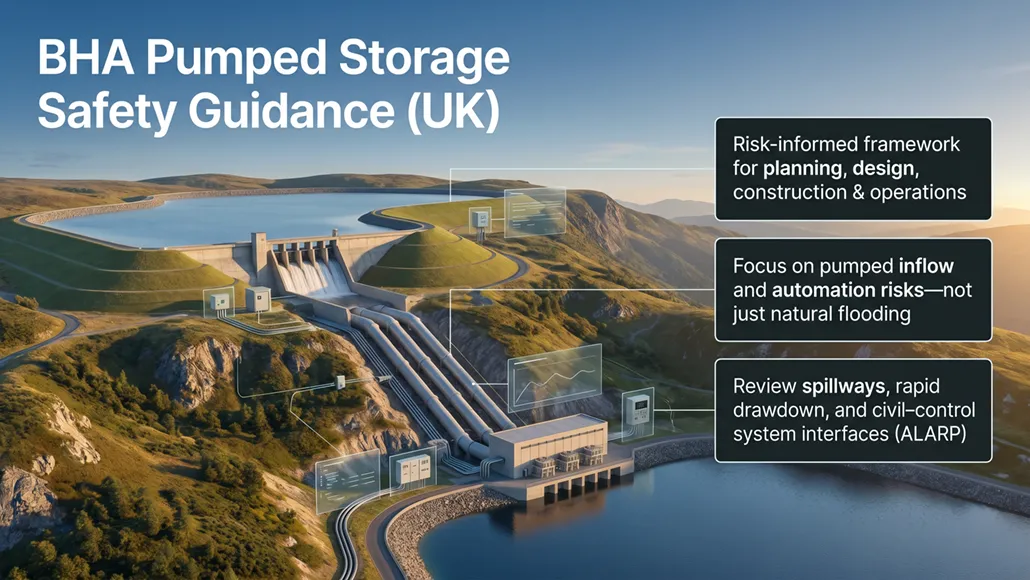

The British Hydropower Association (BHA) has released new pumped storage safety guidance aimed at modernizing the reservoir safety framework for pumped storage hydropower (PSH) schemes across the UK. This publication addresses the increasing deployment of pumped storage projects designed to provide long-duration energy storage and support the integration of renewable energy into the broader electricity system.
Developed collaboratively by a working group of reservoir engineers, hydropower developers, facility operators, and consultants, the document establishes a risk-informed approach for planning, designing, constructing, and operating these critical energy assets.
The BHA determined that existing reservoir safety protocols were primarily built around passive, naturally fed water bodies. Consequently, older guidelines do not fully capture the complex operational characteristics of contemporary modern pumped storage systems, which typically feature high pumping capacities, rapid operational cycling, and a heavy reliance on automation and control systems.
A central focus of the new pumped storage safety guidance is differentiating natural flood events from the unique operational risks generated by pumped inflows. The technical document notes that artificial, pumped inflows can exceed natural water accumulation by multiple orders of magnitude. Because of this high volume, anomalous plant behavior, human operational errors, and failures within control systems now require prioritized safety considerations.
To ensure comprehensive risk management, the updated reservoir safety framework mandates closer evaluation of several operational and infrastructure elements. Essential areas examined in the publication include:
- Spillway provision and rapid drawdown capabilities.
- The direct interaction and interfacing between heavy civil infrastructure and automated operational controls.
- Overall risk mitigation strategies and operational safety protocols.
While the publication does not introduce new statutory regulations for hydropower developers, it is explicitly intended to support professional engineering judgment within the established UK regulatory landscape. The framework encourages operators of pumped storage projects to adopt an approach based on reducing operational hazards to levels considered “as low as reasonably practicable” (ALARP).
As the demand for long-duration energy storage infrastructure continues to expand globally and domestically, the BHA stated that it expects to update this technical document over time to reflect ongoing advancements and newly developed schemes in the sector.