









































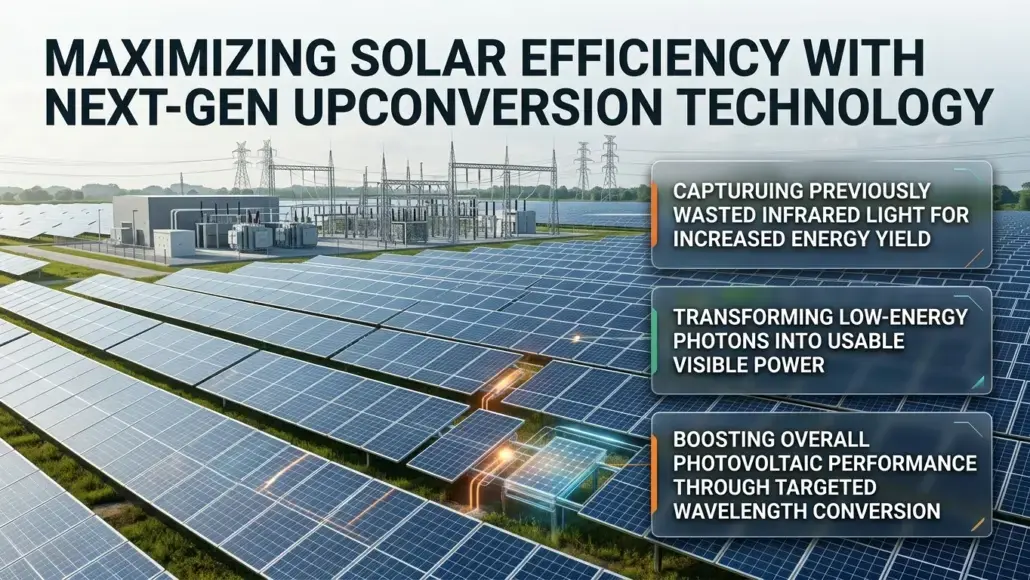

Researchers at the University of New South Wales (UNSW) Sydney have engineered a nanoscale light upconversion device capable of transforming low-energy infrared and red light into higher-energy visible light through targeted photon conversion. This mechanism captures photons that carry less energy and are conventionally wasted in traditional photovoltaic cells. By upconverting these wavelengths into visible light, the device allows the energy to be reflected back into a solar cell to boost its overall performance.
While commercially viable solid-state upconverters have been a primary focus for the industry, they have historically struggled with efficiency losses. The team from the UNSW science faculty navigated this barrier by fabricating a liquid triplet fusion medium that behaves as a solid on excitonic timescales. This liquid triplet fusion medium fills the pores of an alumina nano-scaffold equipped with sensitiser molecules, successfully preventing the back transfer of energy that typically plagues solid-state systems.
Study lead author and UNSW researcher Dr. Thilini Ishwara noted that this method allowed the system to achieve photon conversion efficiencies of 8.2 percent, ranking among the strongest reported figures for this specific architecture.
“This work demonstrates a big step forward,” Dr. Ishwara stated. “Achieving high efficiencies in films is difficult in these ultrathin molecular systems – good light absorption is needed and energy loss needs to be minimised.”
For industry executives evaluating emerging power and manufacturing capabilities, this innovation provides clear operational pathways. Operating effectively within a solid-state structure, the system is fully compatible with standard semiconductor manufacturing. This solid-state structure significantly increases its commercial viability compared to earlier liquid-based approaches.
Consequently, large-scale facilities can recover unutilized light, improving the output of conventional silicon cells where low-energy light previously passed through unused. Beyond solar energy, the UNSW researchers emphasized that the nanoscale light upconversion approach may also be relevant to infrared sensing, photocatalysis, optical communications, and next-generation additive manufacturing technologies like volumetric 3D printing. Advancements in infrared sensing and precision 3D printing remain highly relevant for industry executives tracking future sensing and fabrication integration.
Dr. Ishwara confirmed the team is keen to commercialize the technology. The detailed research findings, exploring how structural exciton localization drives efficient solid-state sensitized triplet fusion upconversion, are published in Nature Photonics.