

































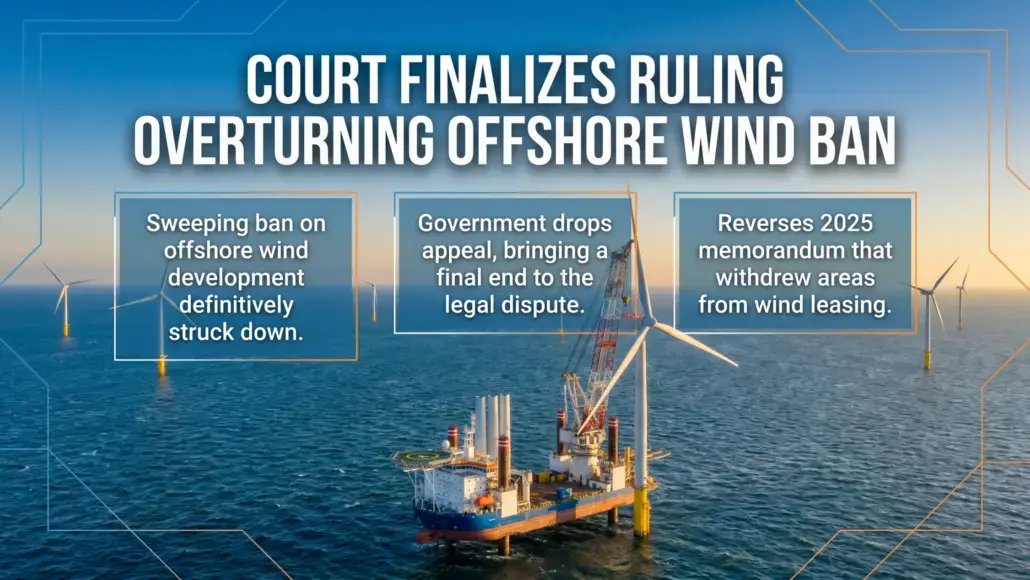

A federal court has finalized its ruling that struck down a sweeping ban on offshore wind development after the government chose to drop its appeal, bringing a definitive end to a legal battle that began in early 2025.
The dispute centered on a presidential memorandum issued on January 20, 2025, titled “Temporary Withdrawal of All Areas on the Outer Continental Shelf from Offshore Wind Leasing and Review of the Federal Government’s Leasing and Permitting Practices for Wind Projects.” Section 2 of the memorandum, widely referred to as the offshore wind ban, directed federal agencies to halt all processing and issuance of permits, approvals, and other authorizations for offshore wind projects. This freeze applied even to areas already under active leases and was tied to an indefinite comprehensive review of offshore wind activities. It also instructed the Department of Interior to assess offshore wind leasing and permitting practices, including environmental review processes under the National Environmental Policy Act.
A coalition of 17 states and the District of Columbia, led by New York, filed a legal challenge on May 5, 2025, in NY et al. v. Trump. The plaintiffs argued that the halt to permitting and leasing harmed the economic and environmental interests of the states and DC, overstepped executive authority in managing federal waters for clean energy development, and violated established legal procedures.
Ten days after the lawsuit was filed, the National Wildlife Federation and nine other environmental non-profits submitted an amicus brief in support of the plaintiffs. The brief stated that “the Agencies simultaneously are seeking to gut the federal wildlife protection that permitting processes are intended to safeguard, and to fast-track non-wind projects that kill and harm species.”
Amber Hewett, senior director of offshore wind energy at the National Wildlife Federation, emphasized that the court’s decision affirmed what advocates had long maintained. “Arbitrary halts to responsible offshore wind development interfere with efforts to protect wildlife, reduce carbon emissions, and address the rising demand for affordable and reliable energy,” Hewett said. “Offshore wind leasing and development is subject to rigorous review and public comment processes to ensure wildlife and communities are protected. The Court’s decision upholds what we have known: that this ban was a baseless overstep of authority impeding responsible offshore wind development, a critical solution to safeguard wildlife and people from the effects of climate change.”
On December 8, 2025, Judge Patti B. Saris issued her decision in the case, ruling that the implementation of the offshore wind ban under Section 2 was unlawful and vacated it in its entirety. The federal government filed notice of appeal on February 17, 2026. However, upon consideration of the appellants’ agreement, the First Circuit Court entered a judgment ordering that the government’s appeal be voluntarily dismissed. The judgment is now final.
New York Attorney General Letitia James released a statement following the resolution. “New York’s wind projects will create jobs, strengthen our economy, and bring down New Yorkers’ electric bills. My office will continue to fight any attempt to undermine that progress,” James said.
Massachusetts Attorney General Andrea Joy Campbell noted that her state has directed hundreds of millions of dollars into offshore wind development, “and the court correctly protected those critical investments from the Trump administration’s unlawful order.” Campbell added that the administration’s decision to drop the appeal and the court’s formal dismissal “will preserve well-paying clean energy jobs and ensure access to reliable, affordable energy as Massachusetts continues to advance its climate goals.”
The conclusion of this case secures the legal standing of existing offshore wind leasing and permitting activities, removing the federal court challenge that had cast uncertainty over the sector’s future along the Outer Continental Shelf.