



































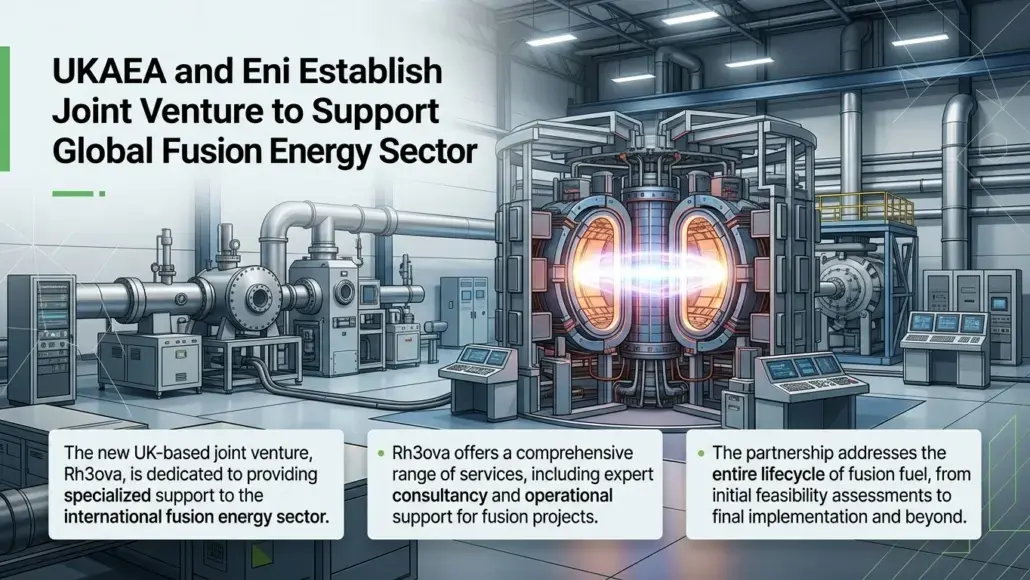

The United Kingdom Atomic Energy Authority (UKAEA) and Italian energy multinational Eni have established a joint venture dedicated to providing specialized support to the international fusion energy sector. Incorporated in the United Kingdom under the name Rh3ova (pronounced Reeova), the partnership will offer a comprehensive range of consultancy and operational services. These services are designed to address the full lifecycle of fusion fuel, spanning from initial feasibility assessments to full-scale deployment and ongoing operational management. The collaboration focuses heavily on the technical and regulatory complexities associated with tritium, a rare radioactive isotope of hydrogen essential for fuel production. Announced on 2 July 2026, the venture aims to resolve one of the most significant obstacles to commercial energy production: the efficient management of the fuel cycle.
Tritium Scarcity and Technical Challenges
Tritium is a fundamental component for future power plants that utilize nuclear fusion, yet its extreme rarity makes it one of the most expensive substances in existence, with market prices reaching approximately $30,000 (€26,000) per gram. While deuterium—another primary fuel source—is readily available in seawater, tritium must be carefully managed from its creation and usage through to its eventual recovery from exhaust gases and refinement for secondary use. Rh3ova notes that this isotope presents unique safety, technical, and regulatory hurdles that must be overcome to develop viable fusion technologies. The efficient handling of tritium throughout the entire loop is considered essential for ensuring that future energy generation remains both safe and cost-effective on a global scale.
Scaling Expertise and Collaborative Infrastructure
The joint venture builds upon a long-standing foundation of technical excellence. UKAEA previously operated the Joint European Torus (Jet), which stood as the world’s most powerful deuterium-tritium fusion machine for over four decades. Stephen Wheeler, the executive director of tritium fuel cycle at UKAEA, emphasized the importance of this transition, stating, “For fusion to be realised as a commercially viable source of energy, however, this expertise must be scaled beyond the lab.” This move from experimental research to industrial application is a key priority for the fusion energy sector as it seeks to mimic the natural processes occurring within stars to provide a clean, low-carbon power source.
Current collaborative efforts include the development of the UKAEA-Eni H3AT tritium loop facility, located at the Culham site in central England. This facility is intended to pilot a continuous, closed-loop fuel cycle at a scale appropriate for power plants, demonstrating the feasibility of long-term fusion operations. While the industry aims for full commercialization in the second half of this century, the work conducted by Rh3ova is expected to provide the critical infrastructure and consultancy needed to navigate the transition from laboratory prototypes to utility-scale energy production.