





















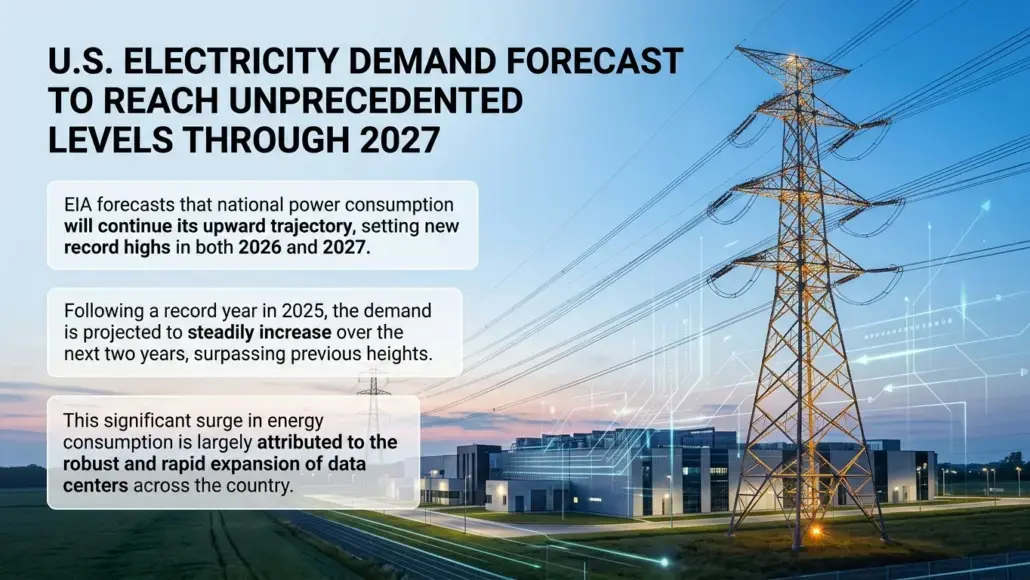

The Energy Information Administration (EIA) has projected that U.S. power consumption will climb to unprecedented heights in both 2026 and 2027, continuing a record-breaking trend. In its Short-Term Energy Outlook released on Tuesday, the agency forecasted that national demand will rise from the record 4,198 billion kilowatt-hours (kWh) established in 2025 to 4,256 billion kWh in 2026, eventually reaching 4,364 billion kWh by 2027. This notable surge is largely attributed to the expansion of data centers dedicated to artificial intelligence and cryptocurrency mining, alongside a broader shift in homes and businesses toward using electricity for transportation and heating instead of fossil fuel. Commercial demand is expected to spearhead this growth, with projections rising from 1,486 billion kWh in 2025 to 1,522 billion kWh in 2026, particularly in states like Virginia and Texas where data center development is concentrated.
Changes in the National Generation Mix
As electricity demand accelerates, the composition of the nation’s energy sources is anticipated to shift. The EIA indicates that natural gas will likely decrease its share of the generation mix from 40% in 2025 to 39% across 2026 and 2027. During the same period, coal’s contribution is expected to slide from 17% to 15%. Conversely, renewable output is poised for a significant climb, rising from approximately 24% in 2025 to 25% in 2026, and eventually reaching 28% by 2027. Nuclear energy is projected to fluctuate slightly, moving from 18% in 2025 to 19% in 2026 before returning to 18% in 2027. In the natural gas sector, although residential, commercial, and industrial sales are expected to decline slightly from previous highs, the volume used specifically for power generation is projected to rise to 35.8 billion cubic feet per day (bcfd) in 2026.
Infrastructure Demands and AI Integration
The rapid escalation of computing power requirements is fundamentally reshaping the grid’s physical footprint. Between 2020 and 2025, the power density of AI servers increased elevenfold, with further growth anticipated by 2027. Modern server racks can now consume as much energy as dozens of residential homes, placing intense pressure on local grids and occasionally requiring utilities to maintain fossil fuel plants longer than originally intended. To manage these loads, operators are increasingly investing in grid batteries and on-site storage solutions. The financial scale of this transition is vast; capital spending by major technology firms exceeded $400 billion in 2025 and is projected to increase in 2026, a rate of investment that currently outpaces global spending on oil and gas production. Despite ongoing research into efficiency methods, such as a new MIT technique for predicting AI workload energy draw, the industry faces significant challenges in ensuring generation keeps pace with the rising U.S. power consumption and avoids potential shortages in data center clusters by 2027.