





















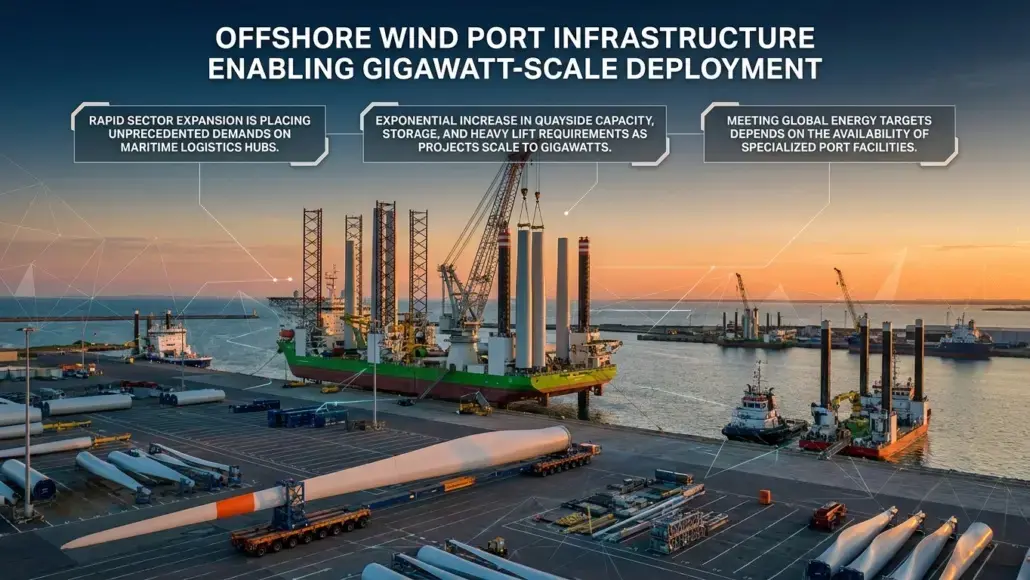

The rapid expansion of the offshore wind sector is placing unprecedented demands on maritime logistics hubs. As project sizes move from hundreds of megawatts to multiple gigawatts, the requirements for quayside capacity, storage area, and heavy lift capabilities are increasing exponentially. The ability of the industry to meet ambitious global energy targets depends heavily on the availability of offshore wind port infrastructure enabling gigawatt-scale deployment. These specialized facilities serve as the primary assembly and staging points for the massive components that define modern wind projects, including turbine nacelles, towers, and blades that can exceed one hundred meters in length. Without significant investment in harbor industrialization, the supply chain for power generation will face major bottlenecks that could delay the transition to renewable energy.
Quayside Reinforcement and Heavy Lift Capacity Expansion
One of the most critical aspects of port infrastructure is the strength and load bearing capacity of the quayside. Modern offshore wind components are incredibly heavy, with nacelles for 15MW turbines weighing over five hundred tonnes. When these components are moved across the quay or lifted by specialized cranes, they exert immense pressure on the harbor surface. Reinforcing existing piers and constructing new heavy duty berths is essential for handling these loads safely. This involves driving deep piles into the seabed and using thick reinforced concrete slabs to create a stable working platform. The quayside must also be designed to accommodate the large jack up vessels and heavy lift ships used for offshore installation, requiring sufficient water depth and berthing length.
The expansion of lift capacity is equally important. Ports must be equipped with state of the art ring cranes or high capacity crawler cranes capable of lifting components to the heights required for pre assembly. In many cases, these cranes are larger than those found in traditional container ports or shipyards. The integration of offshore wind port infrastructure enabling gigawatt-scale deployment requires a shift in port design toward highly specialized, high throughput operations. This includes the creation of dedicated roll on roll off facilities that allow for the efficient transfer of large components from delivery vessels to storage areas. The synchronization of these heavy lift operations is vital for maintaining the rapid installation schedules necessitated by the high capital costs of offshore projects.
Storage Logistics for Large Scale Blade and Tower Components
The massive scale of modern wind turbines requires vast areas of land for component storage and pre assembly. A single gigawatt scale project can involve dozens of turbines, each requiring significant space for its associated tower sections, blades, and nacelles. Logistics managers must carefully plan the layout of these storage areas to maximize throughput and minimize the time spent moving components within the port. The ground must be leveled and reinforced to support the weight of the stored items, particularly the tower sections which are often stored upright to save space. Advanced tracking systems are used to monitor the location and status of every component, ensuring that the right parts are ready for loading onto the installation vessels at the precise time they are needed.
Efficient storage logistics are also important for managing the supply chain from multiple manufacturers. Components may arrive from different parts of the world, and the port serves as the central hub where everything is brought together. This requires a high degree of coordination between the port authority, the wind farm developer, and the various component suppliers. The deployment of offshore wind port infrastructure enabling gigawatt-scale deployment involves the creation of these integrated logistics ecosystems, where data sharing and real time visibility are standard practice. By optimizing the flow of materials through the port, developers can reduce the risk of delays and ensure that the offshore installation campaign proceeds smoothly, even in the face of challenging weather conditions or shipping disruptions.
Integration of Operation and Maintenance Support Facilities
While much of the focus is on the installation phase, ports also play a vital role in the long term operation and maintenance of offshore wind farms. Dedicated O and M bases are required to support the specialized service vessels and technicians who keep the turbines running. These facilities include warehouses for spare parts, workshop areas for component repair, and office space for the asset management teams. The proximity of the port to the wind farm site is a key factor in minimizing the travel time for service crews and reducing the overall cost of maintenance. As wind farms move further offshore, the role of these port based support centers becomes even more critical for ensuring high availability and energy production.
The integration of O and M facilities into the broader offshore wind port infrastructure enabling gigawatt-scale deployment allows for shared resources and improved efficiency. For example, a port that supports multiple wind farms can benefit from centralized spare parts management and shared training facilities for technicians. This regional approach to infrastructure development can significantly lower the operational costs for all projects in the area. Additionally, the presence of a long term O and M base provides stable employment opportunities and supports the local maritime economy. By building a comprehensive support infrastructure, port authorities can position themselves as key players in the regional power generation sector, attracting further investment from developers and service providers.
Sustainable Port Operations and Decarbonized Logistics
As the offshore wind industry matures, there is an increasing focus on the environmental footprint of its own logistics operations. Ports are looking for ways to reduce their carbon emissions and improve their sustainability profiles. This involves the electrification of quayside equipment, such as cranes and vehicles, as well as the use of renewable energy to power port facilities. Many ports are also exploring the use of green hydrogen or other alternative fuels for the vessels that service the wind farms. By decarbonizing the supply chain, the industry can further enhance the overall environmental benefits of wind power generation. The development of offshore wind port infrastructure enabling gigawatt-scale deployment is therefore increasingly aligned with broader green port initiatives.
Sustainability also extends to the management of waste and the protection of local marine ecosystems. Port authorities must implement rigorous environmental monitoring and mitigation programs to minimize the impact of construction and dredging activities. This includes measures to prevent noise pollution and protect water quality in the harbor area. By adopting best practices in sustainable port management, the offshore wind sector can build stronger relationships with local communities and regulatory bodies. The commitment to green logistics is not just a matter of corporate responsibility but also a strategic advantage in a market where environmental performance is increasingly valued by investors and customers. The integration of these principles into port design is a key feature of the next generation of offshore wind hubs. This involves not only technical upgrades but also a cultural shift in how port operations are managed, prioritizing long term ecological health alongside economic efficiency. Collaborative platforms for sharing energy consumption data and best practices in carbon reduction are also emerging, allowing ports to benchmark their performance and drive continuous improvement across the sector. By setting high standards for sustainability, the offshore wind industry can ensure that its growth is truly compatible with global climate goals.
Public Private Partnerships for Harbor Industrialization
The scale of investment required to develop specialized offshore wind infrastructure often exceeds the capacity of individual port authorities or private developers. Public private partnerships are therefore essential for funding and delivering these large scale projects. Governments play a crucial role by providing strategic planning, regulatory support, and in some cases, direct financial incentives or grants. Private sector partners bring technical expertise, operational experience, and access to capital markets. By working together, the public and private sectors can share the risks and rewards of harbor industrialization, ensuring that the necessary infrastructure is in place to support the growth of the power generation sector.
These partnerships often involve long term lease agreements and joint venture arrangements that provide the stability needed for large scale infrastructure investment. The success of offshore wind port infrastructure enabling gigawatt-scale deployment depends on a clear and consistent policy framework that gives investors confidence in the long term demand for offshore wind. Many regions are now developing dedicated offshore wind clusters, where multiple ports and industrial sites work together to support a regional supply chain. This collaborative approach fosters innovation and creates a more resilient infrastructure network. By leveraging the strengths of both the public and private sectors, the industry can overcome the logistical challenges of gigawatt scale deployment and secure the future of offshore wind as a primary source of global energy. The ongoing transformation of the maritime sector is a vital component of the broader transition to a low carbon economy, and ports are at the very center of this change. As the industry continues to evolve, the ability to adapt to new technologies and changing market conditions will be the hallmark of successful port operators. Strategic planning that accounts for future turbine sizes and installation methods is essential to ensure that infrastructure remains relevant over the coming decades. By fostering an environment of innovation and collaboration, ports can secure their position as indispensable hubs for the global energy transition. The journey toward gigawatt scale deployment is complex and challenging, but with the right infrastructure and partnerships in place, the offshore wind sector is well positioned to lead the way to a sustainable future. The legacy of these port developments will be measured not just in megawatts of capacity installed, but in the lasting economic and environmental benefits they bring to their regions. Continued focus on refining offshore wind port infrastructure enabling gigawatt-scale deployment will remain a top priority for power generation stakeholders worldwide.