










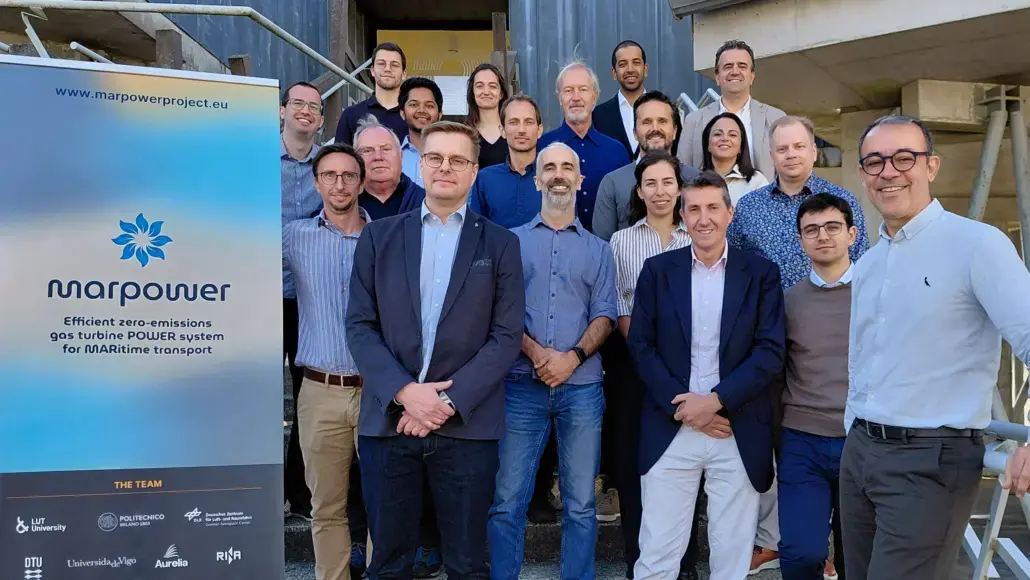

The EU-funded MARPOWER project has reached the halfway point of its four-year development programme, advancing technologies for a gas turbine-based energy conversion system intended for maritime transport. The system is being designed for power generation and cogeneration on board ships, with the ability to operate using different sustainable fuels while improving overall efficiency.
As the project progresses, its work on maritime decarbonisation has moved from system design towards component manufacturing, experimental testing and integrated digital modelling. The overall cycle and system design has been completed, alongside detailed designs for the main components. Progress includes optimised compressors and turbines, a combustion chamber prototype successfully tested with 100% hydrogen, heat recovery technologies, active magnetic bearing systems and a more detailed Digital Twin.
Turbomachinery and Hydrogen Combustion Progress
The project has completed designs for both low- and high-pressure compressors, as well as the aerodynamic and cooling design of the high-pressure turbine and the optimisation of the low-pressure turbine. The high-pressure turbine’s internal cooling channels have been assessed through advanced conjugate heat-transfer simulations, with the resulting design requiring a coolant flow rate approximately 15% lower than estimates based on standard literature correlations.
Meanwhile, the first combustion chamber prototype has been manufactured, instrumented and tested successfully with 100% hydrogen in an atmospheric test rig. The system is being developed to accommodate hydrogen, ammonia, renewable methanol and renewable methane, with limited modifications to the combustion system. Experimental results and further simulations are now informing the design of a second prototype, which will incorporate a flexible air distribution system and additional geometry optimisations.
Heat Recovery, Magnetic Bearings and Digital Twin Development
MARPOWER has also progressed its heat recovery and rotor-control technologies. A scaled recuperator prototype has been manufactured and assembled, passing non-destructive testing and pressure testing at 22.3 bar, around 22 times atmospheric pressure. The project has completed the design of a complementary Waste Heat Recovery System, including the WHR boiler, steam turbine, pump, generator, AMBs and rotor dynamics.
For high-speed machinery, a new axial AMB has been designed, manufactured and integrated into an existing flywheel test rig, where initial rotor impact and recovery tests have been conducted successfully. A first calibrated version of the MARPOWER Digital Twin general model has also been established, with automated simulations supporting assessments of part-load operation, non-nominal conditions and fuel switching. Further validation will use experimental data as it becomes available.
Next Phase Focuses on Vessel Integration and Validation
During the second half of the project, work will concentrate on further experimental testing, component integration and validation under representative operating conditions. Two case studies involving reference container and cruise vessels will examine engine-room arrangements and use digital simulations to assess energy and emissions performance across different operating scenarios.
The project will also evaluate regulatory compliance, safety, maintenance, Life Cycle Assessment and Life Cycle Costing, supporting an assessment of the system’s technical and economic implications for existing ships. Professor Jussi Sopanen, MARPOWER Project Coordinator at LUT University, said: “During the first half of MARPOWER, we have advanced the system design, developed key technologies and started generating experimental results. The challenge now is to bring these developments progressively together, extend testing under more representative conditions and generate the evidence needed to assess the complete system and its integration on board ships”.
The consortium comprises eleven partners from six European countries and is coordinated by LUT University. Its members include Aurelia Technologies, Alfa Laval, Politecnico di Milano, RINA Consulting, RINA Services, University of Vigo, the German Aerospace Center (DLR), the Technical University of Denmark (DTU), Chantiers de l’Atlantique and Zabala Innovation. The project will continue until August 2028.