













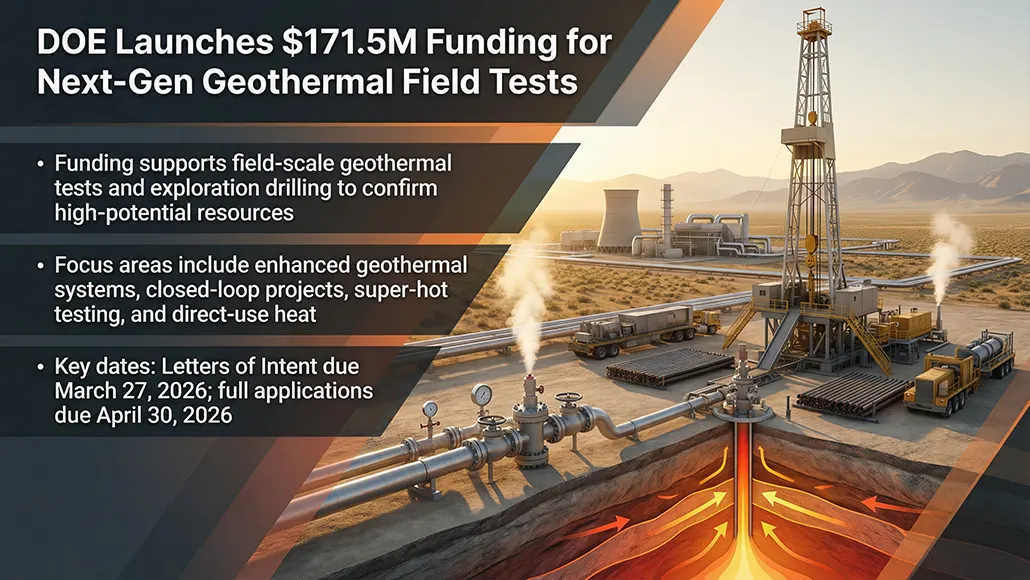

The U.S. Department of Energy (DOE) has announced a funding opportunity totaling $171.5 million to accelerate next-generation geothermal field-scale tests for electricity generation and exploration drilling, aimed at characterizing and confirming high-potential geothermal resources. The initiative, launched under a Notice of Funding Opportunity titled “Next-Generation Geothermal Field Tests and Geothermal Resource Characterization Confirmation,” is designed to advance commercialization pathways and expand the role of geothermal energy in the U.S. power mix.
The funding aligns with President Trump’s Executive Order, “Unleashing American Energy,” which prioritizes domestic energy development and innovation. By supporting field demonstrations and drilling activities, DOE intends to strengthen the technical and economic viability of geothermal systems and contribute to affordable, reliable, around-the-clock electricity supply.
Kyle Haustveit, DOE Assistant Secretary of the Hydrocarbons and Geothermal Energy Office, announced the grant opportunity on Feb. 25. “Work under this opportunity will directly support our commitments to advance energy addition, reduce energy costs for American families and businesses, and unleash American energy dominance and innovation,” Haustveit said. “These demonstrations and drilling activities will help us realize the enormous potential of geothermal to spur domestic manufacturing, enable data center growth, and provide affordable, reliable, and secure energy solutions nationwide.”
The funding opportunity includes six topic areas, with varied funding levels and awards anticipated across different rounds. In the first round, two topics will be open for applications: enhanced geothermal system field tests at sites with electricity generation potential, and drilling projects focused on next-generation and hydrothermal resource exploration, characterization, and confirmation.
Across all rounds, eligible project categories include:
- Enhanced geothermal field tests at prospective electricity-generating sites
- Closed-loop field tests requiring new or additional drilling
- Closed-loop field tests utilizing existing wells
- Super-hot/supercritical field tests at sites expected to exceed 375°C
- Direct use/thermal field tests for applications without electricity generation
- Drilling for next-generation and hydrothermal resource exploration and data collection
Geothermal energy is defined as heat energy from the earth using existing natural or artificial reservoirs of hot water at varying temperatures and depths. According to DOE, wells ranging from a few feet to several miles deep can access underground reservoirs to bring steam or hot water to the surface for electricity generation or other applications.
The United States currently leads the world in geothermal electricity capacity with approximately 4 gigawatts installed. In 2023, U.S. geothermal plants generated 17 billion kilowatthours, accounting for 0.4% of total utility-scale electricity generation nationally, according to the U.S. Energy Information Administration. Geothermal power plants are operating in California, Nevada, Utah, Hawaii, Oregon, Idaho, and New Mexico.
DOE analysis indicates that the United States could potentially deploy at least 300 gigawatts of reliable, flexible geothermal power to the national grid by 2050. Projects supported under this funding opportunity are expected to help de-risk geothermal development across diverse geologic settings, improving data availability and technical validation. The agency’s objective is to use federal financial assistance to encourage private investment, spur industry growth, and help realize the country’s geothermal potential.
Letters of Intent are due March 27, 2026, and full applications must be submitted by April 30, 2026.