



























The European Commission has unveiled a draft Industrial Accelerator Act (IAA) aimed at accelerating industrial decarbonisation and strengthening Europe’s manufacturing base in strategic clean energy technologies. Released on 4 March in Brussels, the proposal introduces policy measures designed to boost the domestic production of key components for renewable energy systems while improving supply chain resilience and maintaining competitiveness in the EU’s energy transition.
The legislation, which will now be negotiated by the European Parliament and the Council of the EU, seeks to enable the large-scale deployment of clean technologies while supporting European industrial capacity. It introduces targeted measures covering renewable energy technologies, battery storage systems and broader industrial decarbonisation initiatives.
Made-in-EU Requirements for Solar and Battery Systems
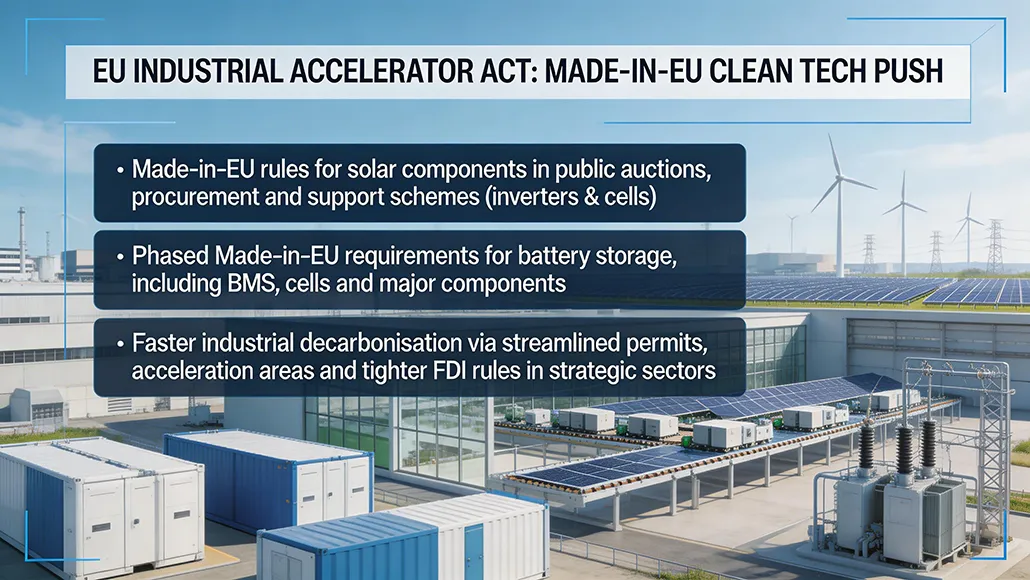
A central element of the draft Industrial Accelerator Act is the introduction of “Made-in-EU” requirements for selected renewable energy technologies in public procurement, renewable energy auctions and public support schemes.
Under the proposal, projects awarded through these mechanisms will be required three years after the legislation enters into force to include solar PV inverters and solar cells manufactured within the EU. The provision is intended to strengthen Europe’s manufacturing capability for strategic solar photovoltaic components while maintaining the pace of renewable energy deployment.
Dries Acke, Deputy CEO of SolarPower Europe, described the proposal as a major step in European industrial policy. “Today’s proposed Industrial Accelerator Act is a watershed moment for industrial policy in Europe. The IAA on the table would allow EU countries, for the first time, to give preference to EU manufactured solar and battery storage systems, in parts of their public auctions, procurement, and support schemes.”
Industry representatives note that the policy focuses specifically on solar inverters and cells, which are considered among the most strategic components in the solar PV value chain.
Phased Manufacturing Requirements for Battery Energy Storage
The draft Act also introduces a phased “Made in Europe” framework for battery energy storage systems (BESS).
From one year after the Act enters into force, battery energy storage systems must originate within the EU, and systems larger than 1 MWh will be required to include an EU-manufactured battery management system.
After three years, additional requirements will apply. These systems must incorporate EU-manufactured battery cells along with at least one additional major component produced in the EU.
According to industry stakeholders, battery storage is critical to enabling greater use of renewable energy and reducing dependence on fossil fuel imports.
Dries Acke stated: “Battery storage is the absolute short cut to maximising Europe’s use of domestically produced renewable electricity and reducing Europe’s exposure to punishing fossil gas import prices. Accelerating battery storage fundamentally underpins the top EU security and competitiveness priorities.”
Measures to Accelerate Industrial Decarbonisation
Beyond manufacturing requirements, the Industrial Accelerator Act introduces a broader set of policy mechanisms designed to accelerate industrial investment in clean technologies.
The proposal includes streamlined permitting procedures for industrial manufacturing projects and energy-intensive decarbonisation initiatives, aimed at reducing administrative barriers that can delay large-scale investments.
The legislation also proposes the creation of industrial manufacturing acceleration areas, which would provide preferential access to financing, raw materials, skilled labour, energy infrastructure, and additional permitting advantages. These zones are intended to support the development of industrial clusters focused on net-zero technologies.
In addition, the Act outlines stricter conditions for foreign direct investment in strategic sectors, including ownership caps, requirements for EU joint ventures, intellectual property licensing obligations, local research and development spending commitments, workforce provisions and local sourcing requirements.
Amendments to the Net-Zero Industry Act
The proposal also includes amendments to the Net-Zero Industry Act (NZIA). These changes address origin requirements for public procurement, renewable energy auctions and public support schemes.
Battery energy storage systems would also be formally integrated into renewable energy auctions under the revised framework. The amendments further introduce provisions related to cybersecurity and rules governing high-risk suppliers.
Solar Thermal Exclusion Raises Industry Concerns
Despite the focus on strengthening European clean energy manufacturing, industry representatives have raised concerns over the exclusion of solar thermal technology from the scope of the “Made in Europe” provisions.
Earlier drafts of the Industrial Accelerator Act had included solar thermal within public procurement and support mechanisms. However, the version released by the European Commission removed the technology from these provisions.
Guglielmo Cioni, President of Solar Heat Europe, said: “This is not a sectoral special plea. It is a consistency check. If the EU wants Made in Europe to mean something, it cannot exclude a proven clean technology that Europe already makes.”
Legislative Process Ahead
The Industrial Accelerator Act was published alongside its annexes, a subsidiarity grid, an impact assessment report and an executive summary. The proposal will now move into negotiations between EU institutions, where its provisions may be revised before final adoption.
Once adopted, the legislation is expected to shape the framework for European clean energy manufacturing, supply chain development and industrial decarbonisation, while influencing how renewable energy technologies and energy storage systems are deployed across the region.