










































The UK government has announced a comprehensive reform of its nuclear regulatory and planning framework, aiming to accelerate project delivery timelines and reduce costs while maintaining environmental safeguards. The move follows an independent review led by John Fingleton, which identified the existing system as overly complex and bureaucratic, prioritising procedural requirements over effective outcomes.
The UK nuclear reforms are positioned as a structural shift toward what ministers describe as “smarter regulation,” with implementation targeted for completion by the end of 2027. The reforms are designed to enable faster approvals and execution across both civil and defence nuclear projects, forming part of a broader strategy to strengthen national resilience, energy security, and industrial competitiveness.
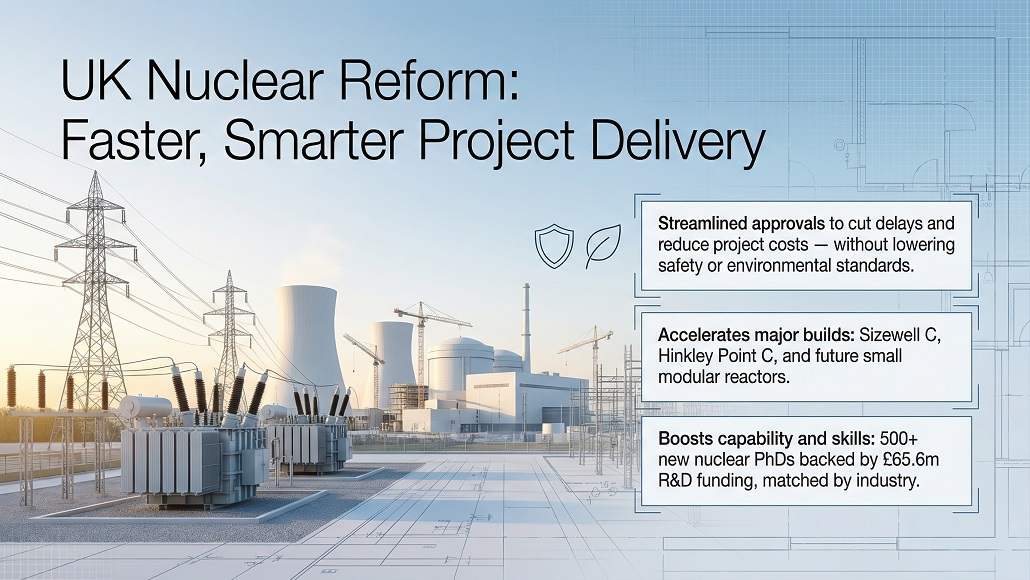
At the core of the reform package is a streamlined regulatory approach that focuses on proportionality, risk-based assessment, and evidence-driven decision-making. Officials state that simplifying planning processes and removing duplicative or overly complex rules will reduce project delivery timelines and associated costs without compromising safety or environmental protections.
Energy Secretary Ed Miliband said: “As the current Middle East conflict shows we need to go further and faster to build the clean energy we need to get off volatile fossil fuel markets and deliver energy security for our country.” He added that the reforms are intended to ensure infrastructure is delivered more efficiently while improving environmental outcomes.
The reforms are closely tied to the government’s broader industrial and energy strategy, which includes advancing major nuclear infrastructure projects. These include the Sizewell C plant in Suffolk, expected to support 17,000 jobs at peak construction, and the ongoing development of Hinkley Point C in Somerset. Plans are also progressing for small modular reactors at Wylfa in North Wales, alongside potential future collaborations with international partners.
Chancellor Rachel Reeves said: “To build national resilience drive energy security and deliver economic growth we need nuclear.” She added that the overhaul would remove “duplicative or overly complex guidance rules and regulations that have been holding back our nuclear ambitions.”
Beyond infrastructure, the UK nuclear reforms also include a significant investment in research and workforce development. More than 500 doctoral students will be trained across UK universities through new programmes, effectively quadrupling the current intake of nuclear PhDs. This initiative is supported by £65.6 million in funding allocated to seven research programmes covering advanced reactor technologies, nuclear fuels, waste management, and materials science.
The funding, delivered through UK Research and Innovation and matched by industry partners, is intended to strengthen the pipeline of technical talent required for both civil and defence nuclear programmes. The Defence Nuclear Enterprise is projected to support 65,000 skilled jobs by 2030, underlining the scale of workforce demand linked to the sector’s expansion.
In parallel, the government continues to invest in defence-related nuclear capabilities, including the construction of four Dreadnought-class submarines and upgrades to nuclear warhead systems and industrial infrastructure.
The regulatory overhaul is expected to have broader implications beyond nuclear, with potential application of similar reforms to other major infrastructure planning regimes. Officials suggest that aligning regulatory efficiency with strategic investment priorities could accelerate delivery across multiple sectors while maintaining compliance and environmental standards.