

























The European Commission (EC) has cleared a €5bn ($5.7bn) offshore wind scheme proposed by the Danish Government, enabling support for the construction and operation of two large-scale offshore wind developments. The approval falls under the Clean Industrial Deal State Aid Framework (CISAF), which came into force on 25 June 2025, and is designed to accelerate renewable deployment while reinforcing the EU’s 2030 energy objectives. Through this offshore wind scheme, Denmark aims to expand its renewable energy base while contributing to broader regional decarbonisation goals.
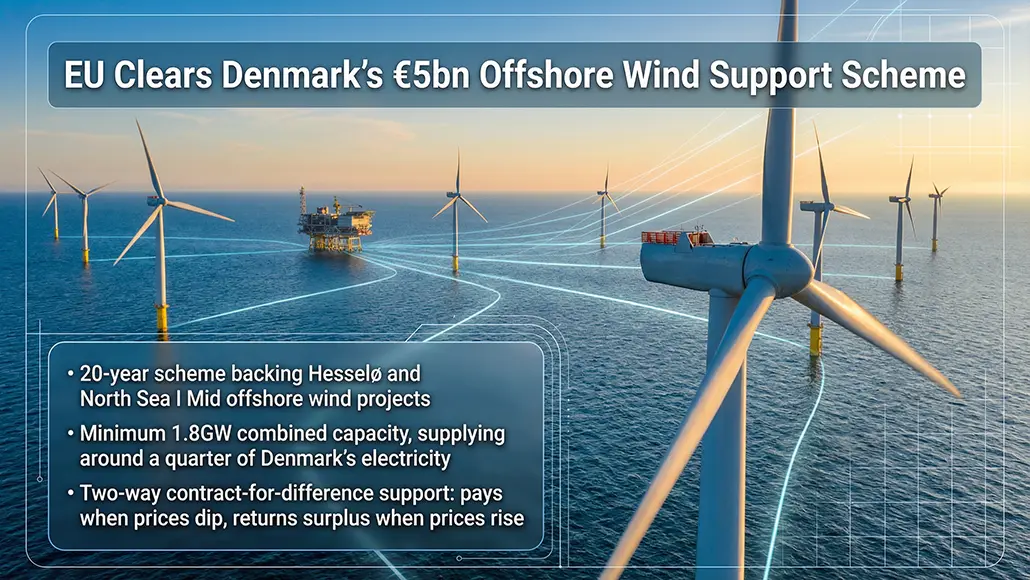
The programme will remain in place for 20 years and centres on the rollout of the Hesselø and North Sea I Mid offshore wind farms. Hesselø is expected to deliver a minimum capacity of 800MW, generating approximately 3.2 terawatt-hours (TWh) annually. Meanwhile, the North Sea I Mid project is planned with at least 1GW of capacity and an estimated output of around 4.6TWh per year. Combined, the two facilities are projected to contribute roughly 25% of Denmark’s total electricity production, based on figures from the previous year.
Support under the mechanism will be issued as a monthly variable premium through a two-way contract for difference model. This structure compares each project’s bid price with a reference market price, recalculated monthly based on operational capability. Where market prices fall below the bid price, operators receive compensation; conversely, when prices exceed it, the surplus is returned to the Danish Government. The EC stated that the structure complies with CISAF provisions, including requirements for competitive bidding and electricity market alignment. The aid is structured as direct price support linked to potential production values rather than actual output, ensuring no payments are made when production results in negative market value.
EU Commission Clean, Just and Competitive Transition executive vice-president Teresa Ribera said: “With this €5bn scheme, Denmark will be able to deploy offshore wind capacities faster, in line with the Clean Industrial Deal.”