






















Events Date: 9

New Zealand Government Initiates Review of Solar Installation Regulations

Note* - All images used are for editorial and illustrative purposes only and may not originate from the original news provider or associated company.

Subscribe

- Never miss a story with notifications

- Gain full access to our premium content

- Browse free from any location or device.

Media Packs

Expand Your Reach With Our Customized Solutions Empowering Your Campaigns To Maximize Your Reach & Drive Real Results!

โ€“ Access the Media Pack Now

โ€“ Book a Conference Call

โ€“ Leave Message for Us to Get Back

Related stories

Energy Storage Systems Supporting Utility Expansion

The rapid growth of global energy demand is driving a massive scale-up of utility infrastructure, where energy storage systems serve as the critical balancer. By providing essential services like grid stability and seamless renewable integration, these systems are enabling a flexible and reliable expansion of modern power networks.

Vattenfall and Nscale Secure Sustainable AI Infrastructure Power Agreement

In a key development for enterprise leaders focused on...

British Hydropower Association Issues Technical Framework for Pumped Storage Infrastructure

The British Hydropower Association (BHA) has released new pumped...
- Advertisement -

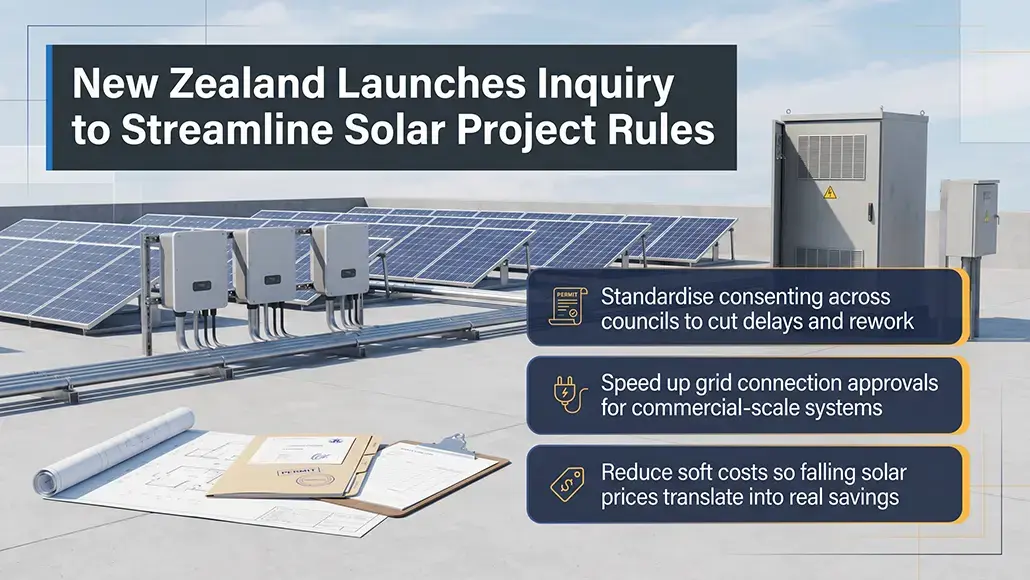
On May 7, 2026, the New Zealand government announced a formal inquiry into the existing regulatory framework governing residential and commercial energy projects. The Minister for Regulation has commissioned this review to address persistent challenges regarding the inconsistency of local council requirements for renewable energy projects. By examining current solar installation regulations, the government aims to identify and eliminate bureaucratic obstacles that have historically inflated the expenses and timelines associated with deploying energy systems. This initiative responds to ongoing concerns from both industry stakeholders and consumers, who have noted that the ease of project implementation often shifts drastically depending on the local jurisdiction.

Streamlining Consenting and Grid Integration

A central objective of this government-led review is to harmonize the national building codes with local bylaws to create a more consistent permitting landscape. Currently, the industry faces significant hurdles due to varying standards for building consents, electrical certifications, and heritage protections. These disparities frequently result in administrative delays that ultimately increase costs for the end user. Furthermore, the review is expected to assess the technical barriers associated with grid connection, as many commercial-scale projects face extended approval timelines from local network operators. By evaluating these bottlenecks, the state intends to align its policy framework with the economic affordability of modern photovoltaic technology.

Economic and Strategic Implications

The economic paradox within the local energy sector remains a primary driver for this policy shift. While hardware costs have decreased globally, soft costs including permitting and installation labor remain disproportionately high in New Zealand. Small-to-medium installation firms currently struggle to standardize their operations due to the necessity of navigating dozens of distinct council rulebooks. By potentially establishing national standards that override local discretion for standard projects, the government seeks to improve operational efficiency across the sector. This review, which will involve consultation with the Ministry of Business, Innovation and Employment and various industry representatives, aims to foster a more predictable environment for solar adoption, ultimately supporting national goals for energy security and long-term sustainability. The government has prioritized this assessment to ensure that solar installation regulations do not serve as an artificial deterrent to the deployment of cost-effective, decentralized energy solutions.

Power Info Today brings together the global energy industry โ€” from generation and transmission operators to utility executives and energy transition leaders โ€” through trusted editorial, market intelligence, and digital engagement.

Our 2026 Media Pack offers integrated solutions to reach your audience:

  • Magazine & Digital Editions Showcase your brand within premium energy industry coverage read by executives and decision - makers worldwide.
  • Industry Insights & Reports Align with data - driven analysis, trend reports, and regional roundups across the global power and energy value chain.
  • Brand Authority & Credibility Position your company as a thought leader through expert commentary, interviews, and special features.

Latest stories

Related stories

Energy Storage Systems Supporting Utility Expansion

The rapid growth of global energy demand is driving a massive scale-up of utility infrastructure, where energy storage systems serve as the critical balancer. By providing essential services like grid stability and seamless renewable integration, these systems are enabling a flexible and reliable expansion of modern power networks.

Vattenfall and Nscale Secure Sustainable AI Infrastructure Power Agreement

In a key development for enterprise leaders focused on...

British Hydropower Association Issues Technical Framework for Pumped Storage Infrastructure

The British Hydropower Association (BHA) has released new pumped...

Nordex Begins Rotor Blade Production Operations in Tรผrkiye

Nordex Group has started operations at its new blade...

Subscribe

- Never miss a story with notifications

- Gain full access to our premium content

- Browse free from any location or device.

Media Packs

Expand Your Reach With Our Customized Solutions Empowering Your Campaigns To Maximize Your Reach & Drive Real Results!

โ€“ Access the Media Pack Now

โ€“ Book a Conference Call

โ€“ Leave Message for Us to Get Back

Translate ยป