
















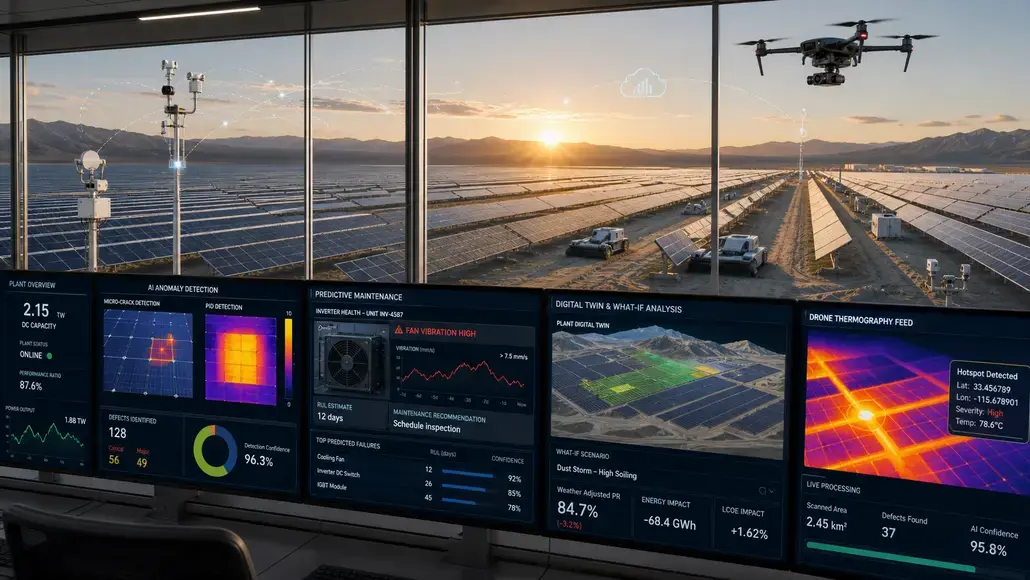

As the global solar fleet expands to a multi-terawatt scale, the complexity of managing these vast and often remote assets has outpaced the capabilities of traditional human-led oversight. The solar industry has entered a digital renaissance, where the focus is no longer just on manufacturing cheaper panels, but on ensuring that every installed module performs at its theoretical maximum. This is the era of AI solar monitoring systems a sophisticated fusion of machine learning, big data, and cloud computing that is transforming the operational landscape of renewable energy. By moving from a reactive “observe and respond” model to a proactive “predict and optimize” strategy, artificial intelligence is driving a significant increase in energy yield and a corresponding decrease in the levelized cost of energy (LCOE).
The primary advantage of an AI-driven approach is the ability to ingest and analyze massive streams of data in real-time. A utility-scale solar farm can consist of hundreds of thousands of individual components, each generating continuous telemetry data. Traditional monitoring systems often rely on simple threshold alerts for example, sending a notification if an inverter’s output drops below a certain level. However, these systems are often too late to prevent damage and too blunt to identify subtle efficiency losses. AI solar monitoring systems, by contrast, use anomaly detection algorithms to identify patterns that deviate from the “normal” operating signature of a specific site. This allows for the detection of issues like micro-cracks, PID (Potential Induced Degradation), or localized soiling long before they manifest as a major system failure.
Predictive Maintenance Solar: From Reactive to Proactive
One of the most impactful applications of AI in the solar sector is predictive maintenance solar. In the traditional model, maintenance crews are either dispatched on a fixed schedule regardless of whether the equipment needs attention or in response to a breakdown. Both approaches are inefficient and costly. AI-driven platforms change this by using historical performance data, meteorological inputs, and component health indicators to forecast when a part is likely to fail. For instance, by monitoring the heat signature and vibration of an inverter’s cooling fan, an AI system can predict a bearing failure weeks in advance, allowing for a replacement to be scheduled during a period of low sunlight.
This predictive capability extends to “intelligent cleaning” schedules. Soiling the accumulation of dust, pollen, or bird droppings is a major source of energy loss, particularly in arid regions. However, cleaning solar panels is expensive and uses valuable water resources. AI systems can calculate the exact “tipping point” where the cost of the cleaning is justified by the expected increase in energy revenue. By correlating localized dust forecasts with real-time performance degradation, the system can optimize the cleaning schedule for maximum financial return, ensuring that maintenance budgets are spent where they will have the greatest impact on solar performance optimization.
Digital Twin Solar and Physics-Based Modeling
The concept of the digital twin solar is at the cutting edge of this technological shift. A digital twin is a virtual replica of a physical solar plant that lives in a software environment. This is not just a 3D model; it is a dynamic, physics-based simulation that mirrors the real-time state of the physical site. By feeding data from the actual farm into the digital twin, operators can run “what-if” scenarios to test different operational strategies. They can simulate how a new tracking algorithm would perform under various wind conditions or evaluate the impact of upgrading specific components without touching the actual hardware.
The digital twin also allows for a more accurate calculation of the “Performance Ratio” (PR). Traditionally, PR is a measure of a plant’s output relative to its potential under ideal conditions. However, many factors such as temperature, spectral shifts, and horizon shading can skew this number. An AI-powered digital twin can account for all these variables with high precision, providing a “weather-adjusted” PR that tells the owner exactly how the plant is performing compared to its true potential. This level of transparency is vital for financial stakeholders and for identifying systemic issues that might be missed by less sophisticated analysis.
Solar Analytics: Turning Raw Data into Actionable Insights
The real power of AI lies in its ability to provide high-level solar analytics that inform long-term business decisions. For developers and asset managers, understanding which brands of panels or inverters perform best in specific climates is invaluable. AI systems can aggregate data across entire portfolios, normalizing for environmental differences to provide an “apples-to-apples” comparison of component reliability. This data-driven procurement strategy reduces risk and ensures that future projects are built using the most durable and efficient hardware available.
Furthermore, AI is revolutionizing the role of aerial thermography. Drones equipped with infrared cameras can now fly over a solar farm and automatically detect “hot spots” that indicate cell-level defects. In the past, analyzing these thousands of images required hours of manual labor. Today, AI-powered computer vision algorithms can process the footage in minutes, automatically categorizing the severity of each defect and logging its exact GPS coordinates into a maintenance ticket. This automation in solar not only saves time but also ensures a level of consistency and accuracy that is impossible for human eyes to maintain over such large areas.
The Future of Automation and Autonomous Solar Operations
Looking ahead, we are moving toward a future of fully autonomous solar operations. Imagine a solar farm where AI not only monitors performance but also controls localized storage, manages grid interactions, and dispatches robotic cleaning crews without human intervention. As we integrate more sensors at the “grid edge” and utilize edge computing to process data locally, the response time of these systems will drop from minutes to milliseconds. This will allow solar plants to act as a truly intelligent part of a smart grid, automatically adjusting their output to provide frequency regulation and voltage support as needed.
In conclusion, AI solar monitoring systems are not just an optional upgrade; they are an essential tool for the sustainable growth of the renewable energy industry. By harnessing the power of predictive maintenance, digital twins, and advanced analytics, we are making solar energy more reliable, more efficient, and more economically competitive. The transition to a clean energy future depends on our ability to manage complexity, and artificial intelligence provides the clarity we need to succeed. As these technologies continue to evolve, they will ensure that every photon we capture is used to its fullest potential, powering our world with unprecedented precision and intelligence.