






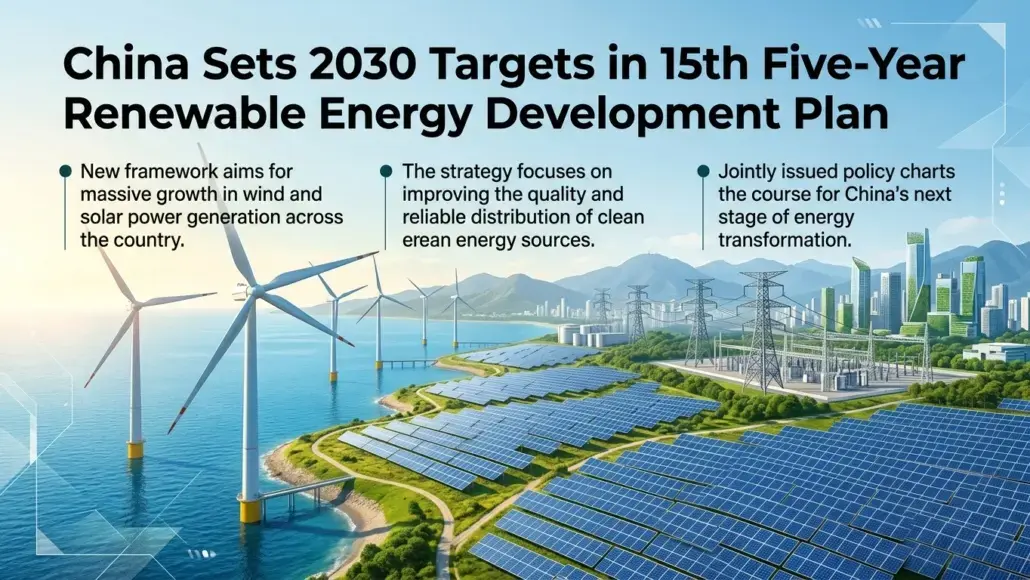

China has officially launched its comprehensive plan for renewable energy development during the 15th Five-Year Plan period (2026-2030), aiming to reach an installed capacity of 3.5 billion kilowatts (kW) by 2030. According to the National Energy Administration (NEA) on Thursday, the new framework was jointly issued with the National Development and Reform Commission. The policy outlines a new development stage characterized by massive scale expansion, quality improvement, and the reliable substitution of traditional energy sources. By 2030, China expects its annual power generation from renewable sources to reach roughly 6 trillion kilowatt-hours (kWh), with total renewable energy consumption projected to hit approximately 1.8 billion tonnes of standard coal equivalent.
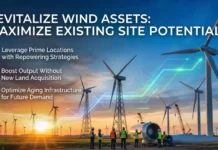
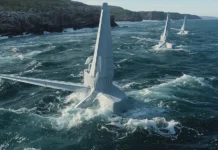
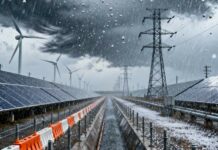
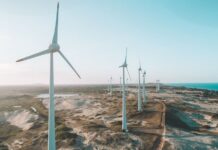
The document highlights that the combined installed capacity of wind and solar power is projected to exceed 2.8 billion kW by the end of the decade, with annual generation from these sources surpassing 4 trillion kWh. This roadmap for renewable energy development also specifies that the total scale of renewable energy used for non-power purposes will increase 2.5-fold compared to 2025 levels, reaching an equivalent of 150 million tonnes of standard coal. To support this growth, the plan mandates the addition of more than 300 million kW of new reliable peak power capacity, while the scale of newly commenced offshore wind power projects nationwide is expected to reach 100 million kW.
Diversification of the Energy Mix and Ecological Integration
China’s 2030 targets extend beyond wind and solar to include a diversified portfolio of hydropower, biomass, geothermal, and marine energy. Conventional hydropower installed capacity is expected to reach 410 million kW by 2030, as the country balances development with ecological protection and the requirements of flood control, irrigation, and navigation. Furthermore, the plan sets specific targets for emerging sectors, including 15 million kW of solar thermal power, 400,000 kW of marine energy capacity, and approximately 160 million kW of pumped storage power capacity. Officials noted that the objective is to create an electricity generation mix featuring “half non-fossil fuels, nearly half renewable energy, and 30 percent new energy sources.”
The policy differentiates between “renewable energy,” which encompasses all naturally replenishing sources including hydropower, and “new energy,” which refers to all renewable sources excluding hydropower. This distinction is central to the country’s strategy of ensuring a reliable and sustainable energy substitution. The NEA emphasized that the transition will prioritize quality and reliability to ensure that green power can effectively replace fossil-fuel-based generation while maintaining grid stability across the national power system.
International Cooperation and Standardization
In addition to domestic expansion, the plan emphasizes China’s role in global energy transition through international cooperation and the alignment of technical standards. The document states that China will actively facilitate the free flow of high-quality green technologies and products in the global market. The government intends to support various institutions and enterprises in deepening their involvement in the development of international standards and certification systems. By advancing the internationalization of its renewable energy technologies and management norms, China aims to promote the mutual recognition of certification results across global markets.
The document further outlines China’s commitment to participating in global governance regarding green and low-carbon development. Adhering to the principle of common but differentiated responsibilities, the country will tailor its cooperation with partner nations to local conditions, focusing on energy transition and green energy technologies. This collaborative approach is designed to address the challenges of climate change collectively while supporting a global transition toward green and low-carbon energy. By fostering these international alignments, China seeks to ensure that its domestic industrial advancements contribute to a broader international low-carbon economy.