








































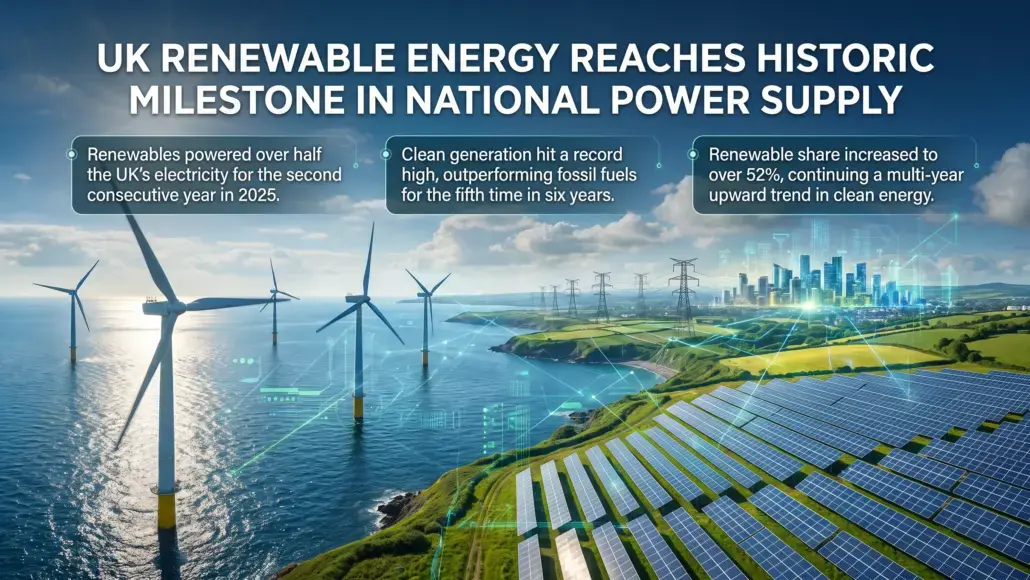

Official figures released by the Department for Energy Security and Net Zero (DESNZ) confirm that UK renewable energy generated over half of the country’s electricity for the second consecutive year in 2025. According to the latest Digest of UK Energy Statistics (DUKES), renewables accounted for 52.1% of total electricity generation, up from 50.5% in 2024. This performance outperformed fossil fuels for the fifth time in six years, with total clean generation reaching a record 153 terawatt hours (TWh), exceeding the previous high of 144.5 TWh set in 2024.
Record Achievements Across Wind and Solar Sectors
Wind power remained the largest single contributor to clean power in the country, delivering a record 29.5% (86.4 TWh) of overall output, compared to 29.2% (83.6 TWh) in 2024. Wind assets accounted for 56.5% of all green power produced during the year. Within this category, offshore wind set an all-time annual high by producing 17.7% (52 TWh) of total power, up from 17.1% (48.8 TWh) in 2024. DUKES noted that this volume is roughly triple the level recorded ten years ago, with offshore wind representing 60% of all wind generation and 34% of overall clean output due to stronger coastal winds and higher turbine efficiency. Onshore wind contributed 11.7% (34.4 TWh), compared to 12.2% (34.8 TWh) in the previous year.
Simultaneously, solar generation reached a record 6.9% (20.1 TWh) of national power, a notable rise from 5.2% (15 TWh) in 2024, driven by expanded capacity and higher-than-average sunshine hours. In contrast, fossil fuels produced 94.9 TWh (32.3% of the total), with gas generating 93.2 TWh (31.75%) following the complete phase-out of coal in 2024. Nuclear power declined 12% to 35.9 TWh (12.2% of the mix) due to plant decommissionings and maintenance outages across ageing facilities. However, total low-carbon sources, combining renewables and nuclear, supplied 64.3% of the grid in 2025.
Industry Impact and Strategic Sector Outlook
The expansion of UK renewable energy demonstrates how clean power continues to displace traditional thermal generation across the grid network. Commenting on the official statistics, RenewableUK CEO Tara Singh stated:
“It’s great to see that renewables have generated over half the UK’s electricity for the second year running, outperforming fossil fuels significantly, and proving once more that clean power is right at the heart of our modern energy system, consistently providing most of the electricity we need to keep British homes and businesses up and running.
“It’s good news for billpayers struggling with the cost of living too, as every wind farm we build pushes the most expensive gas generators off the system. In 2025, wind reduced wholesale electricity prices by 31% by cutting the need for gas-fired power plants. Renewables also enable us to move faster on the electrification of heat and transport to cut bills by reducing the use of costly fossil fuels.
“We can build on today’s milestone by attracting record levels of investment in new wind and solar projects in this year’s clean energy auction which opened this month. We secured a record-breaking amount of offshore wind in the last round which will bring over £30 billion in private investment to the UK, and it’s essential that we continue to procure good value renewables. The last auction showed onshore wind is half the cost of new gas plants and offshore wind is 40% cheaper. Double the amount of offshore capacity that won contracts in the last round eligible to bid in this one, which will ensure that bids will be priced as low as possible due to the intense level of competition. We’re looking forward to the Government announcing the budget soon, and hope that it will be set at a level which maximises the amount of low-cost power we can deliver, as we continue to strengthen the UK’s energy security year on year”.
The continued momentum in solar generation and wind infrastructure positions the sector for upcoming investment cycles as competitive bidding rounds proceed. The latest DUKES report confirms that increased capacity and favorable atmospheric conditions remain key drivers for ongoing electricity generation benchmarks.