










































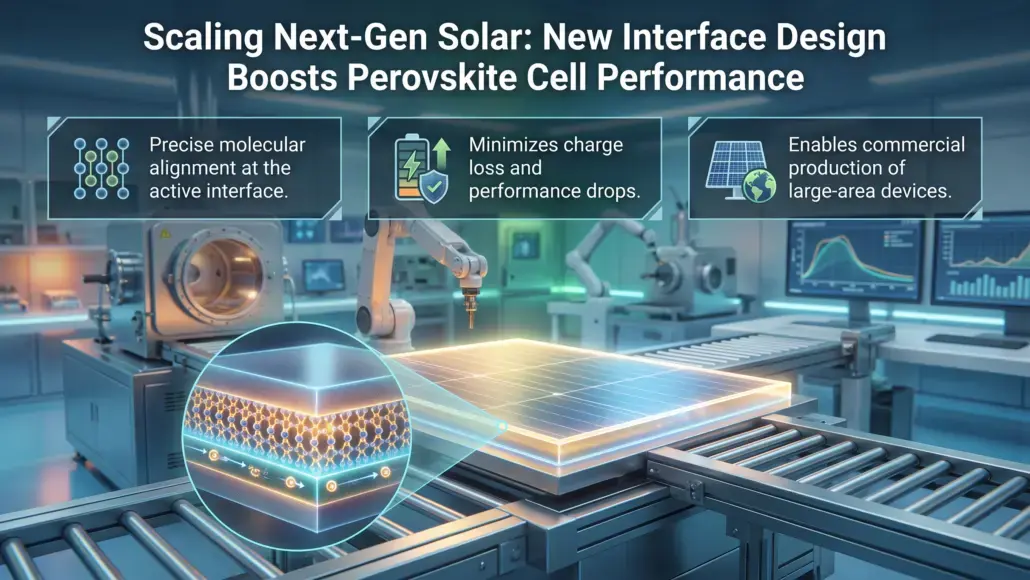

The Gwangju Institute of Science and Technology (GIST) announced that a research team led by Lee Gwang-hee, director of the World’s First Perovskite Solar Cell Commercialization Strategy Research Project, has proposed a new molecular design principle. The principle controls molecular alignment at the perovskite interface to reduce charge loss and ease the performance degradation seen in large-area devices, overcoming a key obstacle to commercializing next-generation perovskite solar cells.
Engineering Ordered Molecular Alignment for Enhanced Efficiency
Perovskite photovoltaics have drawn widespread attention as a next-generation technology because of their high photoelectric conversion efficiency, which represents the rate at which light is converted into electricity. For a device to achieve high efficiency, charge carriers generated in the light-absorbing layer must flow smoothly into the charge transport layer. When the device area is enlarged, however, the condition of the interface where the two layers meet varies by location, causing uneven charge transfer and a resulting drop in efficiency.
Conventional interface treatment techniques introduce organic molecules onto the perovskite surface to reduce surface defects that cause charge loss. When those molecules are arranged irregularly, though, they can impede charge movement and create additional losses at the interface. Going beyond the conventional focus on reducing interface defects, the research team engineered an interface structure in which the molecules are arranged in an orderly fashion, enabling more uniform charge transfer across the interface.
Verified Large-Area Module Performance and Stability
Applying this interface design principle to actual devices, the team achieved a certified photoelectric conversion efficiency of 26.94% in a small-area cell and 23.21% in a large-area cell with an active area of 25 square centimeters. The 25-square-centimeter large-area module was fabricated in a monolithic structure connecting 10 solar cells in series, and its performance was verified through independent certification. This demonstrates that the team’s interface design is effective not only in small-area devices but also in large-area modules.
In long-term stability tests, the cells retained more than 93% of their initial efficiency after 1,000 hours at 85 degrees Celsius, and maintained 85% of their initial efficiency after 1,800 hours under continuous illumination at an intensity comparable to actual sunlight.
Commercialization Prospects and Future Applications
The researchers expect that combining the molecular design principle with mass-production technologies such as continuous manufacturing processes could expand the application of these devices into key sector areas:
- Building-integrated photovoltaics
- Lightweight and flexible solar cells
- Mobile power sources
“Achieving high perovskite solar cell efficiency at large area is a challenge that must be solved for commercialization,” Lee said. “We hope the molecular design principle presented here will serve as a foundational technology that reduces interface losses during scale-up and accelerates the commercialization of perovskite solar cells.”
The findings were published in Advanced Materials, an international journal in the field of materials science.