






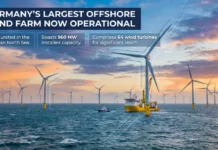
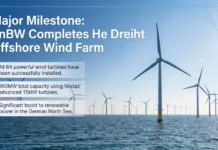



















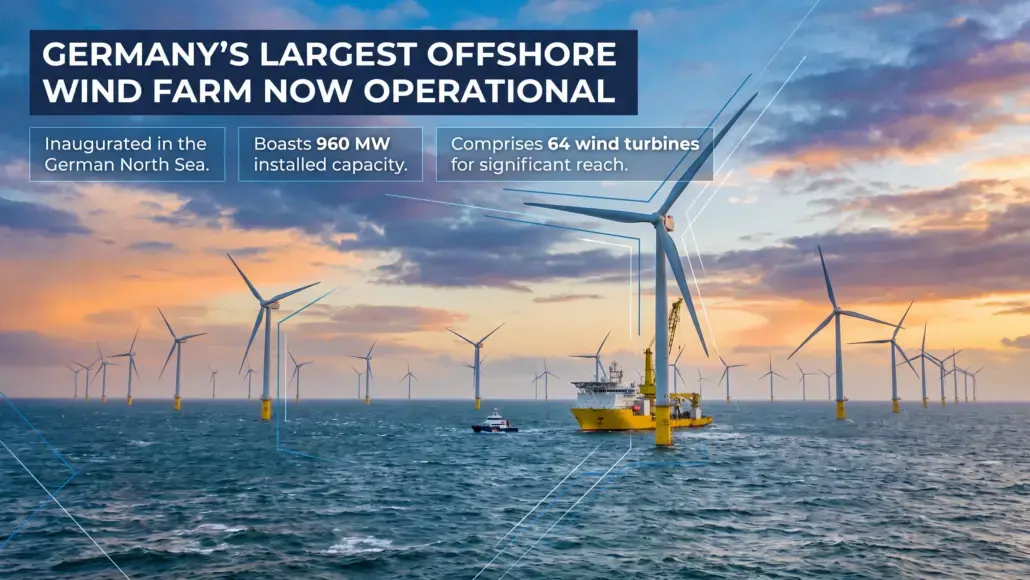

EnBW has officially inaugurated the He Dreiht offshore wind farm in the German North Sea, marking the completion of what is now the largest offshore wind farm in Germany, with an installed capacity of 960 megawatts. The inauguration ceremony was attended by Carsten Schneider, Germany’s Federal Environment Minister, underscoring the scale and national significance of the development.
A Project of Significant Scale and Reach
The He Dreiht offshore wind farm comprises 64 wind turbines and is situated approximately 85 kilometres northwest of Borkum and 110 kilometres west of Heligoland. While construction has been completed, commissioning is being carried out in stages, with individual turbines being connected to the grid, tested, and brought into operation one by one. EnBW has confirmed that the first turbines are already feeding electricity into the German grid, with the remaining units expected to follow in the coming months.
Once fully operational, the wind farm will be capable of supplying electricity equivalent to the annual consumption of around 1.1 million households.
Ownership Structure and Investment
The project is jointly owned by EnBW and a consortium that includes Allianz Global Investors on behalf of Allianz entities, AIP Management, and Norges Bank Investment Management. EnBW holds a 50.1% stake through its project company, while the remaining 49.9% is held by the consortium partners.
He Dreiht represents a total investment of approximately €2.4 billion. The project was awarded to EnBW in 2017 during Germany’s first offshore wind auction and, notably, was granted without entitlement to state funding.
Financed Through Long-Term Power Purchase Agreements
Rather than relying on public subsidies, He Dreiht is being financed entirely through long-term power purchase agreements (PPAs). EnBW has stated that these agreements offer contractual partners long-term price stability and planning certainty while supporting their respective decarbonisation targets.
The contractual partners involved in these power purchase agreements include Evonik, Google, PASM Power & Air Solutions, Fraport, Bosch, Salzgitter, SHS Stahl-Holding Saar, Deutsche Bahn, and DHL Group. Among these, PASM, the telecommunications subsidiary involved in the project, has secured approximately 100 MW of offshore wind capacity for Deutsche Telekom through a 15-year PPA, according to EnBW.
Engineering and Construction Details
Construction of He Dreiht commenced in the North Sea in May 2024. At peak periods, more than 500 people were engaged on the project, with more than 60 vessels involved in construction activities.
The wind farm is equipped with 64 Vestas V236-15.0 MW turbines, each with an individual output of 15 MW and a rotor diameter of 236 metres. The turbines have a hub height of 142 metres, and each rotor covers an area of approximately 44,000 square metres per revolution — equivalent to around six football fields.
The project drew on a broad European supply chain. The 64 foundations — consisting of steel pipes nine metres in diameter and 70 metres in length — were manufactured entirely in Germany. Connecting elements between the foundations and the towers were produced in Belgium, Great Britain, the Netherlands, and Poland. Components were transported to the construction site from the base ports of Esbjerg in Denmark and Eemshaven in the Netherlands.
The He Dreiht offshore wind farm is connected to the German electricity grid by TenneT. Electricity is transported to the coast through an offshore platform and two submarine cables.
EnBW’s Broader Renewable Energy Ambitions
The He Dreiht offshore wind project forms part of EnBW’s wider renewable energy expansion strategy. The company currently holds around 8 gigawatts of installed renewable generation capacity, more than twice its 2018 level, with renewables now accounting for more than 70% of its total installed generation capacity. EnBW has set a target for renewables to represent approximately 80% of its generation portfolio by the end of 2030.
Beyond He Dreiht, EnBW is actively developing further offshore wind projects. These include Dreekant, a 1 GW project located in the German North Sea, and Morven, a 2.9 GW project being developed in Scotland.