





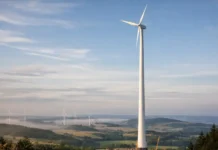























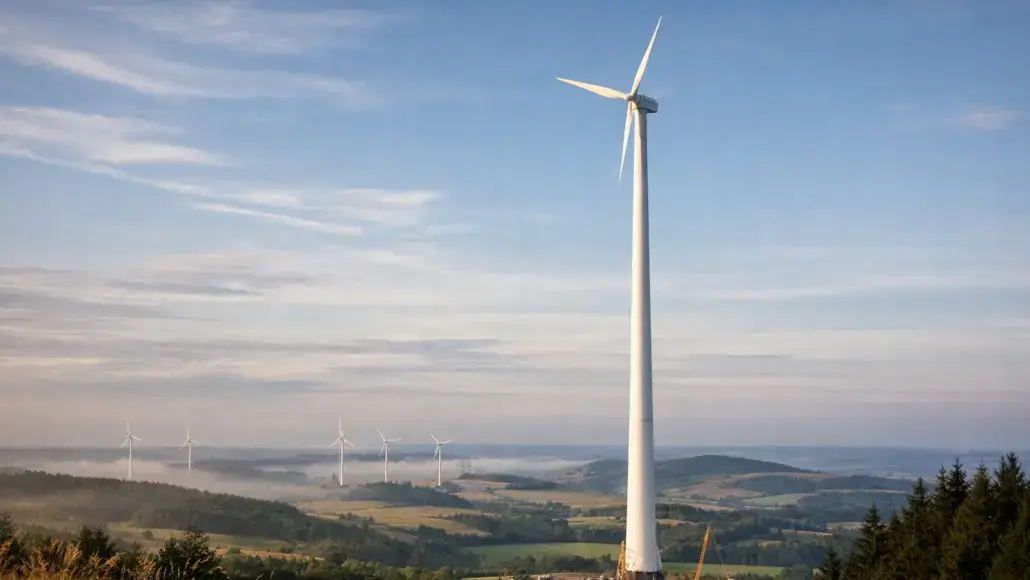

Germany has installed a 365-metre wind turbine designed to harness stronger and more consistent winds at higher elevations, potentially enabling existing wind farms to generate more electricity without requiring additional land.
The pilot turbine, developed by engineering firm GICON, is expected to begin operating with a capacity of 3.8MW. Future versions of the system are planned to exceed 7MW. At the same rotor size, the 365-metre structure could produce approximately twice as much electricity as turbines positioned at lower elevations.
The project represents a significant departure from conventional land-based wind turbines, which typically stand between 60 and 120 metres tall. Standard construction methods were therefore unsuitable for the project.
Engineers used a specialised strand jack system to raise the turbine’s inner tower to its final height. The structure was lifted through a surrounding lattice framework before being secured in its extended position. The remaining high-altitude construction work is expected to take several more days, with official commissioning planned for November.
Dr Jochen Großmann, founder of GICON, said in translated comments: “What was long a challenging concept and then an equally challenging construction project now stands as a globally unique facility in Schipkau.”
Following completion of the pilot plant, GICON has begun preparations to scale the technology, with the longer-term objective of moving into mass production as quickly as possible.
Initial assessments by GICON indicate that Germany could retrofit as many as 4,000 high-altitude wind towers at existing wind farms. The structures could form a “second tier,” allowing established sites to increase electricity generation without relying on complex permitting procedures for new facilities on additional land.
The High-Altitude Wind approach is therefore being positioned as a way to expand output from existing wind farm locations by accessing stronger winds at greater heights.
At a total tip height of 365 metres, the turbine is taller than the 330-metre Eiffel Tower. It is now Germany’s second-tallest structure, behind Berlin’s Fernsehturm, or TV Tower, which reaches 368 metres.
The pilot project will provide the basis for assessing how the system can be expanded and potentially deployed across existing wind farms.