









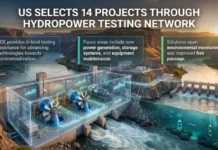










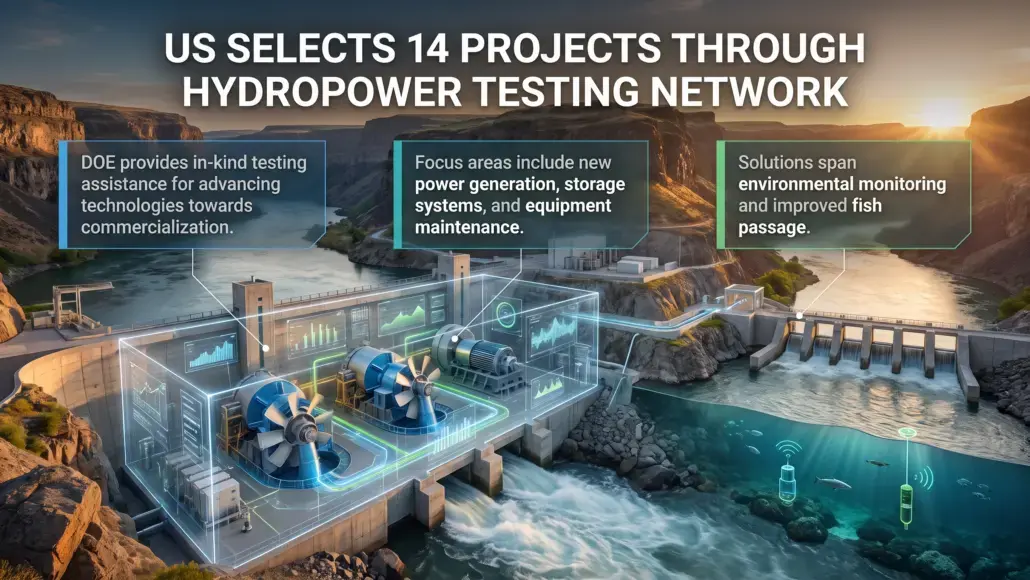

The US Department of Energy (DOE) has selected 14 hydropower projects to enter negotiations for testing assistance through the Hydropower Testing Network, supporting developers working to advance technologies toward commercial deployment.
The selected projects span several areas, including new power generation and storage systems, equipment maintenance, environmental monitoring and fish passage. If negotiations are completed, the developers will receive vouchers providing in-kind support from testing facilities selected according to their technical requirements.
Hydropower Testing Network Expands Technology Access
This marks the second selection round for the network. Funded by the DOE’s Hydropower and Hydrokinetic Office (H2O), the Hydropower Testing Network provides access to more than 65 specialised physical testing and modelling capabilities across 21 facilities. These resources include hydraulic and biological testing as well as techno-economic analysis.
“By pairing industry innovators with leading U.S. test facilities and technical expertise, HyTN accelerates the development of next-generation technologies that keep hydropower reliable and abundant,” said H2O Director Nichole Fitzgerald.
New Generation And Storage Technologies
Among the selected projects, Emrgy will demonstrate a low-head turbine prototype designed to generate electricity from man-made water infrastructure, including irrigation canals. GenH will test a rapidly deployable technology for existing non-powered dams at the University of Minnesota. The results are expected to support a predictive framework for developing systems suited to different locations.
Two projects involve pumped storage. Hydro Green Energy will collaborate with the National Laboratory of the Rockies on an economic analysis focused on a grid-oriented scheme using an existing dam and reservoir. The work is intended to support further progress toward licensing and construction.
RCAM Technologies, operating as Sperra, will work with Polaris EcoSystems to develop a 3D-printed subsea pumped storage system. The technology is designed to store electricity using hollow concrete spheres positioned on the seafloor.
Equipment Maintenance And Component Performance
Several projects will examine equipment maintenance and component performance. Chelan County Public Utility District will conduct two projects with Pacific Northwest National Laboratory (PNNL). One will evaluate self-lubricating, grease-free wicket gate stem bushings, while the other will validate a low-temperature cold spray process for repairing worn turbine components on site without applying heat.
Kingsbury will continue its work with Oak Ridge National Laboratory (ORNL) to assess an advanced thermoplastic polymer as a potential bearing material for hydropower generators. VBASE Oil Company will also continue working with ORNL to test a lubricant intended for hydropower facilities.
Dry Surface Technologies will partner with PNNL to scale production of a non-toxic antifouling coating toward a pilot manufacturing process. The coating is intended to provide a lower-cost method for limiting component clogging and reducing repairs.
Prometheus Innovations has received two project selections with PNNL. One will continue testing a coating designed to prevent aquatic growth, including invasive mussels and brown algae. The second will evaluate an underwater net coating designed to attract or repel fish and help prevent them from entering water intake structures.
Fish passage specialist Radmantis will continue work initiated during the first HyTN selection round at a Verdantas testing flume. The project will examine whether mechanically guided fish entrainment can improve AI-based selective fish passage at hydropower facilities.
Environmental Monitoring Technologies
Environmental monitoring work includes Nucleic Sensing Systems’ validation of a real-time environmental DNA sensor. The device is designed to distinguish fresh, dissolved eDNA from stale or transported material.
The University of Washington’s Applied Physics Laboratory will work with PNNL to evaluate the reliability and durability of a small, low-cost water quality sensor for hydropower and pumped storage facilities.
The voucher programme is managed by ENERGYWERX in partnership with DOE under a partnership intermediary agreement established by the department’s Office of Technology Commercialization.