









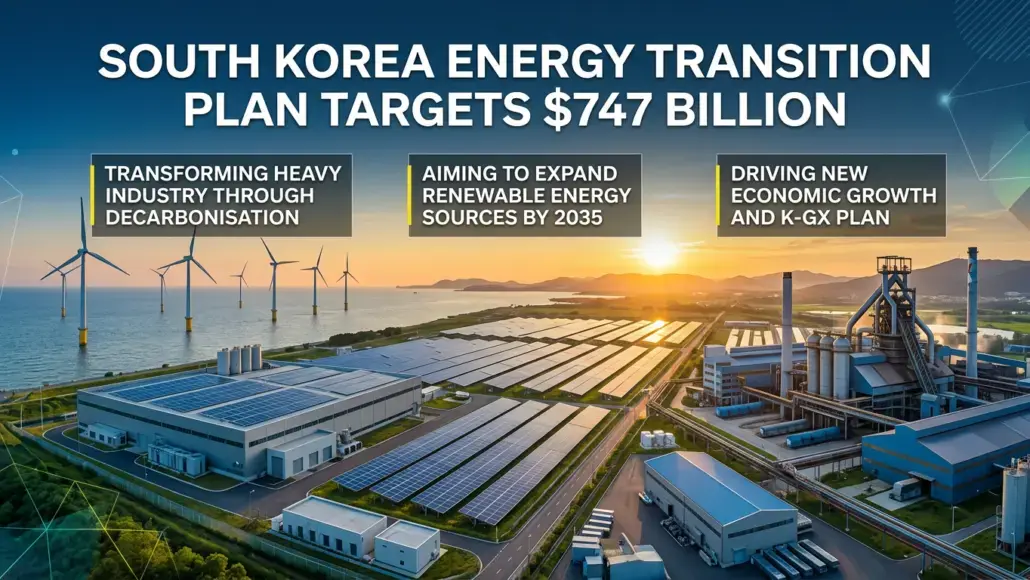

South Korea has unveiled a 1,000 trillion won ($747 billion) energy transition and decarbonisation strategy through 2035, aiming to expand renewable energy, transform heavy industry and create new sources of economic growth.
The Korea-Green Transformation (K-GX) plan includes 200 trillion won in fiscal spending and more than 790 trillion won in climate finance, alongside a separate 220 trillion won in private-sector investment, Finance Minister Lee Hyoung-il said during a presentation attended by senior officials and business leaders.
President Lee Jae Myung called on the country to use its innovation capabilities to strengthen its position in the global green economy.
“We must move away from the practice of chasing others and become architects and leaders of the green market ourselves,” Lee said.
Renewable Energy and Clean Technology Targets
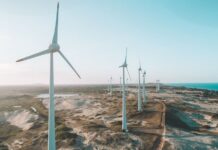
The government aims to reach 100 gigawatts of renewable energy capacity by 2030. The strategy supports industries including green steel, batteries, solar power, wind energy, hydrogen and small modular reactors (SMRs).
South Korea also plans to increase the share of electric and hydrogen-powered vehicles to more than 70% of new vehicle sales by 2035 as part of its efforts to electrify transport and reduce emissions.
The plan targets decarbonisation across five of the country’s highest-emitting industrial sectors: steel, petrochemicals, refining, cement, and semiconductors and displays. At the same time, the government intends to foster 10 green industries, including electric vehicles, power semiconductors and carbon capture technologies.
Industrial Decarbonisation and Domestic Supply Chains
South Korea aims to become the first country to mass-produce hydrogen-reduced steel and establish a leading position in the global green steel market. The strategy also supports emerging industries such as advanced batteries and SMRs.
Another target is to commercialise tandem solar cells by 2028 while developing domestic supply chains for key clean-energy technologies.
Climate Ministry officials said the initiative is intended to address increasing climate risks, energy security concerns and stricter international carbon regulations while turning carbon-neutrality efforts into a source of economic growth.
Projects receiving climate-finance support will be assessed for their greenhouse-gas reduction impact. The government also plans to develop sector-specific decarbonisation roadmaps to help achieve the country’s 2035 emissions targets.
Government and Private-Sector Investment
The K-GX strategy combines public spending, climate finance and private investment to support South Korea’s transition to a lower-carbon economy.
SK Group Chairman Chey Tae-won, who leads the private-sector consultative body supporting the initiative, said the plan demonstrated the government’s commitment to sharing investment risks with businesses. Companies have been hesitant to make long-term carbon-neutrality investments amid uncertainty surrounding technology, markets and policy.
The strategy is intended to mobilise investment across clean energy, industrial transformation and low-carbon technologies through 2035.