
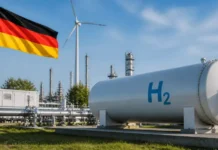
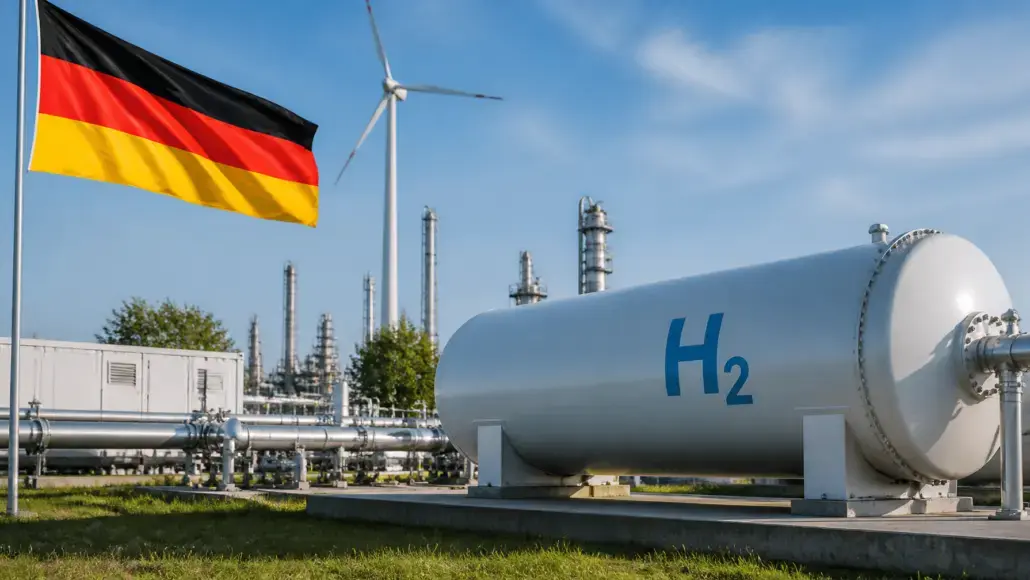

Germany’s Federal Ministry for Economic Affairs and Energy (BMWE) has announced 10 measures to accelerate the country’s hydrogen market, including €1.5 billion in carbon contracts for difference (CCfDs), support to convert 4 GW of power generation capacity to hydrogen, and €4.2 billion for hydrogen network expansion. Announced on 19 October 2026, the package addresses high production costs and limited willingness among potential users to pay for low-emission hydrogen.
The Ministry said, “The development of the hydrogen market is currently facing major challenges and is being delayed, especially since production costs are still significantly higher than the willingness to pay of many potential application sectors.”
CCfD Support For Hydrogen Projects
The government will provide €1.5 billion through carbon contracts for difference, which compensate companies for additional costs associated with shifting to climate-friendly production processes. The funding envelope could be increased if demand is strong during the preliminary stages of the bidding round. Hydrogen projects may also qualify for CCfD support beyond the dedicated hydrogen funding window.
According to the Ministry’s document, the government draft provides for up to €8.7 billion in commitment authorisations through 2050 for CCfDs supporting a range of CO₂-reduction technologies, including hydrogen. This broader authorisation covers multiple technologies and is separate from the €1.5 billion hydrogen funding allocation.
Hydrogen Conversion And Pipeline Expansion
Germany plans to support the technical conversion of 4 GW of power plant capacity to hydrogen. A 2 GW tranche is scheduled to be tendered in 2027, with hydrogen use planned from 2040. A further 2 GW is expected to be tendered between 2030 and 2032, with conversion planned from 2043.
The government will provide €4.2 billion in public funding over the coming years to expand hydrogen transmission infrastructure. More than 500 km of the core hydrogen pipeline network was operational in 2025, while another 2,200 km is under construction.
Low-Emission Steel To Support Demand
The BMWE also intends to establish a lead market for low-emission steel. Under Germany’s Offshore Wind Energy Act (WindSeeG), offshore wind turbines must use steel produced with renewable or low-carbon hydrogen. The requirement is intended to stimulate hydrogen demand while supporting the development of lower-emission industrial production.
The measures combine industrial support, planned power plant conversions and infrastructure investment. Their implementation will depend on tender schedules, project participation and the development of demand across Germany’s energy and industrial sectors.