








The expansion of cogeneration systems (also known as combined heat and power, CHP) has an important role to play on the road to a modern energy world.
With the high efficiency of combined heat and power generation and high degree of flexibility regarding the mode of operation and plant size, cogeneration systems make a significant contribution to increasing energy efficiency at the generation stage. They offer considerable potential for cost reductions in both industry and residential and commercial buildings.
Experts are set to discuss further possibilities opened up by CHP at EM-Power –the exhibition for intelligent energy use in industry and buildings. Together with three other energy exhibitions, EM-Power is taking place as part of the new innovative platform The smarter E Europe from June 20-22, 2018 at Messe München.
Germany should become the world’s most energy-efficient economy – according to the target laid down by the new German government in its coalition agreement. With a revised energy efficiency strategy, the government has set the target of halving energy consumption by 2050 and increasing the share of renewable energies to 65% by 2030.
Cogeneration will play a crucial role in meeting these targets. A recent study conducted by the Fraunhofer Institute for Manufacturing and Applied Materials Research IFAM on behalf of the German Cogeneration Association (B.KWK) demonstrated that the heat transition can be implemented with greater ease using a combination of cogeneration and clean electricity, compared to an exclusively electricity-based solution. Used in this way, cogeneration would not only play a vital part in increasing energy efficiency, but would simultaneously contribute to resource conservation and environmental and climate protection.
CHP is suitable for supplying neighborhoods and properties CHP systems or decentralized heat/power-generation units with an electrical output of up to 50 kW, such as are commonly used to supply energy to neighborhoods and properties, for example, will be supported through a 100% increase in the number of subsidized full load hours from 30,000 to 60,000, according to an amendment to the German Act on Combined Heat and Power Generation (KWKG). And while the EEG exemption for CHP plants, which entered into operation after August 2014 and have an output over 10 kW,was in part discontinued at the start of the year, this will have little effect on the further expansion of cogeneration in Germany.
Whether the CHP plant then operates heat-led – that is, oriented to the local heat demand – or is electricity-led with sufficient heat storage, will always be determined by the
operational scenario. Cogeneration power plants are also extremely well suited to a network-led mode of operation, where the output of multiple plants is prescribed from a
centralized point. One possibility this creates is for the group of cogeneration power plants,connected using smart energy management, to generate the flexible energy supply of the future while functioning as a virtual power plant.
Tenant power: Potential for using cogeneration systems Multi-family dwellings, office buildings and shopping malls – these buildings all have one or more tenants. A great opportunity for owners to uniformly and cost-effectively supply power and heat to all residential or office units. The building sector currently accounts for 40% of Germany’s total energy consumption. There is thus a particularly pressing need for action to increase energy efficiency in this area, if the ambitious 2050 targets for a reduction in CO2 emissions are to be met. The European Energy Performance of Buildings Directive (EPBD) provides the legal basis for this, and a revised version will be approved in the course of the year. This will subsequently be transposed into national law. In concrete terms for Germany, this is anticipated to mean a follow-up regulation to the Energy Saving Ordinance (EnEV) – the Buildings Energy Act (GEG). The federal government would like to use this to merge the multiple pieces of legislation which currently exist in parallel, including the Energy Saving Ordinance (EnEV), the Energy Conservation Act (EnEG) and the Renewable Energy Heat Act (EEWärmeG).
The combination of PV tenant power and cogeneration systems is especially attractive in view of emission reduction targets. It offers potential to reduce the cost of extensive
measuring technology, as well as guaranteeing the tenant power supply in winter and integrating it into the heat supply. A combination with e-charging infrastructure is also
promising.
The Landlord-to-Tenant Electricity Act has offered state support for tenant and neighborhood power since the end of 2017. The tenant power subsidy makes the installation of PV systems, integration of new measuring equipment and conversion to other billing systems more attractive, as the new law offers system operators a subsidy of as much as 3.8 euro cents per kWh for locally consumed tenant power. The subsidy applies to solar power supplied directly to tenants from new solar installations of up to 100 kWp.
As a result, tenant power projects have become financially attractive for many more buildings than before, as tenant power can be profitable for buildings containing as few as 15 residential units.
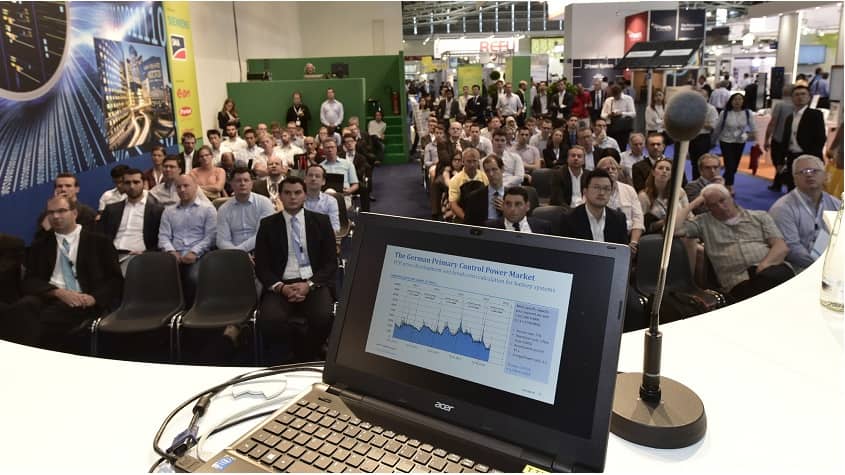
Compact Energy Forums: Energy generation and efficiency in the spotlight EM-Power in Munich focuses on the opportunities for intelligent energy use in industry and buildings. In doing so, it offers industry professionals the ideal platform to discuss the topic and find out more. Visitors can explore the insights gained from the exhibition in greater depth at the Compact Energy Forums. These offer the chance to find out more about energy generation and efficiency in buildings and companies in thematic blocks with a practical orientation, tailored to the specific needs of the different visitor groups. Exhibitors and collaborative partners will present examples of best practice and real-world energy solutions. For example, different thematic blocks will explore residential, building and neighborhood solutions and the specific energy saving potential in the hotel and gastronomy industry, efficient supply concepts for hospitals, and municipal electricity and heat supply. In its very own presentation series, the German Federal Agency for Energy Efficiency (BfEE) will devote itself to topics such as the current EU Energy Performance of Buildings Directive, energy audits or various funding opportunities.
About EM-Power
EM-Power, the exhibition for intelligent energy use in industry and buildings, is the first exhibition in Germany where professional energy customers – with their demand for
efficient energy technologies, intelligent control systems and energy savings – and the key concepts underpinning the energy transition in industry and the building sector take center stage.EM-Power is a unique platform for acquisition, exchange and information on the topic of smart energy generation and consumption behind the meter. The exhibition presents renewable and efficient energy technologies, smart energy management systems and services, as well as operator models which are crucial for the professional prosumer of today and tomorrow.
Compact expert forums showcase specific information for various target visitor groups, such as the real estate sector, hospitals and care facilities, food retail, hotels and food
service, the production industry and more.In 2018, EM-Power Europe will take place in parallel to Intersolar Europe, the world’s leading exhibition series for the solar industry and its partners, ees Europe, the continent’s largest exhibition for batteries and energy storage systems, and Power2Drive, the new exhibition for charging infrastructure and e-mobility. All four exhibitions are being held under the umbrella of The smarter E Europe – the innovation hub for empowering new energy solutions.
For more information on EM-Power, please visit: www.EM-Power.eu/en
EM-Power Europe is organized by Solar Promotion GmbH, Pforzheim and Freiburg , Wirtschaft Touristik und Messe GmbH & Co. KG (FWTM), with Messe München GmbH
(MMG) as a co-organizer.