










































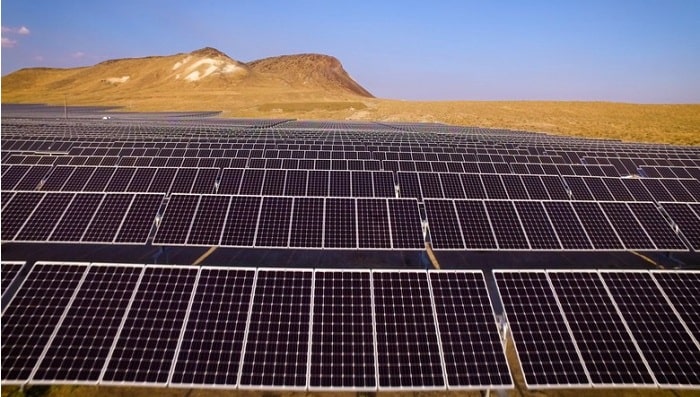

Solar power is an eco-friendly alternative to conventional, non-renewable sources of energy. However, current solar panels require the use of toxic materials as buffers, which is not sustainable. To this end, a team of scientists in Korea, at the Incheon National University, has developed a new eco-friendly alternative, called the ZTO buffer, which can overcome this limitation. This new development to make solar panels even more sustainable is indeed a cherry on top.
Solar panels are composed of photovoltaic cells, whereby materials exposed to light generate excited electrons, in other words: an electric current. Modern thin-film solar cells are made up of micrometer or sub-micrometer-thick layers of photovoltaic material, allowing them to be integrated into flexible, lightweight panels for use in a variety of substrates.
However, this process has some limitations. JunHo Kim, Professor of Physics at INU, who led the study, explains, “Most thin-film solar cells include toxic and expensive elements, which may hinder the expansion of solar cell applications.” Professor Kim and his team are working on the production of a solar cell using naturally abundant, eco-friendly materials, which are easy to extract and inexpensive to manufacture.
The scientists looked at eco-friendly cells made up of kesterite, a natural mineral that acts as a photon absorber. Most kesterite cells use a buffer layer made of cadmium sulfide (CdS) to optimise their performance. Despite their efficiency, the pollution associated with making these buffers and the toxicity of cadmium are not desirable traits in an eco-friendly solar cell. To deal with this issue, the researchers examined a promising alternative, called the “ZTO buffer.” To further improve the efficiency of the solar cell, the team aligned the energy levels of the electrons between the absorber layer (kesterite) and the buffer layer (ZTO). This allowed for a better circulation of electrons between the two layers, increasing the cell’s voltage and overall performance, with a power conversion efficiency of 11.22 percent. To put things into perspective, current kesterite cells using CdS buffers have a maximum efficiency of 12.6 percent, meaning that the proposed cell showed high efficiency. This technique is the first to yield such a high performance using solely eco-friendly, abundant and inexpensive materials.
The team believes that the importance of this research will only grow with the expected increase in the share of renewable energy in the next few decades. As the demand for solar panels grows, it is especially important to source its components in the most environmentally friendly and cheapest way possible.
The research team’s vision for their invention is that of a renewable future. Prof Kim concludes by talking about the potential applications of their findings, “Eco-friendly thin-film solar cells could be installed on the roofs and walls of buildings and houses to produce electricity near us. They could also be employed in ground vehicles (cars, buses, and trucks) and marine transportations (boats and long-range ships) to partially support electric power.”